The former U.S. diplomat for LGBTQ+ rights is urging Canada to boost its support for gender and sexual minorities abroad — and South Africa says Ottawa can help hold the line against the Trump administration's efforts to erode human rights globally.
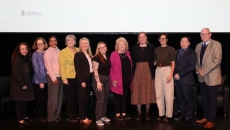
American cuts to foreign aid and Washington's co-ordination with dictators loomed large at this week's Ottawa Civic Space Summit. The a conference of development and human rights workers was hosted by Resilient Societies and Co-operation Canada, a coalition of dozens of Canadian non-profits working in international assistance.
Jessica Stern, who was appointed by former U.S. president Joe Biden as the U.S. special envoy on the human rights of lesbian, gay, bisexual, transgender, queer and intersex people.
"There is so much to be gained from Canada stepping into this vacuum and showing what it stands for," Stern told The Canadian Press.
"There aren't enough countries in the world that champion LGBTQI issues. The consequence is that Canada plays an outsized role."
Stern's role expired in January 2025 when Biden left office. Her last task was completing assessments of LGBTQ+ rights in 193 countries as part of the U.S. State Department's annual human rights report.
When those reports came out months later, the administration of President Donald Trump had deleted each chapter on gender and sexual minorities.
Stern said she believes Washington also has erased internal government records on LGBTQ+ issues and she fears the Trump administration might share the names of activists with hostile governments — or even fund anti-gay conversion therapy.
"We're seeing increased threats against LGBTQI people around the world, but we're seen decreased political leadership to defend them," she said.
For years, evangelical groups have worked to co-ordinate a transnational movement to erode LGBTQ+ rights globally, outlaw certain sexual acts and restrict medical services for transgender people.
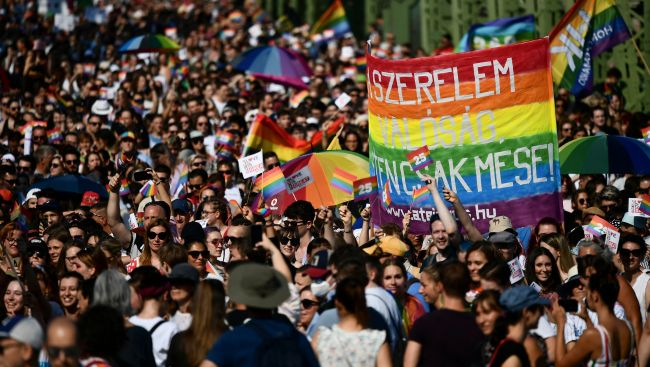
That movement has shifted in recent years to legal restrictions on speech and identity — such as a Uganda law that makes it illegal to identify as LGBTQ+ and makes certain sexual acts punishable by death. The outgoing government of Viktor Orbán in Hungary tried and failed to outlaw Pride marches.
The Trump administration dismantled the $40 billion U.S. Agency for International Development, the world's largest aid organization, cutting millions of people with HIV off from access to lifesaving drugs. Administration officials also have voiced support for European far-right political parties that seek to restrict LGBTQ+ rights.
Steve Letsike, South Africa's junior minister for women, youth and disabled people, told this week's conference that democratic countries should support projects in the U.S. that advance democracy and civil rights.
"It's a moment of pushback, but let's see how we can build up on solidarity with people of America, those who still believe that democracy matters," she said. "And let's support them."
Letsike said South Africa is trying to uphold human rights on the continent in the face of a co-ordinated global movement to erode those rights. She said Canada can help.
"We are seeing the anti-rights agenda, the anti-gender and also the anti-democratic (forces) rising. They are well organized and they are well resourced. They are learning the tactics and the strategies," she said.
"It's quite important that for those of us who are progressive, wanting to see a just world and a better world, (that) we strengthen the bolts, we tighten them clearly, to ensure that we don't reverse the gains of democracy everywhere."
The Dignity Network, a coalition of Canadian groups that advocate for gender and sexual minorities abroad, has called on Ottawa to double its annual foreign aid envelope for LGBTQ+ people to $20 million.
"It would hardly be noticeable in terms of Canada's bottom line, but it would position Canada as the leading government in the world," said Stern, adding that Ottawa also could step up its advocacy against repressive laws.
"Canada can demonstrate leadership in this moment. It can be a beacon of hope, speaking out in multilateral spaces," she said.
"The benefits will be enormous. Canada's reputation will increase. LGBTQI people will thrive. Their families will be happy. Human rights standards will be upheld."
The government Prime Minister Mark Carney has cited human rights and the protection of civilians as one of the three pillars of its foreign policy.
Carney has spoken in support of LGBTQ+ rights and stressed the importance of foreign aid, despite cutting back funding for global health programs such as HIV eradication.
The government has shifted the focus of its foreign aid policy from grants to collaborating with private capital to deliver aid through, for example, corporate projects that create jobs in developing countries.
During a panel discussion at the Civic Space Summit on Wednesday, both Stern and Letsike argued that upholding LGBTQ+ rights helps to build more productive economies.
"Countering discrimination and violence is good business. Employees thrive when they know that they can show up for work safely," Stern said.
She added that activists have a duty to convince voters that foreign aid and the defence of human rights prevent the global instability that undermines economies.
"In every country, we have to do a better job of explaining what's at stake in foreign policy, so that your everyday citizen understands the relationship between the price of gasoline, the cost of eggs and the decisions our governments are making around the world," she said.
Picture Courtesy: AP Photo/Anna Szilagyi