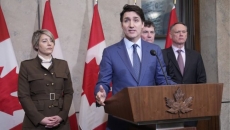
Foreign Affairs Minister Mélanie Joly is welcoming her counterparts from some of the world's most powerful countries to Quebec this week, as Ottawa works to maintain unity between Washington and its Group of Seven partners and pushes back on U.S. tariffs.
"We all need to band together in the best way that we can," said Sen. Peter Boehm, a former diplomat who played a central role in Canada's participation in the G7 for decades.
"Success is getting a statement out that is consensual, and that touches all of the bases."
The foreign ministers of the G7 nations will meet from late Wednesday to Friday afternoon in the Charlevoix region of Quebec. U.S. Secretary of State Marco Rubio is set to attend, alongside representatives from the U.K., France, Germany, Italy, Japan and the European Union.
The ministers are scheduled to have an early afternoon news conference on Friday.
Those ministers have been facing increasing turbulence around the world in recent years — a growing number of military conflicts, a vast number of displaced people and the West's loss of influence to China.
The instability has been turbocharged by U.S. President Donald Trump's return to the White House. Trump has broken with allies who have tried to isolate Russia in response to its war on Ukraine, while also imposing economic pressure on Canada and Europe. His proposal for vacating the Gaza Strip has been widely interpreted as a call for ethnic cleansing.
The G7 started as a forum to encourage liberal democracies to set policies through consensus in response to economic and social challenges. The group, which has set the tone for other industrialized democracies and the United Nations, has been focused in recent years on the impact of Russia's invasion of Ukraine.
Joly said Wednesday morning that she also will use the meeting to push back on U.S. tariffs.
"In every single meeting, I will raise the issue of tariffs to co-ordinate our response with the Europeans and to put pressure on the Americans," Joly said.
She added that Trump's "unjustifiable trade war" is based on a series of pretexts and seems to be aimed at eventually annexing Canada.
Rubio, meanwhile, has said the G7 meeting will focus on Ukraine and North American security.
"It is not a meeting about how we're going to take over Canada," Rubio told reporters in Ireland, adding Trump's tariffs are "policy decisions" and that Trump himself is putting forward the idea of Canada joining the U.S.
"He's made an argument that it's their interest to do so. Obviously the Canadians don't agree, apparently," Rubio said.
Canada holds the rotating G7 presidency this year and a national leaders' summit is planned for June in Alberta. This week, foreign ministers will meet to discuss numerous challenges, starting with a Thursday session on "strengthening the G7."
There will be other working sessions focused on geopolitical challenges. The federal government says they will include the Middle East, "stability in the Indo-Pacific region" and instability in Haiti, Venezuela, Sudan and the Democratic Republic of Congo.
Joly also will have numerous bilateral meetings where she will have a chance to push Canada's own interests.
Those meetings could touch on reviving stalled trade talks with the U.K., boosting military collaboration with Germany or advancing artificial intelligence work with France.
Boehm said Ukraine's plight will loom large in the closed-door working sessions. Canada has chosen Ukraine's security as its top priority as G7 chair. Ottawa has argued that if Russia is not punished for its invasion, other countries will attempt to acquire territory by force.
Europeans say the war must end on terms that prevent Moscow from attacking Ukraine again or encroaching on other neighbouring states. But the U.S. has pushed back on the idea of deploying troops to secure a ceasefire.
Trump's administration instead suggests that new American mining projects in Ukraine would dissuade Moscow from invading.
"The challenge is to see if there can be some middle ground that will meet the concerns" of both Europe and the U.S. on Ukraine, Boehm said.
Canada, meanwhile, has been at the forefront of efforts to use Russian cash in frozen bank accounts — or at least the interest earned on those accounts — to help fund Ukraine's defence. The G7 has taken initial steps to use current and future interest on those accounts as collateral for loans that Ottawa issues to Kyiv.
Ottawa has been pushing to further this effort with support from peers such as the U.K., but other European leaders have been hesitant about tapping into actual frozen accounts.
Boehm said the G7 ministers' closing statement could be similar to one they released in mid-February, on the sidelines of the Munich Security Conference. The ministers had skirted topics like U.S. tariffs but found consensus on issues such as Syria, Iran and the Indo-Pacific.