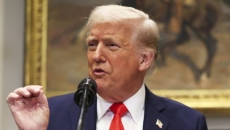
Pulling Canada into his trade war with China, U.S. President Donald Trump claimed Thursday that Chinese fentanylcontinues to "pour" into the United States across both borders.
Trump complained on social media about Chinese airlines refusing to accept Boeing planes to protest his administration's massive tariffs on China. In his post, he also brought up fentanyl.
"And, by the way, Fentanyl continues to pour into our Country from China, through Mexico and Canada, killing hundreds of thousands of our people, and it better stop, NOW!" Trump posted.
Trump slapped Canada with economywide tariffs last month after declaring a "national emergency" under the International Emergency Economic Powers Act linked to the flow of people and fentanyl across the United States' northern border.
He partially paused the levies a few days later for imports compliant with the Canada-U.S.-Mexico Agreement on trade, called CUSMA.
Border data shows a tiny amount of fentanyl is seized at the Canada-U.S. border and an annual U.S. threat assessment released last month doesn't mention Canada once in its analysis of fentanyl trafficking.
The RCMP also said "there is limited to no evidence or data from law enforcement agencies in the U.S. or Canada tosupport the claim that Canadian produced fentanyl is an increasing threat to the U.S."
White House Press Secretary Karoline Leavitt said earlier this week there have been "successes" at the Canada-U.S. border, citing a significant drop in the number of people apprehended.
The White House did not respond to emailed questions on Tuesday about whether Leavitt's comments suggest any coming changes to the emergency order at the northern border, or to Trump's tariffs. Trump's comments Thursday indicate the president intends to keep the duties in place.
Canada was an early target of Trump's trade war and has been the subject of a long list of complaints coming from the White House about everything from defence spending to tradedeficits. The president also has repeatedly called for Canada tobecome a U.S. state — a statement he repeated on Wednesday.
But while Trump took his trade war to the world with "reciprocal" tariffs earlier this month, his steepest tariffs have been reserved for China. Trump hit China with 145 per cent tariffs and Beijing countered with 125 per cent duties on U.S. goods.
Tensions between Beijing and Washington remained high this week, with conflicting reports about where trade talks stand. Trump claimed Wednesday that the world’s two largest economies are “actively” talking about tariffs — Chinese officials have denied that any negotiations are taking place.
Guo Jiakun, a spokesman for China’s foreign ministry, said Thursday that any notion of progress was as groundless as"trying to catch the wind."
The tit for tat between the two countries has come with consequences for Canada.
Canada imposed tariffs on Chinese electric vehicles, steel and aluminum, partly to appease the former Biden administration. In response, China slapped a 100 per cent tariff on Canadian canola oil, oil cakes and peas, as well as 25 per cent levies on other products like pork.
Chinese Ambassador to Canada Wang Di told The Canadian Press that Beijing is offering to form a partnership with Canada to push back against American "bullying." He suggested the two countries could rally other nations to stop Washington from undermining global trade rules.
Wang said Beijing is happy to drop its duties — which are having a large impact on Western Canada — if Ottawa drops its own tariffs.
One expert on Canada-China relations is cautioning Ottawa against forming closer ties with China to fight back against Trump's efforts to realign global trade.
Vina Nadjibulla, vice president of research and strategy with the Asia Pacific Foundation of Canada, a non-profit think-tank, said Beijing is trying to take advantage of the difficult position Canada has been put in by Trump.
"Whatever difficulties we have with the U.S., China is not the solution," she said.
Nadjibulla said that while China is an important trading partner, especially for Canadian agriculture and energy exports, Beijing doesn't follow rules-based trade and engages in subsidies and state control of the economy.
The policies Trump has proposed are problematic and self-defeating, she said, but the issues with Chinese influence inthe global economy are real.
— With files from Dylan Robertson in Ottawa and The Associated Press
Picture Courtesy: THE CANADIAN PRESS/AP-Alex Brandon