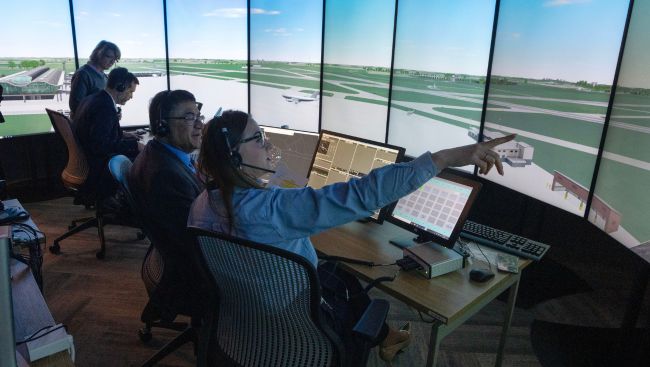
An aviation expert says Canada is losing more air traffic controllers to retirement than it is hiring, despite efforts to ramp up recruitment.
John Gradek, a faculty lecturer with McGill University's aviation management program, said Canada is short about 1,500 air traffic controllers, and 150 more retire each year.
"So guess what? You're not even covering off retirements," Gradek said in an interview with The Canadian Press.
Gradek said air traffic controllers are highly specialized with a "special skill set."
"We know three dimensions. The trick about controllers is they need a fourth dimension, and they have to understand the fourth dimension being time," Gradek told The Canadian Press.
"And so I make a decision to move an aircraft up 1,000 feet or down 1,000 feet, or turn left or turn right. I'm making that decision because I want this airplane to be in this location at this time and in the future.
"So that's a special skill set. Not everybody has it."
Air traffic controllers in the United States have been thrust into the spotlight following the crash of Air Canada Flight 8646 at LaGuardia airport in New York on Sunday.
Both pilots were killed, and more than 40 people were injured when the jet crashed into a fire truck on the runway shortly after landing late Sunday night. The National Transportation Safety Board investigation is in the early stages, with investigators from Canada's Transportation Safety Board also on the ground for it.
Nav Canada, which certifies and hires "air traffic service professionals" declined a request for an interview on the shortages of controllers in this country. In a statement, it said it is working to address staffing through a multi-year strategy.
"Canadians and travellers can be reassured, we are in solution mode: focused on strengthening service resiliency, supporting our people, working constructively with industry partners while upholding the highest standards of safety they rightly expect," spokesperson Gabriel Bourget said in a statement.
Bourget said since 2023, the agency has licensed more than 600 air traffic professionals, including more than 300 controllers.
The agency would not provide information on vacancy rates, but Gradek said those numbers aren't keeping up with the retirement rates.
The union representing air traffic controllers also declined to comment.
There are a number of different roles encompassing "air traffic professionals."
The term "air traffic controllers" includes area control centre controllers (or ACC controllers) which issue instructions to pilots and ensure that aircraft are kept a safe distance apart while airborne.
It also includes tower controllers, which provide pilots clearances and instructions to maintain separation during takeoff and landing.
The total training time ranges from 10 to 18 months for tower controllers, and 20 to 27 months for ACC controllers.
Those who don't make the cut can take jobs as "flight service specialists" which can sometimes manage traffic on the ground at smaller airports, but aren't tasked with giving instructions to planes in the air.
"Only about 10 per cent of the controllers that you in take into class make it out as a full-fledged controller," Gradek said, adding the U.S. rate is about three per cent.
"It is a small number of people that are able to start the program, finish the classroom training and then spend two years exercising some of their skill sets and demonstrating their ability to do what they're supposed to do in a complex world and graduate at the end."
And while Gradek said Canada's training and air navigation systems are "second to none" in the world, some graduates are taking jobs abroad.
Nav Canada wouldn't say how many of the 300 air traffic controllers it licenced since 2023 took up jobs in Canada, other than "a vast majority."
"Australia is hiring controllers like crazy, and New Zealand is hiring, the U.S. is hiring, the U.K. is hiring. So it's not, it's not as if this is a Canadian-only job," Gradek said.
The salary range for a Canadian controller can top $200,000 a year after they're fully certified — according to Nav Canada — while controllers in training earn about $60,000. The median pay for American controllers in 2024 was $US144,580, according to the U.S. Bureau of Labor Statistics.
"So the equipment you're working with is leading edge — or I would say bleeding edge — equipment when you're working here in Canada as a controller. So there's a lot of incentives to stay," Gradek said.
"But we're not putting handcuffs on these people. They are Canadians, and they're free to move. So, that's a risk we take as well."
On Monday, Canadian Transport Minister Steven MacKinnon said he is working with Nav Canada to figure out solutions to the shortage of controllers.
"I’ve asked Nav Canada to continue to come up with solutions for recruitment so that we can reduce the undue reliance we have on a smaller number of air traffic controllers than we would wish to have," MacKinnon told reporters when asked about the issue.
As for Canadians going through the rigorous training system only to take jobs abroad, MacKinnon said he wasn't aware of that being a problem.
"I’ll take a closer look at that," he said.
MacKinnon on Tuesday emphasized the safety of the country's transport systems — notably in aviation — affirming they are "among the most rigorous in the world."
"I do want to be very reassuring that we take every precautionary measure and make sure that Canada continues to perform at the highest levels of security," he told reporters on his way into a cabinet meeting in Ottawa.
"The Americans have very high standards, and we have a very collaborative relationship with the U.S., and I know they’ll be as eager as we to find the answers."
Picture Courtesy: THE CANADIAN PRESS/Ryan Remiorz