

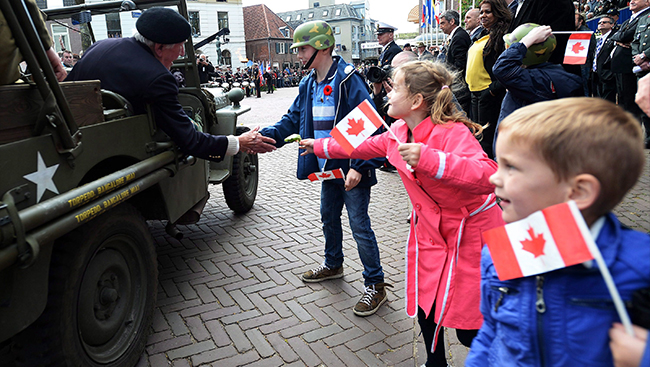
After the Second World War came to a close, Canada pulled itself away from Great Britain and planted itself firmly within a North American political and economic compact that generated prosperity for much of the western world for decades.
But as the world marks 80 years since the end of the war in Europe, an increasingly unstable geopolitical climate — and an administration in Washington bent on fighting a trade war with much of the world — has Canada looking back to the continent as a way to preserve peace and prosperity.
"Without a doubt, we certainly have to be much more aware of the possibility of a larger-scale conflict than we've seen in many, many years," said David O'Keefe, a history professor at Marianopolis College near Montreal who studies the Second World War.
In a rare move for an incoming prime minister, Mark Carney visited Europe instead of Washington in his first trip abroad as head of the federal government. He also has pledged to have Canada take part in the European Union's efforts to rearm the continent through ongoing negotiations on joint military procurement.
The pivot to Europe comes decades after Canada went from backwater status to establishing itself as key middle power during the Second World War.
O'Keefe said Canada's wartime legacy is still remembered in places like the Netherlands, where Canadians played a major role in liberating the country from Nazi tyranny and feeding people who had resorted to eating tulip bulbs due to food shortages.
Members of the Dutch royal family took refuge in Ottawa. Princess Margriet was born there in 1943, prompting the Netherlands to send an annual gift of tulips to the capital city.
The war, O'Keefe said, "signalled the pivot out of the orbit of the British Empire and into more of a North American vision, and that's when we started co-operating intensely with the United States."
After the war ended, the U.S. backstopped much of Canada's national defence and provided ample economic opportunities. Ottawa sought to reinforce the post-war global order by supporting international institutions like the United Nations, the NATO military alliance and the International Monetary Fund.
Those efforts helped to make North America "the most politically stable and economically prosperous continent the world has ever known," said Christian Leuprecht, a political-science professor at Queen's University and the Royal Military College.
"But we've completely lost our sense of how we got here — that this was not by accident but it was a deliberate strategy that we pursued."
Ottawa's role in international initiatives like peacekeeping and conflict prevention dwindled over the decades, as American governments gradually implemented protectionist policies that blunted Canada's economic edge.
That was before U.S. President Donald Trump returned to the White House and started threatening both Canada's sovereignty and its economic well-being — and suggested Washington would not protect NATO allies in a direct conflict.
Suddenly, the world is facing "tectonic realignments," O'Keefe said.
Russia's invasion of Ukraine and unrelated conflicts in the Middle East and Africa have undermined the institutions set up over the past eight decades to prevent global wars.
"The way it seems to be unfolding is more of a tripolar world where you have an authoritarian system in China and the same thing in Russia," said O'Keefe. "And it appears that's what the Trump administration seems to be hell-bent on in the States.
"There could be a whole lot of unexpected things that will pop up when you have something so fundamental as what is happening right now."
O'Keefe said he sees some alarming parallels between Canada's current plight — sharing a continent with a superpower run by an unpredictable leader with expansionist views — and that of another country in years before the outbreak of the last global war.
In 1938, he said, people in Austria were still trying to cope with a shaky economy and the after-effects of losing the First World War when their country was annexed by Nazi Germany.
"We're not walking lockstep, like back in the late 1930s, but certainly the trend lines are there," he said.
O'Keefe said that while Trump's goal of making Canada a U.S. state seems improbable — and would be rejected by most U.S. military officials and elected leaders — it's still cause for concern.
"You can't rule out the possibility that somebody in the White House is going to do something truly stupid and catastrophic," he said.
O'Keefe argued Canada must project enough strength to dissuade American military or economic measures — but not so much that Washington concludes its northern neighbour poses a threat.
"We're not fighting from a position of strength, so we have to be extremely skilled and extremely smart," he said.
Leuprecht said that if Canada wants to make new friends in the world, it needs to make itself useful — by delivering on defence spending commitments and exporting energy to countries eager to buy it. He said allies have been largely silent about the threats Canada faces.
He pointed out that British Prime Minister Keir Starmer chose not to push back on Trump's talk of annexing Canada when asked about it during a February visit to the White House.
"Canada has for decades used Europe … to offset some of that power imbalance that we have with the United States," Leuprecht said.
Carney is trying that approach by seeking agreements with the European Union to jointly procure military equipment, which would boost the defence sector for both partners. He is also pledging not to cut foreign aid.
Leuprecht said that while Canada may now need to spend a lot more on defence and on supporting global institutions, that would be cheaper than fighting actual wars.
Picture Courtesy: THE CANADIAN PRESS/Sean Kilpatrick


