For the first time since the end of the Cold War, Canada is spending roughly two per cent of its GDP on national defence — a key NATO alliance commitment Ottawa previously failed to meet.
NATO's annual report, released Thursday, contains estimates stating Prime Minister Mark Carney’s government met the key spending benchmark for 2025 by shelling out just over $63 billion.
Canada has come under heavy pressure in recent years from its allies — and especially from the U.S. — to dramatically ramp up its military spending.
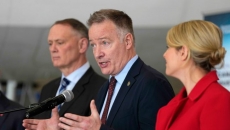
"For the last ten months, Canada's new government has been working with unprecedented speed and scale," Carney told a press conference in Halifax on Thursday.
He called it a promise kept "half a decade ahead of the original schedule."
Carney campaigned during the Liberal leadership race on setting an earlier deadline for meeting the NATO target — 2030, two years earlier than the target date set by Justin Trudeau's government.
The prime minister abruptly announced last summer his government would meet the target immediately.
It's better late than never, said former U.S. ambassador to NATO Ivo Daadler.
"Great. Just two years late," Daadler told The Canadian Press.
"Canada has a lot of catching up to do after decades of underinvestment in defence. But it's good to see a government in Ottawa taking its defence and NATO obligations seriously."
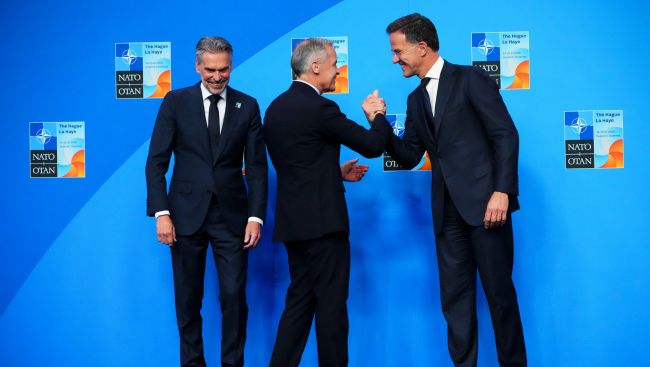
On Thursday morning, NATO Secretary-General Mark Rutte gave credit to U.S. President Donald Trump and his loud rhetoric about free riders in the alliance for convincing every alliance member to meet the spending target.
"I don't believe that without the present American administration the whole of NATO would have been meeting the two per cent at the end of 2025," Rutte told reporters at a press conference in Brussels Thursday.
"Big economies like Spain and Italy and Belgium and Canada were far from the two per cent."
Defence Minister David McGuinty hailed it as a "new era" for Canada's defence. He said the government reached the target by tackling individual projects "systematically, by hitting singles every morning — no home runs."
"The speed with which we moved was a little bit unusual," McGuinty told The Canadian Press, adding it all started with the military's first significant pay hike since 1997.
"The plan to execute on (that) was done in like 101 days. I've been around Ottawa a long time — it's the fastest I've ever seen."
Not that long ago, Canadian politicians spoke about the two per cent target as if it were almost out of reach.
Former defence minister Bill Blair said he never would have been able to get all of that money out the door in a year — even if the finance department had given it to him.
"Quite frankly, if the finance department had come to me and said ‘OK Bill, you can make two per cent this year, here’s $14 billion,' there was no way to actually spend that," Blair said after a military change-of-command ceremony in 2024.
At a separate event that year, Blair said it was "really hard" to convince his cabinet colleagues and Canadians that this “magical” spending level was a "worthy goal" at a time when affordability and housing were dominating the political agenda.
In July 2024, Trudeau dismissed the alliance target as a "crass mathematical calculation" that "makes for easy headlines and accounting practices" but doesn't "actually make us automatically safer."
At the 2014 NATO Summit in Wales, Ottawa promised its allies that it would boost defence spending to two per cent within a decade, after falling to the back of the pack in the 32-member alliance.
But after years of little progress toward that goal, Canada fell under sustained pressure from U.S. political figures to quickly boost its defence spending.
In 2023, a Pentagon document leaked to the Washington Post revealed Trudeau had told U.S. officials Canada would "never" meet the two per cent commitment.
Trump also has repeatedly warned NATO countries not to expect the U.S. to come to their aid if they don’t pay their share on defence.
Carney’s first federal budget laid out nearly $82 billion in defence spending over the coming years, and added an extra $9 billion last summer to achieve the two per cent goal.
Meeting the two per cent benchmark is only the first step in a long uphill climb to rearm Canada’s military — and to sustain such high military spending levels every year.
Carney has also committed to reaching the new NATO target — an even steeper spending level of five per cent of GDP — by 2035.
Picture Courtesy: THE CANADIAN PRESS/Sean Kilpatrick