OTTAWA - Canada is built for a climate that no longer exists and we can either accept that and adapt or face the consequences of inaction, Environment Minister Steven Guilbeault said Monday, as he kicked off public consultations on a national strategy.
But experts on adaptation say Canada needs to do a lot more, and a lot faster, because those consequences are already upon us.
The strategy, which the Liberals have promised will be ready by this fall, is intended to set goals for Canada to adapt its built and natural environment, with deadlines in both 2030 and 2050.
A consultation paper released Monday lists some of the goals the government is considering adopting for 2030, including reducing the number of people exposed to flood or fire risk, restoring communities faster after a disaster, and providing information so individual Canadians can assess their own risk.
"The national adaptation strategy represents a really important new direction for the country to go beyond climate change mitigation, and tackle in a comprehensive and strategic way how we make our communities safer, and better prepared for the impacts of climate change," Guilbeault said.
Guilbeault was in the Pierrefonds neighbourhood of Montreal where the Rivière des Prairies spilled over its banks and into homes in both 2017 and 2019, and the conversations are about turning temporary, emergency flood responses into permanent protections.
The climate changes that are flooding Pierrefonds more frequently are happening nationwide. In Manitoba, where spring flooding prompted 33 local emergency declarations, residents of Peguis First Nation were forced to flee their homes for the sixth time in less than two decades.
In Red Lake, Ont., residents threatened by wildfires the last two summers are now cut off by road as floodwaters washed out their highway this spring.
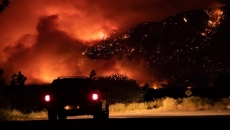
In British Columbia, residents of Lytton still don't know when they might return home after a wildfire razed their town 10 months ago. A few months after that fire, B.C. suffered massive flooding that threatened multiple communities and washed out parts of the rail and highway connections between the West Coast and the rest of Canada. Repair efforts in Lytton were slowed because the road into the town was among those washed out by the rain.
The Canadian Climate Institute said in a report that between 2010 and 2019, insured losses from extreme weather totalled $18 billion, three times the total of the 1980s.
The effect of each disaster is also bigger, with the average cost of individual weather-related events in the 2010s pegged at $112 million, compared with $8 million in the 1970s.
Emergency Preparedness Minister Bill Blair said last week following a visit to Lytton that provinces had requested federal help with wildfires 14 times in the last two years, compared with four requests in the five years before that.
Blair Feltmate, head of the Intact Centre on Climate Adaptation at the University of Waterloo, said the consultation process launched Monday is welcome but is moving too slowly.
"I do not get a sense of the need to act with urgency to put adaptation measures on the ground today, for the perils that are here today that are going to get worse tomorrow," he said. "There seems to me to be a discussion almost characterized by complacency rather than urgency."
Feltmate said public education programs to explain the benefits of relatively cheap and easy fixes to reduce the risk of basement flooding, or lower the risk of fire damage to your home, could prompt action at the homeowner level quickly.
He said 60,000 homes are flooded in Canada every year because of overland floods or water backing up into basements, causing $1.2 billion in insured damage.
He added that Canada's most common response to flooding is the emergency use of sandbags. "That is technically the same technology the Romans used 2,000 years ago."
Ryan Ness, director of adaptation at the Canadian Climate Institute, said the consultation paper captures the general needs for a Canadian adaptation strategy but must get a lot more specific — and fast. "It's clear that there's still a lot of hard work to do to get to a strategy that's actually going to raise the bar for adaptation in Canada."
Canada has budgeted more than $3 billion for climate adaptation but Ness said that's nowhere near enough.
The Federation of Canadian Municipalities estimated in 2020 that it would cost more than $5 billion a year for Canada's cities and towns to avoid the worst of climate-related effects.
Both Feltmate and Ness were on five expert advisory panels tasked with giving the government guidance on the strategy in specific areas including nature, infrastructure, health, economics and disaster resilience.
The final strategy is expected to set measurable goals in each area, but Guilbeault said it wasn't yet clear if the government would enshrine those goals into legislation like it did for greenhouse gas emission targets last year.