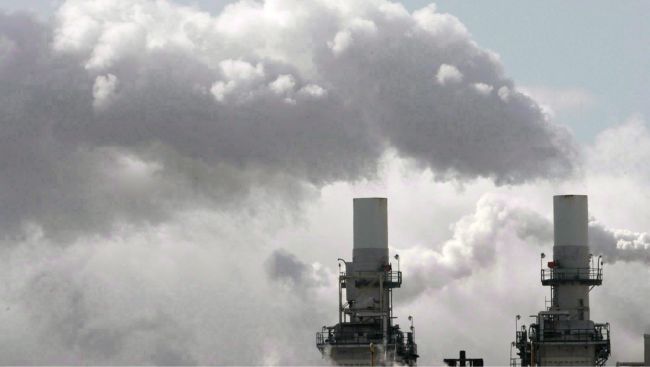
A new study published Friday by the Canadian Climate Institute says Canada is not on track to meet any of its climate targets — not the 2026 interim emissions reduction target, the 2030 Paris Agreement commitment, or even the long-term goal of reaching net-zero emissions by 2050.
The report suggests Canada has moved away from its climate goals thanks to "a slackening of policy effort over the past year, marked by the removal or weakening of climate policies across the country."
That "slackening" includes the elimination of federal consumer carbon pricing, the conclusion of green home retrofit funding and the cancellation of the oil and gas emissions cap, the report says. Provincially, Alberta and Saskatchewan both weakened and suspended their industrial carbon prices, and Ontario repealed its climate accountability legislation.
The climate institute study comes on the heels of Ottawa's emissions reductions progress report, which the government quietly published the week before Christmas.
The progress report — which is required under the government's own climate transparency law — showed the government's best-case scenario model had Canada achieving only a 28 per cent reduction in emissions from 2005 levels in 2030.
As of 2023 — the latest data year available — Canada had only achieved a nine per cent reduction in emissions, while all other G7 countries have averaged a 30 per reduction.
The United States, the second-worst of the group after Canada, cut emissions by 17 per cent compared with 2005 — nearly double Canada's rate of emissions reduction.
The best-case scenario of a 28 per cent reduction by 2030 puts the Carney government behind the emission reduction commitments made by the Harper government, which had promised to bring Canada's emissions to 30 per cent below 2005 levels. In 2021, the Trudeau government increased that target to between 40 and 45 per cent.
"The way to interpret that is that this is if everything works exactly as intended and everything is implemented to the fullest extent, this is the most emissions reductions you're going to achieve," said Simon Donner, a climate scientist at the University of British Columbia, who resigned as chair of the government's Net-Zero Advisory Body in December.
That best-case scenario includes industrial carbon pricing reaching $170 per tonne by 2030, the Clean Electricity Regulations pushing Canada to a net-zero grid coming into force, and enhanced methane regulations. All three of those, however, are subject to negotiation as part of Ottawa's memorandum of understanding with Alberta.
The scenario also factored in emission reductions from the government's electric vehicles mandate — which Ottawa scrapped earlier this month in favour of more stringent tailpipe standards under its new automotive strategy. The new plan is expected to achieve lower emission reductions than the original mandate had projected.
"Unless the Carney government has a whole bunch of additional things planned they haven't announced yet, with really detailed and effective implementation, I don't see how they're going to reach (the 2030 target)," Donner said.
The Canadian Press sent multiple requests for an interview with Environment Minister Julie Dabrusin to talk about the emissions report, but received no response.
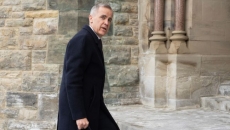
On her way into a House of Commons environment committee meeting on Thursday, Dabrusin said the government was working to get Ottawa's emission reduction commitments back on track.
"I think you're seeing us do that work with the climate competitiveness strategy, with the auto strategy, and there's more to come," she said.
Asked if the government's plans would be enough to get back on track, Dabrusin replied, "We're working."
Opposition parties aren't convinced.
Green Party Leader Elizabeth May said the Carney government is not serious about climate change. May, who supported Carney's budget in December, has since questioned the prime minister's word after accusing him of a climate policy flip-flop.
"If we're serious about emissions reduction, then we have to actually revisit some of the measures that have been eliminated since (Carney) took over," May told The Canadian Press.
"They're miles from hitting any of the Paris Agreement targets, and the prime minister did recommit to me on the floor of the House on Nov. 17 that this government is committed to the Paris Agreement and achieving its targets. So the emissions reduction update, the so-called climate competitiveness strategy — there's lots of highfalutin titles for what boils down to...(no) climate plan.""
Patrick Bonin, the Bloc Québécois' environment critic, also described Carney's moves as a "full-speed backtrack on the environment."
"It's time for Ottawa to wake up, to realize that the climate crisis hasn't disappeared, and put in place real measures to respect our international climate engagements," he told The Canadian Press.
The Canadian Climate Institute's report points to a number of policies that need tightening and follow-through — particularly on industrial carbon pricing.
Still, the report suggested the government's plan for a $130 per tonne credit price would not be enough to put Canada back on track to its targets.
The study makes several recommendations, including continuing to build up Canada's clean electricity grid and enforcing minimum national standards for climate policies.
Ross Linden-Fraser, lead author of the study, pointed to the memorandum of understanding between Alberta and Ottawa as an example of where Ottawa has bent on its established minimums.
"Part of the concern the institute has about the memorandum of understanding is the idea that climate policies should be negotiated bilaterally and that federal floors are negotiable," Linden-Fraser said.
"It's going to be really hard to achieve our climate goals if those floors just get negotiated away."
"We also have to recognize the MOU was the beginning of a negotiation," Donner added.
"If that's the starting point of negotiation and it's already weak in terms of climate policy, it's only going to get weaker."
Picture Courtesy: THE CANADIAN PRESS/Adrian Wyld