OTTAWA - Canada only wants to deal with "trusted partners" in future artificial intelligence ventures, says a federal minister — a signal that the country's rejection of Chinese telecommunications giant Huawei as a 5G provider is at hand.
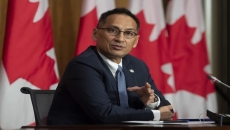
Industry Minister François-Philippe Champagne offered the assessment in an interview Monday from Germany, part of a weeklong, three-country European swing that will take him to Paris later in the coming days for a major international conference on the future of AI.
The federal government has long delayed a decision on the companies that will become its main providers of its AI-powered, next-generation 5G internet network because China had until recently imprisoned two Canadian men, Michael Kovrig and Michael Spavor.
The two men were released in September after more than 1,000 days in Chinese prisons in what was widely seen as Beijing's retaliation for Canada's arrest of Huawei executive Meng Wanzhou on a U.S. extradition warrant — a saga that ended when the U.S. abandoned its prosecution of her.
Champagne said he expects Canada's 5G decision to come within a couple of weeks after the formal return on Parliament on Nov. 22.
"National security comes first, when it comes to something like that. We often think about infrastructure in terms of roads and bridges, but the network infrastructure, the telecom infrastructure, is really the way of the future," said Champagne.
"I think people want to see this kind of virtual network of trusted partners to be ensuring resiliency to people for generations to come."
Canada remains the lone holdout among its partners in the Five Eyes intelligence network — the United States, Britain, Australia and New Zealand — to ban Huawei from its future 5G networks over concerns the company is an arm of Chinese military intelligence, a criticism the company vigorously denies.
Fifth-generation internet — or 5G — will rely on artificially intelligent cloud-based computing that is expected to transform everyday life, enabling self-driving cars and automated medical care, including surgery, among other things.
The Trudeau government has long touted Canada's expertise in AI and its machine-learning computing as a driver of economic growth.
But there have been growing concerns in Canada and abroad about the invasive and disruptive force of opaque algorithms that drive money-making platforms such as Facebook and Google.
The NDP called last month for legislation to rein in Facebook, including addressing misinformation, hate speech and transparency with the use of algorithms.
New Democrat MP Charlie Angus called for the new legislation following the revelations by Facebook whistleblower Frances Haugen. She testified before U.S. Congress that the company's products have hurt children and contributed to the polarization of American politics.
Champagne said he is more than willing to accept input from opposition parties as he aims to table a new digital charter after Parliament's return to address the growing list of issues surrounding AI and the internet-based economy.
"We know that AI is going to transform our lives," said Champagne. But he said the technology needs to be mindful of protecting privacy and that the government needs to create an overarching framework that reflects Canadian values.
"And that for me is very important because now we're seeing the exponential growth of AI. We have a number of champions, we have a number of talents, and we want to steer it in the right direction, (so) that AI will be seen as a technology that's going to be doing good for people."
The European Union has instituted some of the most stringent data protections, which enable internet users to control their personal information while forcing companies to comply with requests.
Champagne said he wants his new digital charter to balance the need to inspire trust while encouraging innovation. And while he wants to consult with stakeholders and opposition politicians, he wants it in place sooner rather than later.
Champagne will also be holding talks on strengthening economic co-operation with Europe in the face of the growing strain on global supply chains that have led to shortages of computer parts and rare-earth minerals needed to power computers and cellphones.
He avoided referring to China by name but noted: "When it comes to data privacy, you have to engage with eyes wide open. Certainly, I think that we will continue to build with our trusted partners when it comes to the supply chain for these key technologies."
The European trip follows his travel last week to the U.S. and Mexico for four days of talks with Canada's continental trade partners on improving supply chain resiliency and finding ways to build back North America's economy following the COVID-19 pandemic.