

The Canadian Union of Postal Workers is declaring a countrywide strike, hours after Ottawa announced door-to-door mail delivery will end for nearly all Canadian households within the next decade.
CUPW posted a notice on its website early Thursday evening that all of its Canada Post members were walking off the job.
"In response to the Government’s attack on our postal service and workers, effective immediately, all CUPW members at Canada Post are on a nationwide strike," the statement reads.
The Canadian Press has requested further comment from the union but has not yet had a response.
Jobs Minister Patty Hajdu wrote that it's up to the union and the Crown corporation to find the balance between the future of postal service and respect for employees.
"Federal mediators remain available to support the bargaining process, and I encourage both parties to continue working toward a fair resolution," she wrote in a statement her office provided in response to the union's notice.
Canada Post spokeswoman Lisa Liu said in a statement that no new mail will be accepted during the labour disruption.
"Mail and parcels will not be processed or delivered for the duration of the national strike, and some post offices will be closed," she wrote.
"The corporation is disappointed that the union chose to escalate their strike activity, which will further deteriorate Canada Post’s financial situation."
The corporation says it and the union have agreed to continue delivering government welfare cheques and that a process is in place to deliver existing live-animal shipments, though no new ones will be accepted.
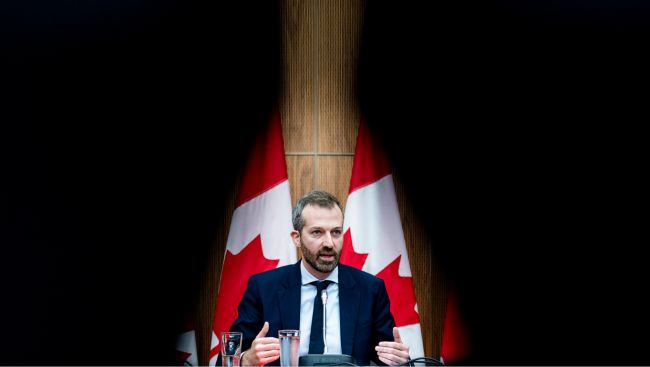
The job action comes after Procurement Minister Joël Lightbound announced sweeping changes Thursday aimed at shoring up Canada Post's finances in response to a decline in letter mail and the Crown corporation's small share of the parcel market.
Those changes also will include slowing down the frequency of mail delivery and shuttering some post offices.
Lightbound said the changes are meant to shore up Canada Post's finances, adding that the corporation "needs to show a path to financial viability."
The minister said the federal government will accept all of the recommendations in the Industrial Inquiry Commission's report on Canada Post, which also called for the introduction of more community mailboxes.
"Canada Post is a national institution, older than our country itself, that has been serving Canadians for more than 150 years. For generations, postal workers have connected communities in every corner of the country, providing an essential lifeline to hundreds of northern, Indigenous and rural communities," Lightbound said.
"At the same time, Canada Post is now facing an existential crisis," he added. "Repeated bailouts from the federal government are not the solution."
The union representing 55,000 postal workers said it was caught off-guard by the changes and argued Canada Post and the government are creating the conditions that drive down demand for its letter and parcel services.
Union negotiator Jim Gallant told CBC News Network's Power & Politics that the union was already in a legal strike position and that different units are "organically" organizing picket lines.
He noted strikes were already underway in Atlantic Canada and he expected all workers to be off the job by Friday.
"It will be the union's direction," he told CBC. "I believe that will happen within the next 24 hours."
"We don't want to be there," he added.
The change to mail delivery is expected to increase the time it takes Canada Post to deliver letter mail from an average of three to four days to an average of three to seven days.
Four million Canadians will also see their service switch from door-to-door delivery to a community mailbox model, and some post offices will be closed for good. Lightbound said that change could generate $400 million per year in savings.
Lightbound said more than three in four households don't have door-to-door delivery now, but there has been a moratorium in place on expanding the use of community mailboxes. That moratorium is ending, he said.
Ottawa predicts it will take up to nine years to introduce community mailboxes for all four million households, but most of them will switch within three to four years.
Canada Post has 45 days to come back to the federal government with a plan to implement the changes.
The federal government said Canada Post needs to change to achieve financial sustainability and maintain reliable service.
Lightbound said Canada Post loses $10 million every day and has needed regular federal bailouts to keep its operations afloat.
He said that while Ottawa will not stop helping Canada Post through its financial difficulties, the Crown corporation needs to cut costs to keep the lights on.
Canada Post welcomed the changes in a statement, saying they will allow it to chart a strong path forward that is in line with the changing needs of Canadians.
"We take this responsibility seriously and will work closely with the government and our employees to move with urgency and implement the necessary changes in a thoughtful manner," said president and CEO Doug Ettinger.
"Our goal is to ensure that a strong, affordable, Canadian-made, Canadian-run delivery provider supports the needs of today’s economy and delivers to every community across the country.”
The commission also recommended changes to Canada Post's collective agreement to allow the Crown corporation to hire part-time employees for weekends to help with the weekday load.
Pressure is mounting to reach a new agreement before the critical holiday season.
After nearly two years of negotiations, the sides are showing few signs of progress. The parties have been far apart on wages and on restructuring the collective agreement to allow for a corps of part-time workers and weekend delivery.
The union earlier this month instituted a flyer ban but had stopped short of picketing since the federal government intervened to quash a holiday strike late last year.
"The timing of the announcement coupled with new global offers could reveal a lot about Canada Post’s plans for bargaining, our jobs and the future of the public post office," CUPW national president Jan Simpson said in a media statement prior to the strike declaration.
"If Canada Post drops its demands to gut the contracts and deal with our issues, we can come to an agreement quickly. If they ignore the overwhelming vote to reject their vision from the employees that do the work, they are proving they have no intention to achieve negotiated collective agreements."
In a media statement, the Canadian Federation of Independent Businesses said reform of Canada Post is long overdue, and urged Ottawa to "push forward with the needed changes" in spite of the strike.
“As expected, Canada Post workers are back on an immediate, nation-wide strike. The impact on small business will be massive," wrote president Dan Kelly.
"Last year's strike alone cost small firms over $1 billion. Doing this in the lead-up to the critical holiday retail shipping season is especially troubling.
Kelly called for the post to be deemed an essential service so that a strike is impossible while a reform is put into place.
Canadian Chamber of Commerce vice-president Pascal Chan wrote that the announced strike "is not welcome news" for business after years of supply-chain disruptions.
"The Canadian Chamber calls for a return to the bargaining table and a commitment to good faith negotiation focused on how to best support consumers and businesses."
Picture Courtesy: THE CANADIAN PRESS/Spencer Colby


