Friday, May 22, 2026
ADVT 
National

Canada primed for more severe wildfire days, driven by dry forest fuel: study

Darpan News Desk The Canadian Press, 02 Jan, 2025 03:13 PM
  • Canada primed for more severe wildfire days, driven by dry forest fuel: study

Canadian forests are increasingly primed for severe, uncontrollable wildfires, a study published Thursday said, underlining what the authors described as a pressing need to proactively mitigate the "increased threat posed by climate change."

The study by Canadian researchers, published in the peer-reviewed journal Science, looked at Canadian fire severity from 1981 to 2020. 

"The widespread increases, along with limited decreases, in high-burn severity days during 1981 to 2020 indicate the increasingly severe fire situation and more challenging fire season under the changing climate in Canada," the study read.

Co-author Xianli Wang, a research scientist with the Canadian Forest Service, says there were on average an additional two days conducive to high-severity fires in 2000 to 2020, compared to the previous two decades. In some areas, it was closer to five days. 

While that may not sound like much, last summer's devastating wildfire in Jasper, Alta., grew to about 60 square kilometres in a matter of hours.

"This is just a more dramatic fire situation that we are currently having than before," he said. 

When it comes to the geographic distribution of severe wildfire, Wang said the findings suggest Canada's record-breaking 2023 season was not an aberration, but a "glimpse into the future." 

"You will see this kind of high-severity burning across the board," said Wang. 

The study suggests the major environmental driver of fire severity was dry fuel, such as twigs and leaves, while the effect of weather – such as hot, dry and windy conditions – was more pronounced in northern regions. 

The results, the study said, demonstrated "the critical role that drought plays" in a fire's severity. 

As climate change lengthens the fire season, the study says spring and autumn have added more high-severity burn days in recent decades. Those increases coincided with areas that also had the most severe summer months.

"A lot of the time, you think only summer fires are more severe – they burn higher flames, they destroy everything – but in the spring it's not that bad. That is not the case anymore," Wang said. 

The greatest increase in burn severity days was recorded in an area covering northern Quebec and an area covering Northwest Territories, northwest Alberta and northeast British Columbia. 

Both of those regions are home to extensive coniferous trees. Areas with more low-burn severity days were mainly in southern broadleaf and mixed-wood forests, the study said. 

Severity is a measure of how much damage a fire wreaks on the forest's vegetation and soil. While fire is a natural part of the ecosystem, Wang said severe fires can in some cases burn so hot and deep into the ground that they wipe out seeds stored in the soil, affecting the forest's recovery.

The findings, the study suggested, could help decision makers choose the best times and locations for prescribed burns – planned and controlled fires intended to support natural regeneration – while also reducing fire hazards to nearby communities. 

MORE National ARTICLES

More shelter beds for people in Victoria street camp cited by police for 'hostility'

More shelter beds for people in Victoria street camp cited by police for 'hostility'
Dozens of new shelter beds are opening for people living on the streets in Victoria, including at an encampment where police escorts have been required for emergency responders. A statement from the Housing Ministry says that up to 72 new beds will be made available for people living on Pandora Avenue and elsewhere.

More shelter beds for people in Victoria street camp cited by police for 'hostility'

Japanese Canadian paper, pillar for community during war, saved from digital oblivion

Japanese Canadian paper, pillar for community during war, saved from digital oblivion
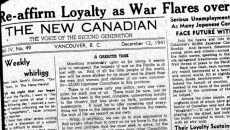
More than eighty years ago, Japanese Canadians came together to sustain The New Canadian, the only newspaper specifically for the community that was allowed to be published through the Second World War. Now the community has come together again — and may have saved the newspaper's archives from the digital scrap heap.

Japanese Canadian paper, pillar for community during war, saved from digital oblivion

SUV allegedly rams into police car

SUV allegedly rams into police car
Surrey Mounties say they got a call about a suspicious vehicle around 146 Street and 108 Avenue, and the driver of a Ford S-U-V allegedly hit a police vehicle as it fled from officers.  Surrey R-C-M-P says the S-U-V also hit another vehicle that was stopped and later drove into oncoming traffic as police were in pursuit. 

SUV allegedly rams into police car

One-third of Canadians report being personally impacted by severe weather: poll

One-third of Canadians report being personally impacted by severe weather: poll
A new poll suggests more Canadians are feeling the direct impacts of extreme weather, but that has not changed overall opinions about climate change. The results from a recent Leger poll suggest more than one in three Canadians have been touched directly by extreme weather such as forest fires, heat waves, floods or tornadoes. 

One-third of Canadians report being personally impacted by severe weather: poll

Former U.S. ambassador to Canada gives 'tsunami warning' about Trump

Former U.S. ambassador to Canada gives 'tsunami warning' about Trump
A former United States ambassador to Canada is sounding the alarm that a second Donald Trump presidency would cause chaos for Canadians as he urged Americans abroad that their votes could prove crucial in the presidential election. Bruce Heyman, who served as ambassador from 2014 to 2017, gave Canada a “tsunami warning,” saying if Trump takes the White House, Canada is at great risk.  

Former U.S. ambassador to Canada gives 'tsunami warning' about Trump

B.C. commuters left without West Coast Express as railways lock out workers

B.C. commuters left without West Coast Express as railways lock out workers
Rail commuters in British Columbia's Lower Mainland must find alternative transportation after Canada's two major railways locked out workers in their first-ever simultaneous stoppage. A bulletin from TransLink, Metro Vancouver's transportation network, says service on the West Coast Express is suspended due to the stoppage, which follows a break down in talks with the union.

B.C. commuters left without West Coast Express as railways lock out workers