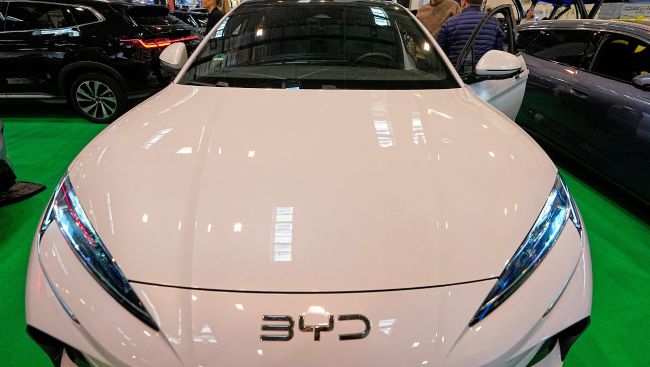
Intelligence and cybersecurity experts are warning the Liberal government about national security risks posed by allowing Chinese electric vehicles onto Canadian military bases.
Critics and some experts are even calling on Ottawa to ban the cars from Canadian Armed Forces bases and other sensitive sites due to onboard sensors they say could collect and transmit sensitive information to the Chinese government.
Their warning comes after Poland and Israel instituted similar bans on EVs built by Chinese companies like BYD Auto over the past year — and as Conservative politicians in Canada raise the alarm over the threat of so-called "spy cars."
Dennis Molinaro, a counter-intelligence expert at Ontario Tech University and a former national security analyst, said the federal government should follow the example of Poland and Israel.
"Absolutely, Canada should be doing the same," he told The Canadian Press. He said a national security law in China that appears to compel private companies to funnel intelligence back to Beijing could make the cars a security risk.
David Shipley, CEO of Beauceron Security, said the risks are high enough that Parliament should at least haul military brass and senior bureaucrats in front of a committee to testify about National Defence's plans for managing those risks.
"The Chinese sometimes send us a good signal about what the risks are," Shipley said. "They banned Teslas from their major political events and military bases for the same reason Israel is banning their BYDs."
Shipley recently told a House of Commons committee that Chinese EVs are "rolling surveillance" platforms and that policy-makers in the nation's capital need to learn why countries such as Poland are taking such precautions.
Neil Bisson, director of the Global Intelligence Knowledge Network and a former intelligence officer, notes the vehicles use lidar and radar cameras and plug into the electrical grid — and their drivers connect their smartphones to the cars' entertainment systems.
"The more that we open ourselves up to allowing Chinese EVs to come in to Canada, the better chance there is that those threat vectors are going to be capitalized on by the PRC," he said.
"From the perspective of the military base, I would say anything you can possibly conceive of being sensitive should be banned. But the problem is even if you're not, let's say, close to a military base, (that) doesn't mean the Chinese EVs aren't picking up on facial recognition."
When The Canadian Press put the question separately to Chief of the Defence Staff Gen. Jennie Carignan and Defence Minister David McGuinty, they committed to looking into the matter.
"Well, we don't have a lot of Chinese vehicles so far," Carignan told reporters at a roundtable in Halifax in February. "I think as this posture changes, the various security regulations will be emitted. But we'll have to look at this before we make any changes to our current posture."
McGuinty said earlier this week he will "take close note" of Poland's move. When asked whether CAF members should be able to drive the cars onto bases, the minister said he would check with officials.
"That's a question I'll raise with the operational folks at our bases," McGuinty told a March 16 news conference.
"I don't think we (National Defence) are purchasing vehicles from China right now that are operational at any one of our 33 bases. It's an interesting development. I'm sure the Polish authorities have their own reasons for doing this."
The question comes as the Liberal government slowly opens the taps to bring more Chinese EVs into the country. Prime Minister Mark Carney announced a new quota in January, set at a favourable tariff rate, for affordable Chinese EVs.
Ottawa is also looking to secure Chinese investment in a Canadian auto sector under strain from U.S. President Donald Trump's relentless trade war.
The issue of Chinese EVs is becoming increasingly politically charged.
Conservative Party Leader Pierre Poilievre's new auto policy calls for banning Chinese-made vehicles from "proximity to Canadian Forces bases and other sensitive or strategic infrastructure."
Ontario Premier Doug Ford, whose province is home to most of Canada's auto sector, has also issued a warning about the cars.
“When you get on your cellphone, it’s the Chinese that are going to be listening to your — and I’m not making this stuff up — they’re going to be listening to your telephone conversation," Ford told a conference of municipal leaders in January.
When asked about risks posed by Chinese EVs at a committee last month, Public Safety Minister Gary Anandasangaree said the federal government must ensure vehicles in Canada do not have the ability to transmit information back to other countries.
Experts warn that could become tricky as the number of Chinese EVs on the roads ramps up.
Molinaro said that while it has not been publicly confirmed that China is using EVs for surveillance, that doesn't reduce the level of concern.
"If we did confirm something, we would be indirectly saying how we would know. I would imagine that intelligence services would be unlikely to want confirm it because they might end up revealing the methods by which they're able to figure that out." he said.
Shipley also noted that while Chinese EVs are "extra risky," it would be short-sighted to assume the problem is exclusively tied to Chinese-made vehicles.
"It would be the height of arrogance to think that if they really wanted to spy on us to this level, they wouldn't hack GM, Ford, Stellantis, Tesla and others," Shipley said.
"The issue isn't Chinese EVs. It's all these internet-connected cars and the risks they pose to our military — and the fact that there is not a single law on the books regulating these things."
Not everyone is so concerned about the risk of Chinese vehicles being used for espionage.
Dan Stanton, an instructor at the national security program at University of Ottawa, said he suspects the issue of Chinese EVs spying on Canadians is a little overhyped.
"I think Canadians get a little too excited about these things and it's usually more benign," he said.
"I don't buy that China puts back doors in all these technologies and they're going to be following me when I go to Costco and Chuck E. Cheese and all that sort of stuff."
Picture Courtesy: AP Photo/Martin Meissner, File