OTTAWA - Stephen Harper has been one of the toughest-talking leaders throughout the Ukraine crisis, yet newly released figures show National Defence is expected to face an even deeper budget hole in the coming year than previously anticipated.
The ongoing reductions come as the prime minister is expected to resist pressure from allies at this week's NATO summit to spend substantially more on the military.
Annual spending on the military, when compared with 2011, is slated to shrink by a total of $2.7-billion in 2015, according to a briefing note prepared for the deputy defence minister.
That would be almost $300-million more than earlier internal estimates, and roughly $600-million higher than the figure defence official acknowledged last fall when they rolled out the department's renewal plan.
In addition to planned cuts under the government's strategic review, deficit reduction action plan, and wage restraint measures, defence is expected to face "other planning pressures," according to a Sept. 16, 2013 memo.
Those pressures include, among other things, severance for laid off civilians at defence; the bill for the Harper government's pledge to sustain newly trained Afghan forces; and the cost of operating the Public Works secretariat that is picking a replacement for the CF-18s.
National Defence has repeatedly said that it — like other government departments — is expected to contribute towards the government's drive towards a balanced budget next year.
The issue of how much allies fork out for their militaries will be among the major closed-door topics when NATO leaders meet this week in Wales.
Canada is under pressure — mostly from the United States and Britain — to dramatically increase its defence budget over the next 10 years to meet the NATO benchmark of two per cent of gross domestic product.
According to the latest NATO figures, the Harper government spends one per cent of GDP on defence, just slightly ahead of financially-troubled Spain, the Slovak Republic, Hungary, Luxembourg, Lithuania, and Latvia.
Only two nations surpass the benchmark — the U.S. and Britain. Others, such as France, Germany, Norway and Italy, come close.
Some allies, such as the Dutch, have begun to rethink planned defence cuts, especially in light of last week's military action by Russian troops in eastern Ukraine, which Foreign Affairs Minister John Baird described as an "invasion."
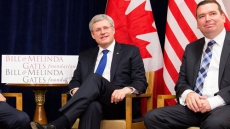
Harper himself has left little doubt on where he believes events of the last eight months in eastern Europe belong in the grand sweep of history.
"When a major power acts in a way that is so clearly aggressive, militaristic and imperialistic, this represents a significant threat to the peace and stability of the world and it's time we all recognized the depth and the seriousness of that threat," the prime minister said at a hastily arranged photo-op with the ambassadors of Ukraine, Estonia, Poland and Latvia on April 14.
“But as I say, the most important thing we need to do is to rally all of our allies throughout the western world and throughout the greater global community to understand that peace and stability is being threatened here in a way that has not been threatened since the end of the Cold War.”
Canada's response, thus far, has been to commit CF-18s to patrolling the skies over the Baltic states; a frigate to sail with NATO's standing task force; a boost in NATO headquarters staff; and ground troops to train alongside allies. It has also sent non-lethal military equipment and aid to Ukraine.
A senior government official, speaking on background, said Canada is prepared to increase the defence budget, but described the NATO benchmark as an abstract figure and expressed concern about committing billions of extra dollars per year without a clear plan by the alliance on how it will deal with the long-term.
Dave Perry, an analyst with the Conference of Defence Associations, said, in order to meet the NATO goal, Ottawa would have to double the military's budget to about $38-billion per year.
Spending more doesn't necessarily mean a more effective military and Canada has demonstrated it gets a lot of efficiency out of the dollars it does commit, he said.
Financial estimates, that were part of the briefing package given to Rob Nicholson when he was sworn-in as defence minister in July 2013, show the Conservatives, despite past promises and rhetoric, weren't planning to spend much more than the roughly $18.9-billion already set aside.
In a rare display of conflicting messages, Nicholson's parliamentary secretary, James Bezan, publicly suggested last spring that the country should be spending 1.7 per cent of GDP on its military.
When the Conservatives introduced their defence strategy in 2008, they underlined how the 20-year plan would provide "stable and predictable" funding to the military by delivering a guaranteed two per cent annual increase.
But Perry said it hasn't worked out that way and, while the escalator is still there, it's been more than offset by cuts elsewhere.
"It's a bizarre situation where you've got $2.7 billion in cuts, taking away with the left hand; but with right hand your getting this escalation amount," Perry said.
The Canada First Defence Strategy also promised that overseas missions would be paid for — as other nations do — through a special budgetary appropriation and not taken out of the departmental budget.
The war in Afghanistan was largely funded that way, but Nicholson's briefing papers show other deployments, notably the 2011 bombing campaign in Libya and the Afghan training mission, were not.