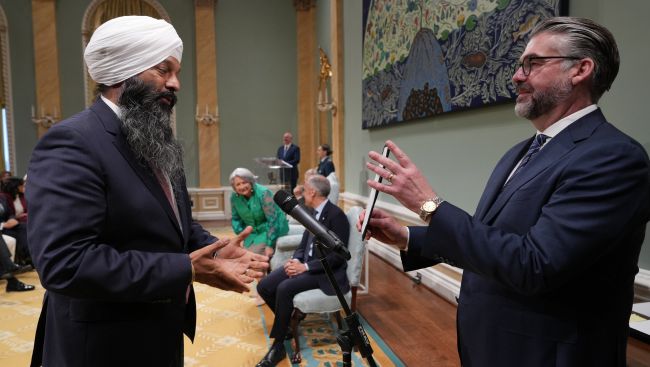
The MP overseeing foreign aid says Ottawa wants to focus its international assistance efforts on countries that can generate economic spinoffs for Canadians.
"The first priority is focusing our development dollars in a trade and development nexus," Randeep Sarai, secretary of state for international development, told The Canadian Press.
"Due to the new trade realities that the world is facing — and specifically Canada — I think we need to use development as a positive tool to help create new pathways and create mutual prosperity for the partner countries as well."
Sarai's comments come as the federal government moves to slash $2.7 billion from the foreign aid budget over four years. Ottawa insists the cuts will bring Canada's spending back to pre-pandemic levels.
The aid sector has argued that by cutting aid and pushing to spend less on global health, Prime Minister Mark Carney is breaking his promise during last year's election campaign to leave the aid budget alone.
Ottawa's move to reduce its foreign aid budget follows Washington's chaotic recent campaign of cuts to most of the United States' overseas development spending. Those cuts have eliminated food aid for some refugee camps and prevented clinical trial patients from finishing their treatments.
Sarai said that to "make up for that big void of development dollars," Canada must be "more effective" and selective in its aid distribution by focusing on countries it wants to trade with.
"Rather than sprinkling a little bit everywhere, we're being a little bit more concentrated," he said.
That policy shift comes as thousands of Global Affairs Canada staff receive notices warning of possible layoffs. Sarai said he hopes GAC's development branch finds efficiencies through voluntary departures, streamlining funding applications and using AI.
"We're trying to be creative (and) use more of our dollars that have a bigger impact," he said.
Being creative, he said, might involve more use of what's known as "blended finance" in aid delivery — where the government partners with private capital or philanthropists using tools like below-market-rate loans.
Ottawa can also back private investments to make them less risky and more attractive to private sector lenders, Sarai said.
Sarai cited the example of a cinnamon-processing facility he visited in Vietnam, where workers — mostly women — harvest and process cinnamon bark and star anise into powders and products that meet high sanitary standards.
He said the facility was supported by a federal government program that has parlayed a $5 million initial investment into $17.5 million in private capital for projects in Vietnam.
Sarai said the program created jobs in the Lao Cai region while promoting gender equality and making affordable goods for countries like Canada. The project sought to shift processing away from middlemen who tended to underpay for raw materials.
"The partner countries want serious development. They want to make money, they want it to be sustainable. They're not looking for handouts," he said.
"We're doing everything. We're alleviating poverty, we're providing good jobs and leveraging our dollars ... and we're creating a stable supply of cinnamon for Canada for all our Canadian cinnamon lovers."
Sarai said renewable energy is another area where public investments in rural areas can make projects attractive to private lenders.
In a Sunday statement marking International Development Week, Sarai wrote that aid can "help diversify our trade by creating opportunities for Canadian businesses, exporters and investors in emerging markets."
Carney telegraphed how his government would be linking aid and trade when he appointed MP Yasir Naqvi as parliamentary secretary both to Sarai and to Minister of International Trade Maninder Sidhu.
Groups like CUSO International say that countries supported during their development tend to favour donor countries decades later with trade and investment opportunities.
Conservative MPs have challenged this claim in recent months, pressing Sarai to provide proof that Ottawa's aid dollars actually pay off for Canadians.
At a reception Monday evening hosted by Oxfam Canada, Conservative MP Stephanie Kusie struck a different tone. She said that as a diplomat, she saw how aid programs benefit people abroad and shore up Canada's security.
"Development is an investment, of course, in the world, for peace, civility, economy, trade, against war and displacement," said Kusie. "It really is our front line of defence that we can have a solid and stable and prosperous world."
Sarai said the government wants to boost the $1.20 in private cash generated by each dollar in aid to $3 using a range of mechanisms, including the federal development financing institution FinDev Canada.
This approach has its critics. The Blended Finance Project, run by University of Ottawa researchers, argues private capital is more costly than public money and raises the risk of corruption due to commercial contracts being shielded from proper scrutiny.
In an October 2024 report, the group argued that — instead of focusing on core needs like water and health care in the poorest nations — past blended finance projects largely supported business goals in middle-income countries, with questionable environmental effects.
Some charities say blended finance works well if it's carefully structured and monitored to ensure it benefits the poorest people.
Canada's push for more private capital in foreign aid involves money from wealthy Gulf countries with dire human rights records. Sarai said Ottawa is partnering on aid projects with "Qatar and the United Arab Emirates, and hopefully with Saudi Arabia."
He said all three nations are "very progressive, and especially in terms of women's engagement and getting more women financially independent" in developing countries.
While Carney has said Canada no longer has an explicitly feminist foreign policy, Sarai said Ottawa's aid spending is focused on ending gender inequities.
"The development goals remain the same — alleviate poverty, create prosperity for the partner country, help women and girls," he said.
"If you want to grow the GDP, if you want to improve health care in a country, if you want to control the birthrate in a country, educating and providing good hygiene and health care to young women and girls is one of the keys."
Sarai said he also wants to engage Canadians on Ottawa's support for "many of the lands and diasporas that they come from — not just the two or three that are usually loud in the media."
That means more federal top-ups for Canadian programs in regions like Latin America, Africa, the Caribbean and small Pacific islands, he said.
Picture Courtesy: THE CANADIAN PRESS/Christinne Muschi