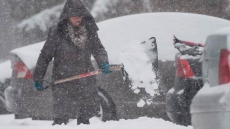
Research suggests climate change could increase the number of nice days Canadians enjoy.
Most global warming studies have focused on extreme weather or broad-scale averages of temperature and precipitation. But Karin van der Wiel, of Princeton University, says that's not how people will experience their new circumstances.
"If you are a person living in Canada, it's never the average climate," said van der Wiel, whose paper is being published Wednesday in the journal Climatic Change.
Van der Wiel and her colleagues thought a good way to demonstrate the daily consequences of increased greenhouse gases in the air would be to calculate how many 'mild days' different regions of the globe would experience — days topping out between 18 C and 30 C, with less than one millimetre of rainfall and not too much humidity.
"We looked at the actual days that feel mild," she said. "These are the days that people can relate to — the day you had a really nice walk in the park or went to a baseball game and it was really nice."
It turns out Canada is one of the places to be.
The globe, on average, is expected to lose four days of nice weather by 2035 and 10 days by 2081. Africa, Asia and Latin America could see 15 to 50 fewer days of mild weather a year by the end of the century. Parts of the U.S. South Atlantic coast could lose a couple of weeks.
But Canada — along with other mid-latitude areas such as Europe — is likely to see gains of anywhere from five days to three weeks.
Scientists have long surmised the impact of climate change could be most benign for humans in those regions. Van der Wiel's study is the first to frame the issue in a way that non-climatologists can understand.

"It's really difficult to feel that what was a once-in-25-year event is now a one-in-20-year event," she said. "I think this 'mild day' that we came up with is easier to relate to."
Not that there isn't a downside. Van der Wiel's paper doesn't include a nasty-day index and previous studies suggest we'll have plenty of them.
Even in Canada, expect more flooding downpours and winter rains that wash away before they can nourish crops. Forest fires, already at record levels, are likely to get bigger. Rocky Mountain glaciers, the water source for many prairie cities, are on their way out. The southern prairies will see more drought.
Forests once harvested for timber are likely to turn into prairie. Pacific coast fisheries are predicted to decline up to 10 per cent.
The paper also points out that areas about to lose nice weather are much more heavily populated than ones about to gain some, which has implications for everything from weather-related disasters to the crops people depend on.

Still, said van der Wiel, the paper is an attempt to translate the grand abstractions of climate models and global averages into a metric that makes sense.
"We are scientists, but we are people too."