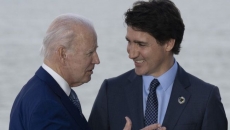
Prime Minister Justin Trudeau is urging businesses to hire Canadians as his government announces new restrictions to limit the number of low-wage temporary foreign workers in the country.
Ottawa is also considering whether to reduce its annual targets for permanent residency — a potentially major shift on immigration policy for the Liberals.
In response to mounting criticism of the recent influx in temporary foreign workers, the federal government is bringing back pre-pandemic rules that made it more difficult for businesses to hire low-wage workers from abroad.
Speaking to reporters at the Liberal cabinet retreat in Halifax, Trudeau said his government loosened the rules to help businesses that were facing labour shortages recover from the pandemic.
But the economic situation is different now, he said, and Canada "no longer needs as many temporary foreign workers."
"We need Canadian businesses to invest in training and technology and not increasing their reliance on low-cost foreign labour," Trudeau said.
"It's not fair to Canadians struggling to find a good job, and it's not fair to those temporary foreign workers, some of whom are being mistreated and exploited."
When asked whether the federal government is considering restricting the number of permanent residents as well, the prime minister said those were "ongoing conversations."
Monday's announcement is the latest effort by the federal government to limit the number of people coming into the country in response to criticism of its immigration policies.
Effective Sept. 26, the government will refuse applications for low-wage temporary foreign workers in regions with an unemployment rate of six per cent or higher.
Employers will be allowed to hire a maximum of 10 per cent of their workforce from the temporary foreign worker program, down from 20 per cent.
Workers hired through the low-wage stream will be able to work a maximum of one year, down from two years.
There will be some exceptions to the rules for specific sectors such as health care and construction.
"To those who would complain about worker shortages, here's my message: there is no better time to hire and invest in Canadian workers," Trudeau said.
Strong population growth over the last couple of years driven by high immigration has increased demand for housing, and economists say that has worsened affordability.
The temporary foreign worker program has also been criticized for allowing cheap labour into the country at a time when the economy is slowing down.
When the federal government eased restrictions for the program in 2022, Canada had about one million job vacancies across the country and the unemployment rate dipped to a record-low of 4.9 per cent.
Job vacancies have decreased significantly since then and the unemployment rate is climbing as high interest rates restrict economic growth.
In July, the unemployment rate was 6.4 per cent.
Economists have criticized the federal government for maintaining the relaxed rules, arguing that they discourage businesses from investing in innovation and suppress workers' wages.
While the Liberal government has defended its decision to loosen the rules, it is now acknowledging that it's time to tighten them again.
According to public data from Immigration, Refugees and Citizenship Canada, 183,820 temporary foreign worker permits became effective in 2023. That was up from 98,025 in 2019 — an 88 per cent increase.
Immigration Minister Marc Miller was asked about Trudeau's suggestion that the government is considering lower permanent resident targets.
"All options are on the table," Miller said.
"I've heard directly from Canadians about where they see the direction of immigration going, and I think they're asking us to adjust."
Miller said cabinet has not yet discussed lowering immigration targets, but that over the next few weeks it will consider a wide range of options.
Canada is currently set to welcome 500,000 permanent residents in both 2025 and 2026, up from 485,000 this year.
Speaking to reporters on Monday, Conservative deputy leader Melissa Lantsman said the Liberal government's announcement amounted a reversal of its own policies.
She also attacked Housing Minister Sean Fraser, who was previously responsible for the immigration file.
"Today, they’ve walked back the disastrous policies of Sean Fraser, who at the time was immigration minister, who broke our immigration system and is now responsible for fixing housing. Canadians don’t buy it anymore," Lantsman said.
As immigration minister, Fraser increased permanent resident targets and argued that Canada needed more people to grow the economy and help build more homes.
Historically, there have been no targets for temporary residents and the temporary foreign worker program is overseen by the employment minister.
However, Miller announced in March the federal government will begin including targets for both temporary and permanent residents in its immigration levels plan this fall.
Miller also pledged to decrease the share of temporary residents in the country to five per cent of the population over the next three years.
According to Statistics Canada data, temporary residents represented 6.8 per cent of the population as of April 1.