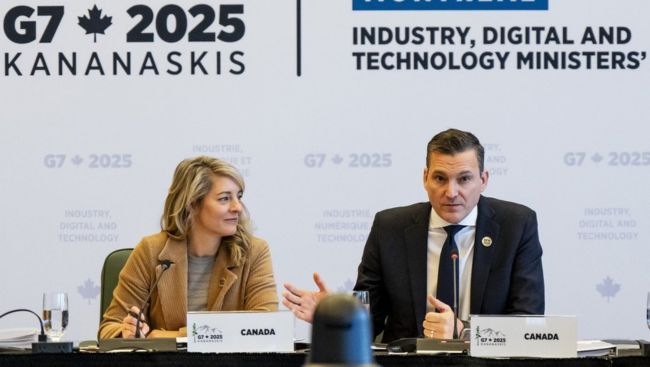
Canada's artificial intelligence minister kicked off two days of meetings among G7 ministers Monday touting new digital agreements with Europe — a move that comes at a time of deep divisions between the EU and the U.S. on AI regulation.
"In the global economy where trust is becoming a scarce commodity, the EU and Canada share a deep reservoir of trust, earned over decades of co-operation and built on these kind of (agreements)," Evan Solomon said at a press conference with Henna Virkkunen, executive vice-president of the European Commission for technological sovereignty, security and democracy.
"Combined with our technological capabilities, we are positioned to lead responsibly, lead with our shared values and trust on AI."
Solomon held two press conferences on the first day of the two-day meeting — one on a new partnership with Germany and the other on a new agreement with the European Union.
The agreement with Germany is meant to increase collaboration on AI, quantum technology, digital sovereignty and infrastructure. Solomon also announced the signing of two agreements with the EU — one focusing on adoption and responsible development of AI and the other on co-operation on digital credentials.
The European Union has been a proponent of AI regulation, while the United States under the Trump administration has opposed regulation. In Montreal, Solomon faced questions from reporters about that dynamic.
"Canada and Europe have both very much been aligned on finding a place where we have the balance between privacy, safety, and AI safety, not just with AI, whether it's with deep fakes and other issues, but also making sure we don't constrain innovation," Solomon said.
He said he was "delighted" the U.S. was taking part in the ministers' meetings.
"They're talking about aligning and working together, which we encourage. We all want to encourage the fact that the G7 and organizations and collaborations like this continue to act as ways to find coherence and find alignment on these foundational issues," Solomon said.
"So this is actually a very important day for that. But look, every country is going to chart its own path."
At the press conference with Virkkunen, he said one of Canada's goals is to broaden trade relationships, including digital trade relationships with Europe. He noted Canada's digital partnership with the EU began in 2023.
When Solomon was first named artificial intelligence minister, he said Canada would not "over-index" on regulation and cited U.S. and Chinese disinterest in such efforts.
A month ago, at the Govern or Be Governed conference in Montreal, the European Union’s democracy commissioner said he wouldn't "lecture" Canada or any other country as the EU pushes ahead on regulating tech platforms and artificial intelligence. AI pioneer Yoshua Bengio told the same conference Canada should partner with allies like the European Union.
Artificial intelligence was set to take up much of the agenda at the Montreal gathering — part of a series of ministerial meetings being held as Canada holds the presidency of the G7 group of nations this year.
Prime Minister Mark Carney hosted the G7 leaders’ summit in June, welcoming leaders from the United States, France, Germany, Italy, Japan and the United Kingdom, along with the European Union, to Kananaskis, Alta.
"The decisions that we'll make here together will shape the nature of our technological progress in our democratic world, and it's happening at unprecedented speeds," Solomon said in his opening remarks on Monday.
He said Canada's G7 presidency will focus on "giving business leaders the tools and the confidence to use the AI technologies that we have, especially small and medium-sized businesses."
Mark Daley, professor and chief AI officer at Western University, said co-operation on AI policy is essential.
"The faster the world moves, the more important co-operation is, and the digital world moves at the speed of light and seems to continue to accelerate," Daley said.
"So having this opportunity for the digital ministers specifically to focus on the digital world and AI and all of the impacts this (has) on our society, I think is really critical from a co-ordination and collaboration standpoint."
Solomon said Canadian priorities for the ministers' meeting include broadening trade routes and partnerships, driving investment in Canada and ensuring those partnerships help "strengthen our sovereign AI and our sovereign quantum."
The meeting isn’t entirely about digital and tech issues; Industry Minister Mélanie Joly is also hosting.
Paul Samson is president of the Centre for International Governance Innovation, which put together advice from various think tanks ahead of the leaders’ June meeting.
Samson said normally the leaders’ meeting comes after the ministers’ meeting, but that was flipped around this year because of the timing of the spring election. That means the ministers will "absolutely" be following up on the issues raised by the leaders, he said.
Heidi Tworek, a professor of history and public policy at the University of British Columbia, said that as host, Canada has an opportunity to wield influence through the choice of location and priority topics.
Asked how much the meeting could accomplish, Tworek said "a lot of that is going to obviously hang on the American priorities and presence and so on, because we know there are of course some tensions" over the EU’s AI and digital regulation legislation.
There are areas where the G7 countries are on the same page, Tworek said.
"One base level thing is that actually all of these countries seem to agree that AI is going to be really integral moving forward, right? Which isn't necessarily to be taken as a given," she said.
While global AI governance isn’t going to settled at this meeting, understanding what the various parties are doing is important, Daley said.
"It’s also important for Canada to be part of that conversation so we can see where our closest partners and friends are heading and with whom we want to co-operate more in the future," he said.
One important area is interoperability of AI technology, Daley said.
"They're not glamorous, they're not glorious, but standards actually can change the world. And Canada as a middle power, this is one of the levers we have traditionally used in technology domains to have outsized influence, positive influence on the world."
Picture Courtesy: THE CANADIAN PRESS/Christopher Katsarov