
Tuesday, May 26, 2026
ADVT 
National

Canada won't 'leverage' energy, critical minerals in trade talks: PM

Darpan News Desk The Canadian Press, 01 May, 2026 02:13 PM
  • Canada won't 'leverage' energy, critical minerals in trade talks: PM

Prime Minister Mark Carney says Canada will not use energy or critical minerals as “leverage” in upcoming trade talks with U.S. President Donald Trump’s administration.

But Carney suggested further integration with the United States in those sectors — highly coveted by the Trump administration — remains in question.

“I reject that characterization of it’s leverage. It's looking at, is it in our mutual interest to trade more. Where is it? And if it's not there, we have other options,” Carney said Friday in his first interview with The Canadian Press since entering federal politics.

"Should we be further integrating our energy markets with the United States at a time they view that as, quote, 'leverage'?"

Carney's comments come as his government grapples with damaging U.S. tariffs that remain locked in place as a scheduled review of the continental free trade pact approaches.

Carney pointed to the plight of Canada’s “incredibly” integrated automobile market, which he said is at risk of being “pulled apart” by U.S. tariffs.

On Wednesday, United States Trade Representative Jamieson Greer told a group of visiting Canadian politicians, trade envoys and businesspeople in Washington that Canada should not attempt to use its energy and natural resources as leverage in negotiations on the continental free-trade pact.

Greer said the administration is looking to work with Canada on energy and critical minerals development in ways that would benefit both countries.

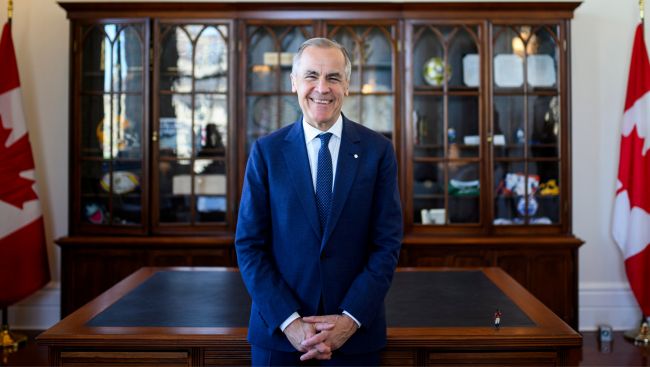
Carney spoke with The Canadian Press in his office on Parliament Hill, now decorated with sports paraphernalia — an Edmonton CFL helmet and football, various items of Oilers swag. The office has changed noticeably since the departure of his predecessor Justin Trudeau, who was less of a sports fanatic and more of a sci-fi buff — though did have a Habs jersey on display.

Carney granted a rare series of interviews to journalists this week, including CBC News and the French-language newspaper La Presse, to mark the one-year anniversary of his electoral victory last year and highlight some of his accomplishments.

He talked up a marked improvement in federal-provincial relations over the past year and the creation of new federal offices to speed up industrial project approvals and major government purchases for the military.

Carney also defended Trudeau’s record on trade and his handling of Trump. He credited Trudeau with successfully negotiating the CUSMA agreement during Trump’s first term in the White House.

The Canadian Press asked Carney if he understands Trump and his notions about the “art of the deal” better than Trudeau did, given the stark change in the tone of the relationship with the U.S. president that happened when Carney succeeded Trudeau.

Carney said he’s learned over the past year that Trump prefers being spoken to directly but respectfully, and abhors statements cloaked in “flattering language.”

Carney said that CUSMA “stands the test of time” and added he believes most of the trade pact will survive its upcoming renewal.

“Much of it will be retained. Some things are going to have to change, but we're looking to make sure they change in a way that's in Canada's interest,” he said.

Picture Courtesy: THE CANADIAN PRESS/Spencer Colby

MORE National ARTICLES

Weak loonie signals economy is 'in trouble': currency expert

Weak loonie signals economy is 'in trouble': currency expert
The Bank of Canada's end-of-day exchange rate Monday had the loonie trading at 68.48 cents US, but the Canadian dollar neared 70 cents in the minutes after Prime Minister Justin Trudeau said the planned tariffs would be paused for at least 30 days. The overall trend for the Canadian dollar however has been weak, which has implications for the economy. 

Weak loonie signals economy is 'in trouble': currency expert

Interprovincial trade barriers: what they are, why they exist and how to cut them

Interprovincial trade barriers: what they are, why they exist and how to cut them
The Trump administration's on-again, off-again threat to impose damaging tariffs has boosted an old idea for driving economic growth in Canada: eliminating interprovincial trade barriers. Here's a look at how interprovincial trade barriers work and why years of efforts to tear them down them have largely failed.

Interprovincial trade barriers: what they are, why they exist and how to cut them

Trudeau says U.S. tariffs on Canada will be paused for 30 days

Trudeau says U.S. tariffs on Canada will be paused for 30 days
Prime Minister Justin Trudeau says "proposed tariffs" between Canada and the United States will be paused for at least 30 days while the countries work together on the border.

Trudeau says U.S. tariffs on Canada will be paused for 30 days

Canada's forestry sector faces uncertainty with 25 per cent U.S. tariffs

Canada's forestry sector faces uncertainty with 25 per cent U.S. tariffs
A wide shadow of uncertainty has been cast over Canada's forestry sector by U.S. President Donald Trump's decision to impose a 25-per-cent tariff on its lumber products. Several industry groups have released statements criticizing the tariff as unnecessary and harmful for both sides, a sentiment echoed by British Columbia Premier David Eby who vows full support for the provincial sector.

Canada's forestry sector faces uncertainty with 25 per cent U.S. tariffs

Trump mistaken, U.S. banks can and do operate in Canada says finance professor

Trump mistaken, U.S. banks can and do operate in Canada says finance professor
A finance professor at the University of Toronto says American banks do operate in Canada despite assertions by U.S. President Donald Trump that they are not allowed to do business in the country. The Office of the Superintendent of Financial Institutions lists Amex Bank of Canada, Citibank Canada and J.P. Morgan Bank Canada on Schedule II, all having U.S. parent companies. 

Trump mistaken, U.S. banks can and do operate in Canada says finance professor

B.C. critical minerals being diverted away from United States: David Eby

B.C. critical minerals being diverted away from United States: David Eby
Companies in British Columbia are in the process of redirecting critical minerals and energy products to markets outside the United States, Premier David Eby said, as the reality of U.S. President Donald Trump's tariffs sets in. Eby noted B.C. has opened new trade offices in Taiwan, Vietnam and the Philippines over the last 18 months.

B.C. critical minerals being diverted away from United States: David Eby