
Thursday, May 14, 2026
ADVT 
National

Canada's 2030 emissions target is out of reach after progress stalled in 2024: report

Darpan News Desk The Canadian Press, 18 Sep, 2025 09:41 AM
  • Canada's 2030 emissions target is out of reach after progress stalled in 2024: report

Canada's short-term targets for reducing its emissions are now out of reach after emission levels remained unchanged last year, and recent federal policies have set back Canada's progress, Canada's leading climate policy research organization says in a new report.

The Canadian Climate Institute released its early analysis of national emissions for 2024 on Thursday. It suggests they totalled 694 million tonnes — the equivalent of what 146 million gas-powered cars emit over the course of a year.

The latest government figures estimate Canada's emissions hit the same level in 2023.

The institute says a drop in emissions in sectors like electricity production and heavy industry were offset by increased emissions from the oil and gas sector.

Canada has committed to reducing its greenhouse gas emissions to 40 to 45 per cent below 2005 levels by 2030. Currently, Canada's emissions are about 8.5 per cent below what they were in 2005.

To reach its target, Canada would need to lower emissions by 40 million tonnes a year. The climate institute says that's impossible.

"It really is a combination of time left (and) technical feasibility. I mean, rolling out the scale of emission reductions required to close that gap is massive," said Dave Sawyer, principal economist with the Canadian Climate Institute.

"It's a challenge when you've got emissions growing as we do, especially in the oil and gas sector. I mean, that's the bottom line."

The news that Canada is set to miss its 2030 target comes as no surprise, as Canada continues to be the worst-performing country in the G7 on reducing emissions.

Environment Commissioner Jerry DeMarco warned a year ago that Canada was going to miss the target and said there was still 20 to 30 years' worth of emissions reduction work ahead of it before it could catch up.

Researchers with the climate institute say Canada is only on track to reduce emissions to 20 to 25 per cent of 2005 levels.

In its report, the institute says Canada's Canada's progress toward lowering its emissions is "fragile."

"Basically we see momentum is going in the wrong way," Sawyer said.

"Most other sectors are either flat or stalled, and maybe declining slightly. But really it's the upward pressure of oilsands that is driving emissions and methane reductions aren't accelerating as fast as they had."

The institute's report estimates emissions from the oil and gas sector increased 1.9 per cent in 2024, accounting for nearly a third of Canada's overall emissions. Transportation emissions were flat, accounting for 23 per cent of Canada's total emissions, while emissions from buildings, heavy industry and electricity were all lower.

Sawyer said the slowing momentum on reducing emissions also stems from federal and provincial policy shifts prioritizing economic growth over climate policy.

Those shifts include Prime Minister Mark Carney repealing the consumer carbon price and pausing the electric vehicle mandate, Saskatchewan moving to prolong its coal plants and Alberta maintaining a frozen industrial carbon price for 2026.

"These things all contribute to less emission reductions in the future or rising emissions," Sawyer said.

Carney and his ministers have refused in recent weeks to say whether Canada is still committed to its 2030 and 2035 targets, though the government says it is still focused on hitting net-zero by 2050.

Carney has said he wants to make Canada "climate competitive" and has said his climate plan is forthcoming.

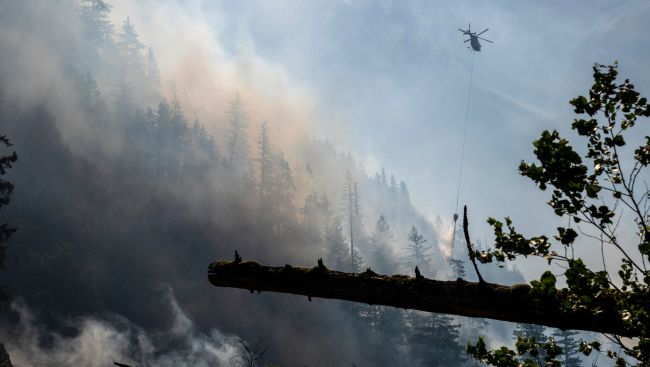
Picture Courtesy: THE CANADIAN PRESS/ Tijana Martin
MORE National ARTICLES

Trump's choice for chief trade negotiator says tariff threat is about fentanyl

Trump's choice for chief trade negotiator says tariff threat is about fentanyl
Jamieson Greer, Trump's choice for U.S. trade representative, told his Senate confirmation hearing that America doesn't want to see another fentanyl death. He said the president would be acting within his powers if he imposed steep duties on Canadian imports.

Trump's choice for chief trade negotiator says tariff threat is about fentanyl

B.C. investigates 'significant' opioid diversion, including international trafficking

B.C. investigates 'significant' opioid diversion, including international trafficking
A "significant portion" of opioids prescribed by doctors and pharmacists in British Columbia are being diverted, and prescribed alternatives are being trafficked provincially, nationally and internationally, a Ministry of Health investigative unit says.

B.C. investigates 'significant' opioid diversion, including international trafficking

MPs reject Trump's idea of clearing out Gaza as Israeli minister points to Canada

MPs reject Trump's idea of clearing out Gaza as Israeli minister points to Canada
Canadian politicians are pushing back on the idea of clearing Palestinians out of the Gaza Strip as an Israeli minister suggests some of them could be sent to Canada. The previous day, U.S. President Donald Trump stunned leaders across the Middle East and beyond when he suggested that the territory be cleared out and made into a U.S.-owned resort destination.

MPs reject Trump's idea of clearing out Gaza as Israeli minister points to Canada

Ottawa, provinces should discuss possibility of west-east oil pipeline: Wilkinson

Ottawa, provinces should discuss possibility of west-east oil pipeline: Wilkinson
Federal Energy Minister Jonathan Wilkinson says Ottawa and the provinces should discuss the possibility of an oil pipeline to Eastern Canada to improve energy security and diversify trade. Wilkinson said Thursday that United States President Donald Trump's tariff threats have exposed "vulnerabilities" in the Canadian economy, including in the energy sector. 

Ottawa, provinces should discuss possibility of west-east oil pipeline: Wilkinson

Federal government commits more than $160 million to Jasper recovery

Federal government commits more than $160 million to Jasper recovery
The fire-ravaged town of Jasper, Alta., has received two pieces of critical funding from the federal and provincial governments as it attempts to stabilize in the wake of last summer's devastating wildfire. The federal government announced on Thursday it's committing $162 million to the recovery in Jasper, Alta. — a portion of which is being dedicated to interim and long-term housing.

Federal government commits more than $160 million to Jasper recovery

Fast-track approval no guarantee of success for B.C. mines, researcher suggests

Fast-track approval no guarantee of success for B.C. mines, researcher suggests
The mining industry is applauding the British Columbia government's decision to fast-track permits for several projects amid the ongoing U.S. tariff threat, but research suggests economic factors have been behind long delays for many other proposals. Simon Fraser University associate professor Rosemary Collard says research shows that regulatory fast-tracking of mining projects is no guarantee that they will all materialize.

Fast-track approval no guarantee of success for B.C. mines, researcher suggests