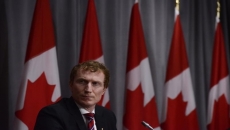
A Canadian cabinet minister was among the guests waiting in the virtual wings of a recent Zoom panel when the moderator posed one last question to the chairman of the U.S. House Intelligence Committee, promising the discussion would "move to Canada" next.
Rep. Adam Schiff couldn't resist: "We may all be moving to Canada soon," he deadpanned.
But as a resurgent COVID-19 ravages the U.S., fuelled by cavalier openings in states like Florida and Texas and a White House determined to resurrect the economy at all costs, the red-alert status spreading across the continent's lower half has more Canadians than ever ignoring America's increasingly persistent knock.
An online poll by Leger and the Association for Canadian Studies released this week found a whopping 86 per cent of respondents in Canada opposed to letting U.S. tourists north of the border, compared with 11 per cent who supported it. An Abacus Data poll out Friday found much the same thing.
And when Rep. Brian Higgins, a New York Democrat, updated his bipartisan call for a plan to reopen the border, the ensuing Twitter barrage of sarcasm, satire and outright anger belied Canada's reputation as a bastion of civility, replete with memes of building walls, slamming doors and Bugs Bunny taking a handsaw to the 49th parallel.
Higgins took it all in stride.
"I don't blame them for wanting us out of there," the congressman said Friday of the Canadian reaction.
"I have an obligation to be honest, and I have an obligation to always keep trying. And if anything, what I hope will come from all of this is an appreciation for the tale of two neighbouring countries' response to COVID-19: America's has been deplorable, and the Canadian response has been fast, strong and united."
When the outbreak first took hold in North America in March, Canada and the U.S. agreed to close their shared border to discretionary travel while allowing the movement of goods and essential workers to continue. That initial 30-day agreement has been extended three times now, and will surely be extended again before its next July 21 expiry date.
Since March, the U.S. has seen more than 3 million cases and 133,000 deaths, and the crisis is accelerating in states across the union. Florida is breaking records daily for new COVID-19 cases and deaths. In Arizona and Texas, one in four tests is coming back positive. Further north, states like Wisconsin and Michigan are seeing fresh spikes in their active caseloads. Hospitals are again rapidly nearing capacity.
In their letter last week to acting Homeland Security Secretary Chad Wolf and Canada's Public Safety Minister Bill Blair, Higgins and 27 other members of Congress, Democrat and Republican alike, urged the two countries to stop kicking the can down the road and draft a detailed plan for the gradual reopening of the border.
"The continual 30-day extensions without a plan for how restrictions will be modified prolongs uncertainty for both communities and creates unnecessary tension as we approach each new expiration," they wrote.
"We are asking that the United States and Canada immediately craft a comprehensive framework for phased reopening of the border based on objective metrics and accounting for the varied circumstances across border regions."
That doesn't mean throwing open the border to Americans, Higgins said. But it could mean redefining essential travel to include foreign property owners and people with business interests or family members on the other side, provided they wear masks and practice physical distancing.
"Never in our lifetime have we had a situation where the health of you and your family is dependent on your fellow citizens to do the right thing," he said.
"A phased opening could expand the category of 'essential traveller,' but (include) certifying some way that you are adhering to the Centers for Disease Control and Prevention's protocol as it relates to stopping the spread of COVID-19."
Ontario Premier Doug Ford, a pro-trade conservative and longtime champion of Canada-U.S. ties, has been among those urging zero tolerance at the border until the crisis in the U.S. has passed — a position spokeswoman Ivana Yelich reiterated Friday.
"The premier has been clear: the border must remain closed to non-essential travel until the U.S. has made significant progress in containing COVID-19," Yelich said. "The recent spike in the number of COVID cases in the U.S. is very concerning. As such, the premier will continue to support restrictions at the U.S. border beyond the July 21 deadline."
The worsening public health situation in the U.S. has not diminished the importance of cross-border business travel, including face-to-face meetings or technical on-site visits, to the health of Canada's economy, said Mark Agnew, director of international policy with the Canadian Chamber of Commerce.
Despite the best efforts of both countries, the current border measures have been confusing for some, causing stress and delays even for those who have work permits that allow them to cross, Agnew said.
"It would be helpful for the government to set out the circumstances under which border measures will start to normalize, to enable companies to plan."
Despite the political challenges the U.S. outbreak now poses for the federal Liberal government in Canada, it's past time to start thinking about how to ease the border restrictions, said Laurie Trautman, director of the Border Policy Research Institute at Western Washington University in Bellingham, Wash.
"There is an immediate need to be more thoughtful and strategic about how our countries go about doing that," Trautman said, floating the idea of wider family exemptions and allowing homeowners to visit their foreign properties.
In northern Washington state, law enforcement is growing concerned about the challenge of protecting vacant homes owned by Canadians, she added.
"Grandparents should be able to see their grandkids," Trautman said. "Exempting these two groups from the restrictions would not ‘open up the floodgates’ and seem reasonable and empathetic to me."