MONTREAL - Canada handled the first two years of the COVID-19 pandemic and weathered the ensuing upheaval better than several other nations with comparable health-care and economic infrastructure, a new study suggests.
The research, published in the Canadian Medical Association Journal on Monday, credits Canada's strong performance to restrictive and persistent public health measures as well as a successful vaccination campaign.
A team of Ontario researchers analyzed data from February 2020 to February 2022 in the group of industrialized countries known as the G10, which actually has 11 members. They compared Canada, Belgium, France, Germany, Italy, Japan, the Netherlands, Sweden, Switzerland, the United Kingdom and the United States — all countries with similar political, economic, and health-care systems.
"If you look at Canada compared to the G10, the differences are enormous," study co-author Dr. Fahad Razak said in a recent interview. "If you look at our vaccination rate, we had the highest in the entire G10."
After Japan, Canada had the second lowest rate of people infected and the second lowest rate of people dying, he added. The study says Japan is considered an outlier within the G10, for reasons that aren't clear.
The research suggests Canada’s cumulative per-capita rate of COVID-19 cases was 82,700 per million, while all other countries — with the exception of Japan — were above 100,000 per million.
Canada’s rate of COVID-19-related deaths was 919 per million, once again second lowest behind Japan. All other countries were over 1,000 per million.
Razak said at least 70,000 more Canadians would have died during the first two years of the pandemic if Canada had the same death rates as the United States, the country with the highest cumulative number of COVID-19-related deaths.
"That means most of us would probably personally know a grandparent, or a friend or family member ... who’s living today in Canada who would have died if we had the same trajectory as the United States," Razak said.
He said Canada's comparatively positive outcomes came about despite gaining access to vaccination later than most countries, noting there were also other health-care system structural disadvantages to overcome across the country at the outset of the pandemic.
"Some hospitals were so overwhelmed that we had to ambulance or airlift patients to other hospitals," he said.
But Canada, he said, differed from other developed countries when it opted to implement public health measures that were both strict and persistent. Though such measures drew vehement opposition in some circles, Razak said they helped mitigate the pandemic's overall impact.
"Compared to many other countries ... they would have periods with tight restrictions but quickly pull back," he said. "For Canada, it was really this high and persistent level almost entirely for the first two years."
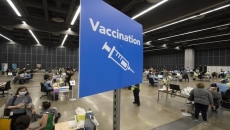
But Razak said the success of Canada's immunization drive emerged as the strongest takeaway from the research, praising officials for engaging with the population and ensuring vaccines were readily available across the country.
More than 80 per cent of eligible Canadians have been fully vaccinated with two doses as of June. The percentage of the vaccinated populations in other G10 countries is between 64 and 77 per cent, according to the study.
"There was a magic in Canada around these vaccine roll-outs during dose one and dose two," Razak said.
"When we speak to our colleagues across the world, Canada was the envy of the world in terms of our population rallying around this. It is a lesson to the world, that very high engagement can occur with the right strategy."
The study also showed the countries' response to the pandemic left an economic burden, with government debt rising for all countries and Canada registering one of the highest relative increases.
"We had these very significant economic impacts, we had very tight restrictions on our individual freedom which led to things like isolation ... but we also had really among the best results in terms of controlling the impact of the virus," Razak said.
"Was it worth it? That’s not a scientific question, that’s a values and morals and policies question."