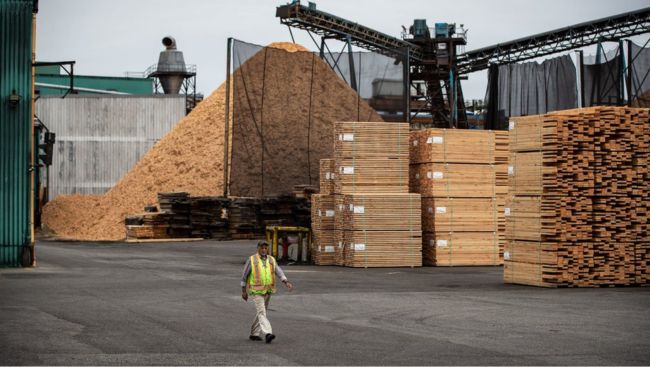
A wide shadow of uncertainty has been cast over Canada's forestry sector by U.S. President Donald Trump's decision to impose a 25-per-cent tariff on its lumber products.
Several industry groups have released statements criticizing the tariff as unnecessary and harmful for both sides, a sentiment echoed by British Columbia Premier David Eby who vows full support for the provincial sector.
Eby says the sector is already paying softwood lumber duties of 14.4 per cent when it ships to the United States, not to mention other challenges such as the pine beetle outbreak that wiped swaths of forests.
He says the additional tariff will also bring pain for U.S. consumers, since demand for homebuilding will be on the rise to replace thousands of buildings lost in the Southern California wildfires.
Forest Products Association of Canada president Derek Nighbor says in a statement that the United States can meet about 70 per cent of its homebuilding lumber needs, but that's without taking into account the rebuilding around Los Angeles and in North Carolina after hurricane Helene last year.
The BC Lumber Trade Council calls the tariff a "punitive, unjustified protectionist measure," adding in a statement that the 25 per cent charge on top of the current duties will "disrupt trade, raise costs for consumers, and threaten jobs and communities on both sides of the border."
"For Canadian producers, higher tariffs erode competitiveness and put mills under financial strain, leading to curtailments, job losses, and economic harm to forestry-dependent communities," the council statement says.
"Unjustified trade barriers weaken both economies and put workers, businesses, and consumers at risk."
The latest figures for B.C. provincial trade data on forest product exports to the United States show a value of almost $6.2 billion for the first 11 months of 2024 — about 58 per cent of total forest product exports from the province.
Forest product exports to China — including Hong Kong and Macau — are ranked second at $2.3 billion or 22 per cent of total exports, followed by Japan at $806 million or 8 per cent.
"It’s not only the close proximity that makes Canada and the U.S. great partners in forest products trade, but it’s also the unique quality of the wood and wood fibre-based products that come out of Canada’s northern, colder, longer growing cycle forests," Nighbor says in his statement.
"In the immediate, our priority is to work with the Government of Canada in support of our sector’s employees and their families and the forest-dependent communities they call home.”
The new tariff has also sparked opposition from within the United States, with National Association of Home Builders chairman Carl Harris saying in a statement that the trade barrier "will have the opposite effect" of the Trump White House's expressed goal "to lower the cost of housing and increase housing supply."
“Tariffs on lumber and other building materials increase the cost of construction and discourage new development, and consumers end up paying for the tariffs in the form of higher home prices," Harris says, adding the group is urging the Trump administration to reconsider.
Eby echoes those sentiments, noting Canadian lumber is a reliable and cost-effective way for U.S. homebuilders to supplement their construction needs even with the softwood lumber duties that had been in place before the latest tariffs announced by Trump.
"It's going to make it more expensive for L.A. to rebuild, certainly at a time of increased demand," Eby says. "But right across the United States, it's going to hurt families on both sides of the border, and it doesn't make any sense.
"This is a sector that is asking for — and is going to receive — our support in restructuring to be able to respond to this new reality, to access those new markets and to ensure sustainable forest jobs into the future."
B.C. Conservative forests critic Ward Stamer says uncertainty is pervasive across the forestry industry in the province, since no one knows for sure how the U.S. construction market will react to the tariffs.
"Is the market going to be able to respond positively and still want to continue to buy our products? Or is the market going to say, 'No, it's too expensive now,' and next thing we know we have mills closing?
"That's what's happening today, the phone has been ringing off the hook because of the uncertainty that we don't know what these effects will have on the markets," he says.