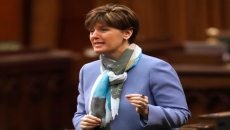
HOUSTON - Jeremy Hansen, a colonel and CF-18 pilot in the Royal Canadian Air Force, has been selected to become the first Canadian to venture further into space and orbit the moon.
Representing the @csa_asc on #Artemis II to the Moon is @Astro_Jeremy, from London, Ontario.
— NASA (@NASA) April 3, 2023
Jeremy Hansen was a fighter pilot before joining CSA, and currently works with NASA on astronaut training and mission operations. This will be Hansen’s first mission in space. pic.twitter.com/zIVetAQeFE
NASA and the Canadian Space Agency made the long-awaited announcement Monday introducing the four astronauts who will steer the next stage of an ambitious plan to establish a long-term presence on the moon.
"I am left in awe of being reminded what strong leadership, setting big goals, with a passion to collaborate and a can-do attitude can achieve, and we are going to the moon together," Hansen said after the announcement. "Let's go!"
The other three astronauts on the Artemis II mission are all American: Christina Hammock Koch, Victor Glover and G. Reid Wiseman.
"It's difficult to pick just four from a group that by its very definition attracts the best and the brightest that humanity has to offer," said Norm Knight, chief of NASA's flight director office.
Knight said the astronauts will be the "forerunners as humanity looks to find its place among the stars."
Artemis II, as it's known, is currently slated to launch as early as November 2024 and will be the first crewed mission to the moon since the final Apollo mission took flight in 1972.
The crew will orbit Earth before rocketing hundreds of thousands of kilometres for a figure-8 manoeuvre around the moon before their momentum brings them home.
Vanessa E. Wyche, director of NASA's Johnson Space Center, home base for America's astronaut corps, said this mission represents the culmination of years of hard work and dedication by NASA and its partners.
"Under Artemis, we will explore the frontiers of space and push the boundaries of what is possible," she said.
The plan is to put a man and woman on the moon in 2025 in service of the ultimate goal: eventually dispatching astronauts to Mars.
President Joe Biden articulated the vision last month in his speech to Parliament, seizing on the Artemis mission as a towering symbol of limitless potential for Canada, elbow-to-elbow with the U.S.
"We choose to return to the moon, together," Biden enthused, invoking the famous words of John F. Kennedy in 1962.
"Here on Earth, our children who watch that flight are going to learn the names of those new pioneers. They'll be the ones who carry us into the future we hope to build: the Artemis generation."
The @NASA Artemis II crewed mission around the Moon will inspire the next generation of explorers, and show every child – in America, in Canada, and across the world – that if they can dream it, they can be it. pic.twitter.com/X8q3GLTBiQ
— President Biden (@POTUS) April 3, 2023
Canada's Industry Minister François-Philippe Champagne echoed a spirit of co-operation Monday, telling the Houston audience the two countries can accomplish "big things" together.
"I know Canadians could not be more proud — proud to have for the first time a Canadian astronaut who will travel to space as part of the Artemis II mission," he said.
Canada is designing, building and operating a lunar utility vehicle to support operations on the mission.
"This is more than just about going back to the moon, this is about investing in the future," Champagne said. "This is about possibilities, this is about seizing the opportunities of the space economy from health and food security, to climate change, and much more."
Hansen, 47, from London, Ont. is one of four in Canada's current astronaut corps.
He said American leadership and Canada's "can-do attitude" are the reasons why he is going to the moon.
"It is not lost on any of us that the United States could choose to go back to the moon by themselves, but America has made a very deliberate choice over decades to curate a global team," he said.
He told the crowd gathered at the announcement thousands of Canadians have risen to the challenge of bringing value to space exploration.
"All of those have added up to this moment where a Canadian is going to the moon with our international partnership, and it is glorious," he said.
Another member of Canada's astronaut corps is David Saint-Jacques, an astrophysicist and medical doctor from Montreal and the only member of the group who's already been to space.
Saint-Jacques, 53, flew to the International Space Station in 2018. He was selected for the corps in 2009 alongside Hansen.
Joining Hansen and Saint-Jacques in 2017 were test pilot and Air Force Lt.-Col. Joshua Kutryk, 41, from Fort Saskatchewan, Alta., and Jennifer Sidey-Gibbons, 34, a mechanical engineer and Cambridge University lecturer from Calgary.
"This is a big moment for humanity," Champagne said Sunday after touring the Johnson Space Center in Houston, where he had a chance to chat with astronauts and visit Mission Control.
"This time Canada is writing history with our American friends … it's not even a new chapter. For me, it's almost like a new book in space exploration."
On the ground, Canada is engaged in a variety of cutting-edge research endeavours that will be of mutual benefit to Artemis, Champagne said.
In the "Deep Space Food Challenge," launched in 2021, participants must develop ways to produce food in the harsh environments of deep space with few resources — think Matt Damon in "The Martian" — that will one day be necessary to sustain life.
Those challenges will only become more difficult as Artemis moves into its later stages, which include a long-term presence on the moon and ultimately voyaging to Mars.
"As one scientist only recently said, 'The science of today is the economy of tomorrow,'" Champagne said. "By increasing the complexity, that's why we push the boundaries of science and innovation."
Former astronaut and now-retired Quebec MP Marc Garneau, who back in 1984 became the first Canadian to ever go to space, said Biden's speech left him with a "flashback" to another seminal moment in Canada-U.S. space relations.
Garneau's maiden Space Shuttle flight was still three weeks away when he got an invitation to go to the White House along with two of his fellow crew members to meet the U.S. president.
As it turned out, he wasn't the only Canadian meeting Ronald Reagan that day in the Oval Office. So too was Canada's newly elected prime minister, Brian Mulroney, whose friendship with Reagan has since become the stuff of bilateral lore.
"We were invited to the White House — to the Oval Office, in fact — and met with the president and the new prime minister as they met for the first time," Garneau recalled.
"That was an example of space being one of those things that exemplifies how Canada and the United States have been really, really good partners … and how close our two countries really are with respect to space, and in other ways as well."
Canada and NASA have been working together since the early 1960s and the headiest days of the U.S. space program, when Canada's first satellite was launched on a U.S. rocket, Garneau said.
The Canadarm, that iconic, Maple Leaf-emblazoned fixture of the shuttle program, would later cement Canada's status as a country the U.S. could count on.
"It's built on the fact that Canada has always been a reliable, dependable partner that has delivered what it said it would do," Garneau said.
"We have an incredibly good reputation from that point of view."