More Canadians have expressed an interest in joining the military since U.S. President Donald Trump took office on Jan. 20 — but the Canadian Armed Forces isn't attributing that spike to Trump and his talk of annexing Canada.
"In the last month we had about 1,000 more applicants than we did this time last year, but it's not attributable to any specific incident that we can track so far," said Cmdr. Pascal Belhumeur, head of the military's personnel generation group.
Belhumeur said the military won't have data to explain the spike for some time.
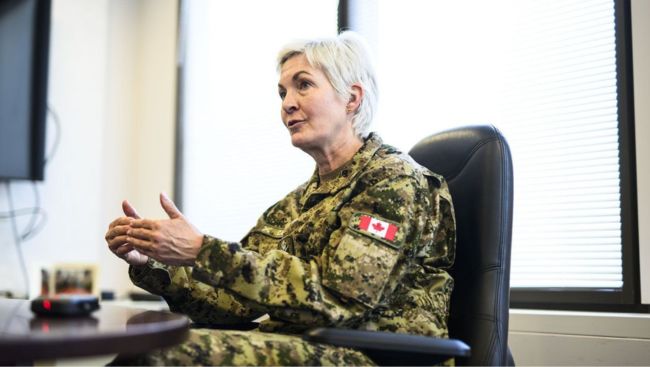
Gen. Jennie Carignan, chief of the defence staff, said the Armed Forces is on track to meet its recruitment goal of enrolling 6,496 members this fiscal year.
"Since Day 1 as chief of defence staff, I've been clear: recruitment is my No. 1 priority," she said.
The turnaround follows three years when more people left the military than signed up — a trend Defence Minister Bill Blair described as a "death spiral" last March.
While the numbers have stabilized — Carignan said there was a net gain of 1,300 members this year — the military is still short more than 13,600 troops.
"It means more than just changing how we recruit, but it also means changing who we recruit," Carignan said.
In December 2022, the federal government announced it would allow permanent residents to join the military for the first time. There was immediate interest, with more than 21,000 people applying in the first year.
In the last year, some 14,000 permanent residents expressed interest in joining the Armed Forces. About half of them completed the application process but only 455 have actually put on a uniform.
The vast majority of those — 357 — were enrolled in just the last three months.
"We made a policy change, we decided to bring in permanent residents, but we didn't put the enablers in place in order to do that," Belhumeur said.
The Armed Forces is now working with Immigration, Refugees and Citizenship Canada to share information that will help speed up security screenings, and has a new process to allow applicants without what the military calls "high-risk foreign implications" to join up under the same process used by citizens.
Another pilot project will end the blanket ban on applications from people with certain medical conditions, including asthma, anxiety, ADHD and allergies, and instead assess recruits to see whether they're "fit to the task."
"We're able to accept folks with a whole host of different conditions," said Maj.-Gen. Scott Malcolm, the military's surgeon general.
As of last December, new recruits have been starting their training under a probationary period while their security clearance processes are still underway. The decades-old aptitude test has been replaced with a new application form, and an online portal is being built to track the process.
The military's goal is to reach its approved strength of 71,500 regular forces members and 30,000 reserve members by April 2029.
Since Trump took office one month ago, he has repeatedly threatened Canada with debilitating tariffs and has taken aim at Canada's military spending.
He has long been critical of Canada's failure to meet the NATO target for alliance members' defence spending: the equivalent of at least two per cent of GDP.
"Canada's been very tough on the military, because they have a very low military cost. They think we're gonna protect them with our military, which is unfair," Trump said last week, adding, "I think Canada is going to be a very serious contender to be our 51st state."
When asked whether the military sees Trump's annexation comments as posing a security threat, Carignan said that "militarily, we're not there at all."
"The relationship with our American military colleagues is very stable and very strong," she added.
Between Trump's threats and the looming prospect of a federal election in the next two months, the issue of Canada's military spending is getting increased attention.
Prime Minister Justin Trudeau pledged last summer to reach the two per cent target by 2032. Blair more recently mused about moving that date up to 2027 but has not explained how that would happen.
Top Liberal leadership contenders have rolled out their own pledges, saying they'll boost spending by offering a significant pay raise to the troops.
Carignan said the discussion highlights why recruitment must be the top priority.
"My job is to make sure that I convert those investments into actual military capabilities," she said.