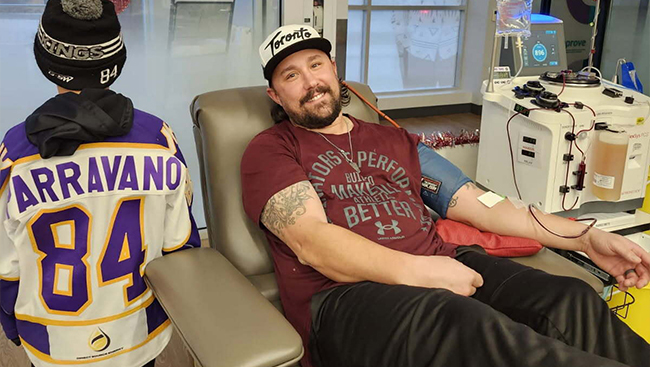
Marc Parravano has donated blood 146 times.
He remembers regularly going to the blood collection centre with his mother when he was a kid and followed in her footsteps after he turned 17 and was able to donate himself.
"I get a sense of accomplishment and reward because I'm helping others," Parravano, now 40, said in an interview.
Just as his mom did for him, he's teaching his three sons that giving blood saves lives. His 11-year-old, Christian, proudly went with him to the donation centre wearing his number 84 hockey jersey when Parravano made his 84th donation in December 2023.
Parravano, who lives in Vaughan, Ont., started out donating whole blood, which men can do every eight weeks and women can do every 12. But a couple of years ago, he switched to donating plasma, the liquid part of the blood that can be taken weekly because the red blood cells, white blood cells and platelets are returned to the body during the process. The body replaces its plasma within a few hours.
Parravano is one of only two per cent of eligible Canadians who donate blood and plasma, according to Canadian Blood Services. That's despite a recent survey suggesting 71 per cent of people agree it's "one of the most meaningful ways people can give back to their community," the agency said.
But demand for blood and plasma is quickly rising and the current base of about 420,000 "incredibly dedicated" active donors isn't going to be enough, said Dr. Graham Sher, CEO of Canadian Blood Services.
On Thursday, the agency announced that it plans to recruit one million new donors over the next five years, citing a projected 10 per cent increase in demand for blood due to a growing and aging population.
The need for plasma is even higher, with already insufficient quantities in Canada to make enough immunoglobulin drugs. In years past, the antibody therapies were used mostly in patients with some type of immune deficiency, but are increasingly being used experimentally to treat a wide range of illnesses, including cancer.
The demand for plasma is expected to grow by at least 50 per cent over the next five years, Sher said.
"We need to have enough plasma in Canada so that we can have that immunoglobulin manufactured from Canadian-collected plasma, as opposed to being very heavily reliant on an international source," he said.
"This is a lesson learned as a result of the pandemic where we really can't rely on global supply chains ... particularly for expensive and rare pharmaceuticals like immunoglobulins."
The blood services agency is using several strategies to meet its ambitious goal, Sher said, including increasing the number of collection centres in many parts of the country so they're close to as many potential donors as possible.
"One of the most important barriers to donation is time and convenience," he said.
"(People say) 'I used to donate at the end of my work shift when I worked in an office tower in downtown Toronto. I'm now a remote worker post-pandemic and you don't have a collection centre within 30 miles of my home.' So we're hearing a lot of that," Sher said.
The agency is also expanding the hours collection sites are open, including Saturdays in many locations.
Reaching out to diverse communities and building trust is also a critical part of the plan, Sher said.
Patients with some illnesses respond best to transfusions with blood that has a closely matched subtype that is inherited along ethnic and racial lines, he said.
That's the case in sickle cell disease, which is most prevalent in Black populations, Sher said.
"When we look at our donor base today, the number of African Black or Caribbean Canadians on the donor base today is significantly underrepresented compared to the percentage of the population that identifies as African Black or Caribbean," he said.
"That is one example of a population that we're wanting to target so we can have more donors come in ... that will allow us to better match our product to Canadian patients who will be from those populations or those ethnic backgrounds."
Attracting younger donors is also a significant goal, Sher said.
"We really are trying to build a new generation of donors from a young age," he said, noting that if a young person comes to donate blood three times, they will often be donors for life.
Motivating more people to give blood requires a different pitch than the agency has made in the past, he said.
"Everybody knows that giving blood can save a life ... that message has been tried and tested and used repeatedly," Sher said.
A new marketing campaign called "Who's Saving Who?" puts the focus on what donors get out of the experience of giving blood, including a sense of achievement and connection to others.
A video features actors depicting patients in graphic situations where blood or plasma transfusions are needed — including a traumatic fall, a car accident, giving birth and a child receiving cancer treatment.
Each speaks directly to the camera, telling the viewer they are giving them a chance to give.
"This campaign is really meant to jolt people out of their complacency to go from intent — (knowing) giving blood is a good thing to do — to action," Sher said.
Picture Courtesy: THE CANADIAN PRESS/HO, Gabriella Parravano