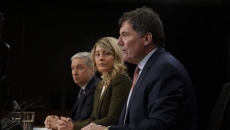
Canadian officials said a Thursday meeting with U.S. Commerce Secretary Howard Lutnick was constructive and lowered temperatures amid the ongoing trade war launched by U.S. President Donald Trump last month — but they expected no immediate changes to punishing tariffs.
"This was a constructive discussion," said Industry Minister François-Philippe Champagne in Washington. "We have our disagreements, but as long as you have dialogue you are making progress."
Trump's plans to massively realign global trade have thrown markets on both sides of the border into disarray and are forcing layoffs in some of Canada's critical industries like steel production.
Champagne was joined by Finance Minister Dominic LeBlanc, Canada's Ambassador to the U.S. Kirsten Hillman and Ontario Premier Doug Ford for the meeting at the end of another roller-coaster week in trade relations between the two countries.
On Tuesday, Trump threatened to double steel and aluminum duties on Canada in response to Ford slapping a 25 per cent surcharge on the province's electricity exports to three U.S. states. Before the end of that day, Ford backed off the surcharge and Trump backed down on doubling the steel and aluminum tariffs.
Trump went ahead Wednesday with an additional 25 per cent import tariff on all steel and aluminum imports into the U.S., including from Canada.
Canada responded with 25 per cent tariffs on another $29.8 billion worth of American goods, which took effect just after midnight Thursday. Canada last week applied 25 per cent tariffs to $30 billion in U.S. goods in response to the first round of tariffs from the U.S.
"We're like a family. Sometimes there's tension between families," Ford said Thursday in Washington at a separate news conference from the federal ministers. "But that was an extremely productive meeting."
A news release from the U.S. Department of Commerce said the Canadian and American officials discussed the Trump administration's "goal of fair trade with Canada and the province of Ontario, while working to secure America’s border and eliminate fentanyl."
"Both countries recognized the strength and history of their relationship," it said.
Jamieson Greer, Trump's recently confirmed United States trade representative, was also at the meeting.
Champagne and LeBlanc were not clear whether much will change in the relationship between the two countries after Mark Carney replaces Justin Trudeau as prime minister Friday.
Champagne said he expects Carney and Trump to have a conversation in the coming days.
Trump and Trudeau have had a difficult and often tumultuous relationship. Trump has goaded Trudeau for months about Canada becoming the 51st state, referring to him repeatedly as "Governor Trudeau."
The comments continued Wednesday as Trump met with NATO Secretary-General Mark Rutte in Washington.
"To be honest with you, Canada only works as a state," Trump sad.
Trump called the international border between the two countries an "artificial line" and said there's no chance he'll relent on tariffs.
"Now there will be a little disruption ... it won’t be very long," he said. "But they need us, and we really don’t need them … We have to do this. I’m sorry. We have to do this."
That issue was front and centre Thursday as the man set to become America's top diplomat in Ottawa took questions at his congressional confirmation hearing.
When asked about Trump's repeated annexation threats during his Senate confirmation hearing, Pete Hoekstra said that "Canada is a sovereign state."
When senators asked him whether a "joke" about annexation is ever appropriate, Hoekstra said he could not comment on the president's relationship with Trudeau.
If confirmed, the former Michigan congressman will become ambassador at a fraught time in U.S.-Canada relations.
Trump linked some tariff actions to the flow of deadly fentanyl but Canadian officials have said the president's goal is to use economic force to annex Canada.
Hoekstra told the hearing Trump has a series of priorities for Canada, which include freer trade and fighting the flow of fentanyl.
New Hampshire Sen. Jeanne Shaheen pushed back on Hoekstra, saying that the volume of fentanyl coming from Canada is minuscule and noting that Canada has one of the lowest tariff regimes.
Hoekstra later acknowledged "it's not a huge amount" of fentanyl coming from Canada.
Shaheen's state borders Canada and she said businesses there were operating according to the rules in the Canada-U.S.-Mexico Agreement, also called CUSMA, which was negotiated by Trump during his first administration.
Shaheen said she's fielded calls from business owners whose orders from Canada were cancelled as a result of Trump's tariffs and rhetoric.