Wednesday, February 11, 2026
ADVT 
National

Canadians' trust in police declining: Poll

Darpan News Desk The Canadian Press, 16 Jun, 2020 06:17 PM
  • Canadians' trust in police declining: Poll

More Canadians are questioning their trust in the police as protests against racism and police brutality sparked by the killing of George Floyd last month sweep across North America, a new poll suggests.

While the majority of Canadians remain largely trusting of their law-enforcement agencies, the Leger and Association for Canadian Studies survey shows a noticeable drop in the number who said they trusted the police somewhat or a lot in recent months.

Seventy per cent of survey respondents over the weekend indicated they trusted the police a lot or somewhat — a decline of nine percentage points from May and 11 points from April.

The decline coincides with the May 25 killing of Floyd, a Black man, by white police officers in Minneapolis, which was captured on video and has since sparked anti-racism protests in the U.S. and Canada as well as calls for changes to police conduct.

"It does signal that a percentage of Canadians are asking themselves questions about how police forces are doing their work," Leger executive vice-president Christian Bourque said of the survey results.

On that score, the poll found that 90 per cent of respondents were in favour of police wearing body cameras while 87 per cent supported providing more hours of training for officers on relations with visible minorities.

RCMP Commissioner Brenda Lucki said last week that she had agreed to equip some Mounties with body cameras and calls have been growing for other police forces to follow suit to increase transparency and curb police brutality in Canada.

Yet only 52 per cent of respondents supported the idea of prioritizing the hiring of visible minorities by police services while 32 per cent were in favour of taking firearms away from officers patrolling urban centres on foot.

Bourque could not immediately explain why respondents were lukewarm to putting a premium on hiring more visible minorities, and said that there is also limited support for disarming police in the same way as countries such as Britain have done.

"Anything that has to do with disarming police officers, Canadians do not seem to see that from a very positive perspective."

The online poll was conducted June 12 to 14 and surveyed 1,527 adult Canadians. It cannot be assigned a margin of error because internet-based polls are not considered random samples.

The poll also found the majority of Canadians support extending the Canada Emergency Response Benefit, the $2,000-a-month payment the federal government established to help those whose livelihoods have been affected by the COVID-19 pandemic.

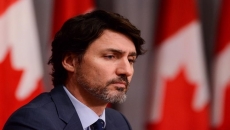
The CERB was set to expire in mid-July, though Prime Minister Justin Trudeau announced on Monday that the federal government is working on an extension as many Canadians continue to struggle to make ends meet because of the pandemic.

Eighty-one per cent of respondents said they supported the CERB, which was largely unchanged from last month.

As for what happens to it from here, 38 per cent wanted it maintained in its current form and 25 per cent wanted it maintained but with a reduced amount for recipients.

Only 21 per cent said they wanted it ended entirely. The remaining 16 per cent said they did not know or preferred not to answer.

"There's still broad support for it everywhere," Bourque said. "So even though we've heard debate about whether we should stop it, should we keep it ... if you were the federal government, you would think people want them to keep the CERB for longer."
MORE National ARTICLES

C.D. Howe's Business Cycle Council says Canada has entered a recession

C.D. Howe's Business Cycle Council says Canada has entered a recession
Canada has officially entered a recession due to the economic devastation caused by the COVID-19 pandemic, the C.D. Howe Institute's Business Cycle Council declared Friday.

C.D. Howe's Business Cycle Council says Canada has entered a recession

Tiff Macklem new Bank of Canada governor

Tiff Macklem new Bank of Canada governor
Tiff Macklem, a former second-in-command at the Bank of Canada, is returning to the central bank to take over the top job at a moment that he says cries out for bold, unprecedented responses to the economic crisis fuelled by COVID-19. 

Tiff Macklem new Bank of Canada governor

Trudeau announces ban on 1,500 types of 'military-style' guns

Trudeau announces ban on 1,500 types of 'military-style' guns
Prime Minister Justin Trudeau says the federal government is banning a range of assault-style guns, with an order that takes effect immediately. The cabinet order he described in a Friday-morning announcement doesn't forbid owning any of 1,500 "military-style" weapons and their variants but it does forbid them to be used and halts the trade in them

Trudeau announces ban on 1,500 types of 'military-style' guns

COVID in all regions of Canada as Nunavut sees 1st case

COVID in all regions of Canada as Nunavut sees 1st case
COVID-19 has now spread to every region in Canada, with Nunavut reporting its first case on Thursday, as Ontario reported its largest one-day climb in fatalities and the country's budget officer predicted a staggering $252-billion deficit. The case in northern Nunavut was identified in the 1,600-strong largely Inuit community of Pond Inlet on Baffin Island. The territory's chief public health officer, Dr. Michael Patterson, said a rapid response team was on its way to the community to help manage the situation.

COVID in all regions of Canada as Nunavut sees 1st case

Military identifies service members missing in deadly helicopter crash

Military identifies service members missing in deadly helicopter crash
The Canadian military is deploying a flight investigation team to look into the causes of a helicopter crash off the coast of Greece that has claimed the life of at least one service member and left five others missing. Prime Minister Justin Trudeau confirmed during a news conference that six people were aboard the Cyclone helicopter that went down in the Ionian Sea on Wednesday as the aircraft was returning to the Halifax-based frigate HMCS Fredericton from a NATO training mission.

Military identifies service members missing in deadly helicopter crash

Budget officer says federal deficit could top $252 billion

Budget officer says federal deficit could top $252 billion
Parliament's budget watchdog says that it's likely the federal deficit for the year will hit $252.1 billion as a result of the COVID-19 pandemic, and could go even higher if emergency measures remain in place longer than planned. The figure is an estimate based on the almost $146 billion in spending measures the government has announced to help cushion the economic blow from the pandemic, estimated declines in the country's gross domestic product, and the price of oil remaining well below previous expectations.

Budget officer says federal deficit could top $252 billion