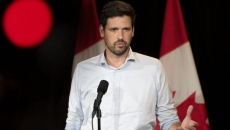
As the debate rages on about how to tackle rapidly rising housing costs, Bank of Canada governor Tiff Macklem says the newly announced cap on international student enrolments should help ease rent price inflation.
"You saw this week the government capping student visas," Macklem said in an interview with The Canadian Press.
"That, I think, will help take a bit of pressure off rents going forward."
The federal government announced a two-year limit on new study permits to get a handle on a soaring international student program.
Immigration Minister Marc Miller said at a cabinet retreat in Montreal on Monday that the number of new visas handed out this year will be capped at 364,000, a 35 per cent decrease from the nearly 560,000 issued last year. The number for 2025 will be set after an assessment of the situation later this year.
The decision was prompted in part due to the strain strong population growth is putting on the housing market.
Many economists agree that capping the number of new study permits issued may help moderate rent price inflation, however the degree to which it could ease rental prices is unclear.
"While I could see the growth rate and rent cooling off a little bit, I sincerely doubt that rents are going to go in the opposite direction," said Douglas Porter, chief economist at Bank of Montreal.
"So bottom line is, I believe, we're still going to be dealing with some pretty serious rent inflation in the next couple of years."
The Bank of Canada has made significant progress in its fight against inflation that began in March 2022 when it started raising its key interest rate target. Prices are growing at a slower pace across the economy and fewer goods and services are seeing abnormally large price increases.
Though there have been bumps on the path back to the bank’s two per cent target, Canada's inflation rate has become much more manageable, sitting at 3.4 per cent in December.
However, the Bank of Canada faces a thorny problem: shelter costs are rising quickly and interest rate hikes can do little about it.
Porter says that during normal times, the Bank of Canada may have been able to ignore a sharp rise in shelter costs.
But after two years of above-target inflation, he says the central bank can't afford to let inflation stay elevated for much longer because it risks feeding into higher inflation expectations.
"We are in this tough situation where, yes ... inflation (other than for) shelter basically has to be below target for a while here for the bank to come close to hitting its target," Porter said.
On Wednesday, the Bank of Canada announced its decision to hold its key interest rate at five per cent once more and signalled it has begun discussing the timeline for rate cuts.
But the central bank emphasized the role housing and food prices are playing in holding up inflation, noting shelter costs are now the primary driver of above-target inflation.
"We do expect to see some continued deceleration in food prices," Macklem said in the interview Wednesday. "Housing, I will admit, is tougher to predict."
In December, shelter costs, which take into account home ownership and rental costs, were six per cent higher than a year ago, significantly outpacing overall inflation.
Data from Rentals.ca and market research firm Urbanation showed the average asking rent for December in Canada jumped 8.6 per cent year-over-year to a record high of $2,178 per month.
When asked how the central bank envisions getting back to two per cent inflation if shelter prices continue soaring, the governor said slower price growth in other parts of the economy would need to offset housing cost increases.
"You do need to see some further deceleration in some of the other components (of inflation)," he said.
Royce Mendes, a managing director and head of macro strategy at Desjardins, says the Bank of Canada should be patient and allow for shelter price inflation to ease over time.
"The governor should be careful about reading too much into shelter price inflation when it comes to determining the future path of monetary policy," he said.
Being too aggressive and keeping interest rates high for too long time would cause significant economic pain, he said.
"If the bank wants to get total inflation down to two per cent in the near term, they're going to have to crush the economy to get all of that other inflation down to virtually zero," Mendes warned.
Housing affordability has been a major issue in Canada post-pandemic for a host of reasons, including strong population growth that's exacerbated a pre-existing housing shortage.
Mike Moffatt, a housing expert and economics professor at Western University, said the crush of international students coming to Canada has put stress on the housing market.
The increase in temporary residents means thousands more people are competing for lower-cost rentals and investors are buying up properties to convert into student housing, he said.
"It's good to see the federal government start to bring some rationality back to the number of international students," Moffatt said.
"We need to bend the curve and allow the housing market to catch up to our population growth."
The Bank of Canada's policy decisions however have also contributed to shelter price inflation by raising mortgage interest costs for homeowners. Meanwhile, housing developers are less inclined to build when financing is expensive, leading to more strain on housing supply.
At best, Mendes said that the effect of monetary policy on housing costs is "ambiguous."
"At worst, the Bank of Canada's elevated interest rate policy is actually fuelling some of that shelter inflation," he said.
The Bank of Canada has been more vocal over the last few months about its limited ability to control soaring housing costs.
It has noted that strong population growth has blunted the effect of higher interest rates on other components of shelter, such as home prices, and pointed to a lack of housing supply.
Rents have also skyrocketed as more newcomers enter the country and look for a place to live.
"We've had a long-standing structural supply issue on housing in Canada," Macklem said. "With the rapid rise in immigration recently, that has exacerbated that problem."
The governor didn't have an answer when it comes to the net effect of population growth on inflation and thereby the central bank's monetary policy decisions. Instead, he noted that population growth fuelled inflation through housing, but helped alleviate price pressures by easing labour shortages.
Both Mendes and Porter estimate that the recent population growth has contributed to the run-up in inflation.
"I think the net impact of population growth on inflation has been positive. But that's due to the fact that it's exacerbated existing, longer term structural supply constraints in the housing market," Mendes said.
In the long run, Porter said the effect of population growth on inflation could be neutral.
Although Canada's housing challenges are expected to persist in the short run, Macklem expressed some optimism that recent government announcements regarding housing — including making more land available and reducing red tape — will help narrow that gap between supply and demand over time.