Sunday, December 21, 2025
ADVT 
National

Carbon pricing rebates land in bank accounts as Liberals defend embattled policy

Darpan News Desk The Canadian Press, 15 Oct, 2024 10:20 AM
  • Carbon pricing rebates land in bank accounts as Liberals defend embattled policy

Canadians are set to receive carbon pricing rebates Tuesday, as the Liberals defend one of their most embattled policies.

The government says this is the first time all banks will label the payment as the Canada Carbon Rebate, after years of inconsistent and vague phrasing on bank statements.

The quarterly rebate will go to Canadians who filed their income tax while living in Alberta, Saskatchewan, Manitoba, Ontario, and all four Atlantic provinces.

The payments vary by household size and province, while those in rural areas get a top-up.

On Tuesday, rural residents will get a boost in their quarterly rebate, with a 20-per-cent top-up along with a retroactive 10-per-cent payment for April and July.

Economists are widely in favour of carbon pricing, arguing it is the most cost-effective way to reduce emissions, but the Liberals' policy is facing pushback at the provincial and federal levels, with the Conservatives calling for a "carbon-tax election" to bring down the cost of living.

The federal NDP and some of their provincial counterparts have distanced themselves from the policy which they previously supported.

Ottawa sends the rebates to offset what people pay in carbon pricing when they buy fuel so they're not less worse off as a result.

People who do things to lower their fuel use are even better off, because they still get the same rebate but pay less in carbon pricing.

British Columbia, Quebec and Northwest Territories have their own carbon pricing system for consumers so residents there don't receive the federal payment. Yukon and Nunavut use the federal system but have an agreement to distribute the proceeds themselves.

The parliamentary budget officer says most Canadians get back more from the rebates than they pay. 

He also says, though, that the economic impact of carbon pricing could lower wages over time, erasing that benefit for some Canadians. The government argues that climate change itself can cause economic harm if it is left unchecked.

Ottawa has been battling with banks about how the deposits are labelled since they moved to quarterly payments for the rebates in 2022.

Many Canadians were confused — or didn't even realize they were getting a rebate — when payments showed up with vague labels like "EFT deposit from Canada," "EFT Credit Canada" or just "federal payment."

Some banks previously argued the term "Canada Carbon Rebate" went beyond their 15-character limit on deposit descriptions.


MORE National ARTICLES

Canada to hit China with tariffs on electric vehicles, aluminum, steel

Canada to hit China with tariffs on electric vehicles, aluminum, steel
Canada is moving to match the United States with new tariffs on electric vehicles made in China in a bid to keep the cars from getting a significant foothold in the North American market. Prime Minister Justin Trudeau outlined the plan at the federal cabinet retreat in Halifax on Monday, promising to increase import taxes on Chinese-made EVs to 106.1 per cent on Oct. 1, up from 6.1 per cent.

Canada to hit China with tariffs on electric vehicles, aluminum, steel

Canada to restrict low-wage foreign workers, consider lower immigration targets

Canada to restrict low-wage foreign workers, consider lower immigration targets
Prime Minister Justin Trudeau is urging businesses to hire Canadians as his government announces new restrictions to limit the number of low-wage temporary foreign workers in the country. Ottawa is also considering whether to reduce its annual targets for permanent residency — a potentially major shift on immigration policy for the Liberals.

Canada to restrict low-wage foreign workers, consider lower immigration targets

Canada's two major railways resume service as railroaders return to work

Canada's two major railways resume service as railroaders return to work
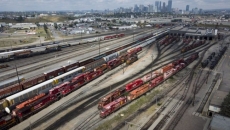
Trains began to trundle along the tracks of Canada's two major railways on Monday after the federal labour board ended a four-day work stoppage that snarled supply chains and upended commutes. Amid a bitter labour dispute, the Canada Industrial Relations Board on Saturday ordered Canadian National Railway Co. and Canadian Pacific Kansas City Ltd. to resume operations and 9,300 workers to return to their posts at 12:01 a.m. ahead of binding arbitration set to begin this week.

Canada's two major railways resume service as railroaders return to work

Strike threat looms in HandyDART dispute as union vote suspends job action

Strike threat looms in HandyDART dispute as union vote suspends job action
Potential disruption to British Columbia's HandyDART transit service this morning was averted after workers suspended job action to vote on a final contract offer, but strike action remains a possibility. Amalgamated Transit Union Local 1724 says it will give a 72-hour strike notice if the membership votes down the latest offer by Transdev Canada.

Strike threat looms in HandyDART dispute as union vote suspends job action

Crews face tree danger from high winds as B.C. wildfires abate due to precipitation

Crews face tree danger from high winds as B.C. wildfires abate due to precipitation
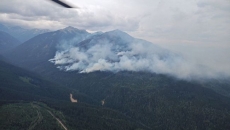
Heavy rain in parts of British Columbia over the weekend has lowered wildfire activity in the southern part of the province, but firefighters say strong winds are creating some tree hazards for crews. The BC Wildfire Service says in its latest update that the number of active blazes in the province has fallen to around 311, continuing a downward trend from Friday when there were about 340 fires burning.

Crews face tree danger from high winds as B.C. wildfires abate due to precipitation

B.C. caps rent increases next year at 3 per cent, matching inflation

B.C. caps rent increases next year at 3 per cent, matching inflation
The maximum allowable rent increase in British Columbia next year will be 3 per cent, down from the current 3.5 per cent. The Housing Ministry says the new amount, taking effect on Jan. 1, is tied to inflation, and comes after increases were kept "well below inflation" in 2023 and 2024.

B.C. caps rent increases next year at 3 per cent, matching inflation