

Prime Minister Mark Carney says he is "concerned" about U.S. "escalation" on its push to buy Greenland after it threatened to impose tariffs on eight European nations opposed to the U.S. plan for the self-governing Danish territory.
U.S. President Donald Trump said Denmark, Norway, Sweden, France, Germany, the United Kingdom, the Netherlands and Finland will face a 10 per cent tariff starting Feb. 1.
Trump said that tariff will climb to 25 per cent on June 1 if no deal is in place for “the complete and total purchase of Greenland” by the United States.
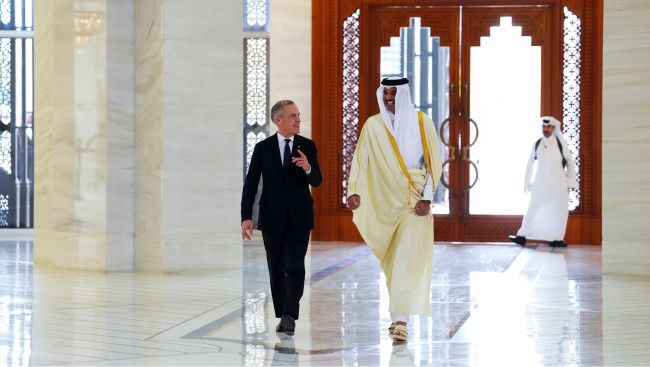
"It's a serious situation, and we're concerned. We're concerned about this escalation, to be absolutely clear," Carney said at a news conference in Doha when asked about Greenland. "We always will support sovereignty and territorial integrity of countries wherever their geographic location is."
Carney added that Canada's position remains unchanged: the future of Greenland should be determined by its people and Denmark.
The prime minister said Greenland is protected through NATO and Canada is committed to working with alliance partners to increase Arctic defence capabilities.
"I had conversations with the NATO secretary-general in Paris 10 days ago... about how we're going to further enhance that security umbrella. It's something that Canada is working on already," Carney said.
Mark Rutte, NATO secretary-general, said that he spoke with Trump Sunday in a post on social media platform X.
"Spoke with (Trump) regarding the security situation in Greenland and the Arctic. We will continue working on this, and I look forward to seeing him in Davos later this week," Rutte said.
Denmark's Foreign Affairs Ministry issued a joint statement with the other nations being threatened with American tariffs Sunday, saying they stand together in solidarity.
"Tariff threats undermine transatlantic relations and risk a dangerous downward spiral," the statement says. "We will continue to stand united and coordinated in our response. We are committed to upholding our sovereignty."
Canada's latest defence policy warns of Chinese and Russian ambitions in the Arctic and says China's interests "increasingly diverge from our own on matters of defence and security."
That policy was released in May 2024, before Carney came to office and began a major reset of relations with China.
Carney said Friday that he found "much alignment" with Chinese President Xi Jinping on Canadian and Greenlandic Arctic sovereignty.
He told reporters Friday that his government has increased Canada's military presence in the Arctic "to 365 days a year on land, sea, and in the air."
Carney says that he will share his position on Greenland with Trump if he sees the president in Davos, Switzerland, at the World Economic Forum this week.
Trump insists the U.S. needs control of Greenland for national security reasons and has said he would take it over "whether they like it or not."
Steve Bannon, former Trump chief strategist, said on his program "Bannon's War Room" Saturday that Canada is "rapidly changing" and becoming "hostile" to the U.S.
"Canada is in the vital national security interest of the United States," Bannon said.
"This is inextricably linked to Hemispheric defence. Hemispheric defence for the United States starts in Canada."
Picture Courtesy: THE CANADIAN PRESS/Sean Kilpatrick


