
Tuesday, March 10, 2026
ADVT 
National

Carney defends paying 2 CEO appointees upwards of $577,000 a year

Darpan News Desk The Canadian Press, 10 Oct, 2025 10:25 AM
  • Carney defends paying 2 CEO appointees upwards of $577,000 a year

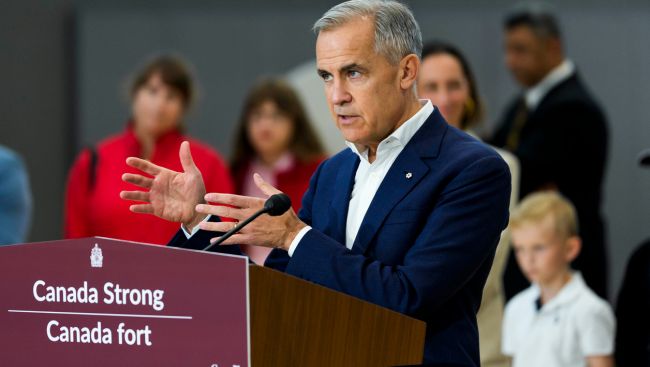
Prime Minister Mark Carney is defending his decision to pay the CEOs of two new government offices annual salaries that are higher than those of his own cabinet ministers.

Douglas Guzman, the head of a new defence procurement office, and Dawn Farrell, the head of the new Major Projects Office, will each make more than $577,000 a year — not counting performance pay.

Carney says their responsibilities are enormous and include things like making major military procurement decisions and reviewing industrial development projects worth "tens and tens of billions of dollars of economic activity."

In a social media post this week, Conservative Leader Pierre Poilievre criticized Carney's appointment of Guzman, who formerly worked in senior positions at the Royal Bank of Canada and Goldman Sachs.

Poilievre said Carney is expanding the bureaucracy and giving new appointees "massive taxpayer-funded paycheques."

But Carney said he needs the best people to deliver on important mandates, adding he believes their pay in the private sector was "substantially higher."

Picture Courtesy: THE CANADIAN PRESS/Justin Tang

MORE National ARTICLES

Weak loonie signals economy is 'in trouble': currency expert

Weak loonie signals economy is 'in trouble': currency expert
The Bank of Canada's end-of-day exchange rate Monday had the loonie trading at 68.48 cents US, but the Canadian dollar neared 70 cents in the minutes after Prime Minister Justin Trudeau said the planned tariffs would be paused for at least 30 days. The overall trend for the Canadian dollar however has been weak, which has implications for the economy. 

Weak loonie signals economy is 'in trouble': currency expert

Interprovincial trade barriers: what they are, why they exist and how to cut them

Interprovincial trade barriers: what they are, why they exist and how to cut them
The Trump administration's on-again, off-again threat to impose damaging tariffs has boosted an old idea for driving economic growth in Canada: eliminating interprovincial trade barriers. Here's a look at how interprovincial trade barriers work and why years of efforts to tear them down them have largely failed.

Interprovincial trade barriers: what they are, why they exist and how to cut them

Trudeau says U.S. tariffs on Canada will be paused for 30 days

Trudeau says U.S. tariffs on Canada will be paused for 30 days
Prime Minister Justin Trudeau says "proposed tariffs" between Canada and the United States will be paused for at least 30 days while the countries work together on the border.

Trudeau says U.S. tariffs on Canada will be paused for 30 days

Canada's forestry sector faces uncertainty with 25 per cent U.S. tariffs

Canada's forestry sector faces uncertainty with 25 per cent U.S. tariffs
A wide shadow of uncertainty has been cast over Canada's forestry sector by U.S. President Donald Trump's decision to impose a 25-per-cent tariff on its lumber products. Several industry groups have released statements criticizing the tariff as unnecessary and harmful for both sides, a sentiment echoed by British Columbia Premier David Eby who vows full support for the provincial sector.

Canada's forestry sector faces uncertainty with 25 per cent U.S. tariffs

Trump mistaken, U.S. banks can and do operate in Canada says finance professor

Trump mistaken, U.S. banks can and do operate in Canada says finance professor
A finance professor at the University of Toronto says American banks do operate in Canada despite assertions by U.S. President Donald Trump that they are not allowed to do business in the country. The Office of the Superintendent of Financial Institutions lists Amex Bank of Canada, Citibank Canada and J.P. Morgan Bank Canada on Schedule II, all having U.S. parent companies. 

Trump mistaken, U.S. banks can and do operate in Canada says finance professor

B.C. critical minerals being diverted away from United States: David Eby

B.C. critical minerals being diverted away from United States: David Eby
Companies in British Columbia are in the process of redirecting critical minerals and energy products to markets outside the United States, Premier David Eby said, as the reality of U.S. President Donald Trump's tariffs sets in. Eby noted B.C. has opened new trade offices in Taiwan, Vietnam and the Philippines over the last 18 months.

B.C. critical minerals being diverted away from United States: David Eby