

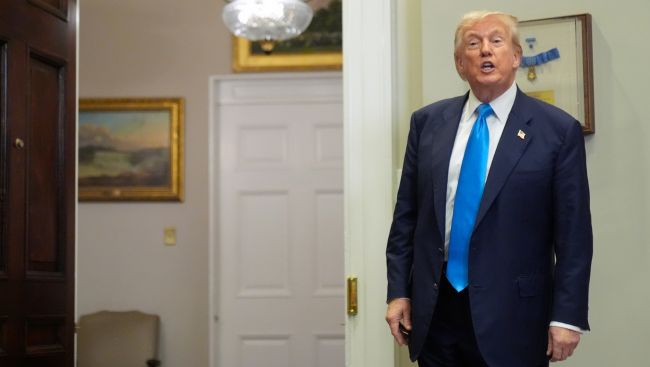
Prime Minister Mark Carney said Friday his government is disappointed that U.S. President Donald Trump followed through on his threat to increase tariffs to 35 per cent if Ottawa didn't make a trade deal.
"While we will continue to negotiate with the United States on our trading relationship, the Canadian government is laser focused on what we can control: building Canada strong," Carney said in a media statement released just after midnight.
The White House has said the tariffs will not affect goods compliant with the Canada-U.S.-Mexico Agreement on trade, commonly known as CUSMA.
Earlier in the week, Carney had been tempering expectations of an agreement materializing by Friday, saying Ottawa will only agree to a deal "if there's one on the table that is in the best interests of Canadians."
Carney has described the trade talks as complex, comprehensive and constructive.
Trump, meanwhile, has complained repeatedly about America's northern neighbour. When asked about the holdup in Canadian negotiations on Thursday, Trump said "they have to pay a fair rate."
Trump signed an executive order Thursday night to hit Canada with the increased duties. A fact sheet from the White House rationalized the rate change by saying Canada "failed to cooperate in curbing the ongoing flood of fentanyl" and citing Ottawa's implementation of retaliatory tariffs.
Carney said that "Canada accounts for only one per cent of U.S. fentanyl imports and has been working intensively to further reduce these volumes."
Trump's 50 per cent tariffs on semi-finished copper also came into effect just after midnight, but the latest duty exempts the raw input material. Canada is also being slammed by Trump's tariffs on steel, aluminum and automobiles.
Canadian officials have been pushing to have those sectoral duties dropped in any agreement, and U.S. Treasury Secretary Scott Bessent suggested Thursday that there's negotiating room on aluminum tariffs.
Bessent told CNBC that Ford trucks use a lot of aluminum and "we will be negotiating with Canada on those."
In a separate executive order Thursday, Trump increased his so-called "Liberation Day" tariffs on many other nations; those duties are to be implemented in seven days.
Markets were in turmoil again Friday morning due to uncertainty over the president's latest tariff moves and a report on U.S. job growth that was sharply lower than expected.
Reaction to the tariffs in Canada was swift. Canadian Chamber of Commerce president and CEO Candace Laing said in a media statement that the White House's fact sheet on fentanyl was "fact-less."
Lana Layne, president of the Unifor private sector union, said the tariffs are "an extortion game that's being played by the president of the United States."
Conservative Leader Pierre Poilievre said his party is holding out hope for a deal that will end all U.S. tariffs on Canada, including Trump's sectoral duties on specific industries.
"That is the deal Canada had before and the Prime Minister should accept nothing short of that," Poilievre said in a post on social media.
Ontario Premier Doug Ford said "Canada shouldn’t settle for anything less than the right deal."
About 80 to 90 per cent of Canadian goods might be able to avoid Trump's higher tariffs because they comply with CUSMA's rules of origin, said Michael Dobner, the national leader of economics and policy practice at PricewaterhouseCoopers Canada.
That doesn't mean all of those exporters have filed the necessary paperwork to avoid the duties, he added. It's not clear exactly how much of what Canada exports to the United States now is CUSMA-compliant.
While no industry can be singled out as the one most at risk, Dobner said, any business that must use many parts sourced outside North America is in jeopardy of increased duties.
Canadian Federation of Independent Business president and CEO Dan Kelly said many small- and medium-sized businesses are worried about facing the brunt of the duties.
They may not have the financial flexibility to change their inputs to North American products easily, or have the capacity to quickly get the paperwork to show CUSMA compliance.
The federation's data shows that, so far, most small businesses are absorbing some or all of the costs associated with Trump's tariffs, under the assumption that Canada will find some sort of solution.
"Is 35 per cent going to be the straw that breaks the camel's back?" Kelly said.
Kelly said if Canada remains in "no man's land," Ottawa should release funds collected by retaliatory tariffs to help struggling businesses.
Both Kelly and Dobner said that while the increase in tariffs will be terrible for some businesses, the larger concern for all industries is the ongoing uncertainty that has put a chill on investment.
"Generally speaking, even without that increase, there has been a bit of a freeze in investment in Canada," Dobner said.
Picture Courtesy: AP Photo/Mark Schiefelbein


