

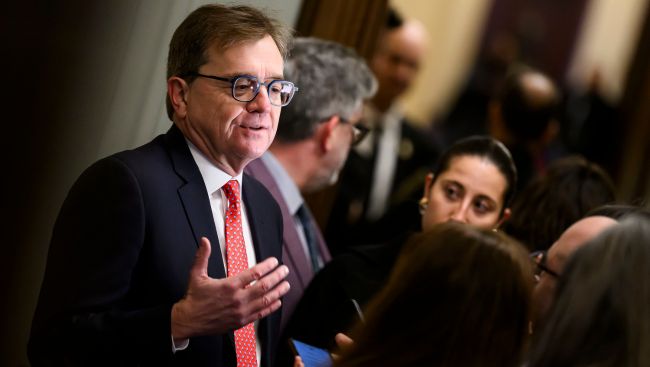
Prime Minister Mark Carney has chosen MP and former cabinet minister Jonathan Wilkinson to serve as Canada's next ambassador to the European Union.
Wilkinson previously held cabinet positions under former prime minister Justin Trudeau, including natural resources minister and environment minister.
The appointment reverses the past practice of having a political appointee serve as a special envoy while naming a seasoned diplomat to oversee Canada's mission in Brussels.
The Prime Minister's Office said in a news release Thursday that the MP for North Vancouver—Capilano has the "proven experience, judgment and leadership" needed to advance Canada's partnership with the EU.
In an open letter to his constituents Thursday morning, Wilkinson said he will be vacating his seat "in the coming months."
The former cabinet minister wrote that the world has changed dramatically since he was first elected in 2015 and he believes this new role is the best way he can contribute to Canada's long-term interests.
"The European Union is one of Canada's most important partners on trade, climate, security and the defence of democracy. In Brussels, I will work to ensure that this partnership delivers real benefits for Canadians," Wilkinson wrote.
Wilkinson said he will continue to serve as MP until he is fully in his new role. The news release says Wilkinson will become ambassador at the beginning of summer.
Carney also thanked Stéphane Dion for his work as Canada's special envoy to the EU and Europe. Dion, also a former cabinet minister, was a political appointment.
Canada's ambassador to the EU oversees technical files such as efforts to shape Europe's environmental regulations on timber imports and to share perspectives on digital regulation and taxation.
While the role has been vacant since September, Carney appointed last October a "personal representative" to the EU to oversee trade and defence ties — particularly a security partnership signed last summer allowing Canadian defence firms to partner with European companies on projects eligible for EU loans.
That personal envoy role is staffed by John Hannaford, a former diplomat who also served as the highest-ranking official in the public service.
Carney has made the economy his primary focus in foreign policy. Neither Wilkinson nor Hannaford has been tasked specifically with advancing human rights and democracy in Europe's periphery, including Armenia — something which had been part of Dion's brief.
Thursday's announcement comes as Carney prepares to become the first non-European leader to take part in the European Political Community Summit when he heads to Armenia this weekend.
The appointment of Wilkinson will trigger a byelection in his Vancouver-area riding when he steps down to take the ambassadorial post.
Wilkinson's first professional exposure to politics was in his home province of Saskatchewan in the early 1990s, when he served as an adviser to former NDP premier Roy Romanow.
After leaving Saskatchewan politics in the mid-1990s, Wilkinson spent the subsequent 20 years in leadership roles at a number of private sector green technology companies.
Wilkinson returned to politics in 2015, winning the North Vancouver—Capilano riding for the Liberals in an election that saw Trudeau lead the party from third-party status to a majority government.
He was first appointed to cabinet in July 2018, in the fisheries, oceans and Canadian Coast Guard portfolio.
He became the environment and climate change minister just over a year later, taking over from Catherine McKenna as Saskatchewan and Alberta were challenging the constitutionality of the federal minimum carbon price in court.
His appointment was seen as an overture to the Prairie provinces at a time when their relations with the federal government were strained due to environmental policy. The Liberals were shut out of Saskatchewan and Alberta in the 2019 election.
Carbon pricing ultimately made its way to the Supreme Court of Canada, which affirmed the federal government's ability to set a minimum pollution price in March 2021.
Despite that ruling, growing opposition to the federal carbon price contributed to Trudeau's government losing public support, which led to his resignation last year.
Carney ended consumer carbon pricing shortly after appointing his first cabinet, which included Wilkinson as natural resource minister.
Before Carney ended the politically unpopular carbon price, Wilkinson had defended the policy by saying it gives Canada an affordable means of addressing climate change.
Picture Courtesy: THE CANADIAN PRESS/Justin Tang


