Canada will do what it can to help implement the peace deal between the United States and Iran, including possibly helping as a third-party moderator overseeing how funds are used to end the war Washington started alongside Israel.
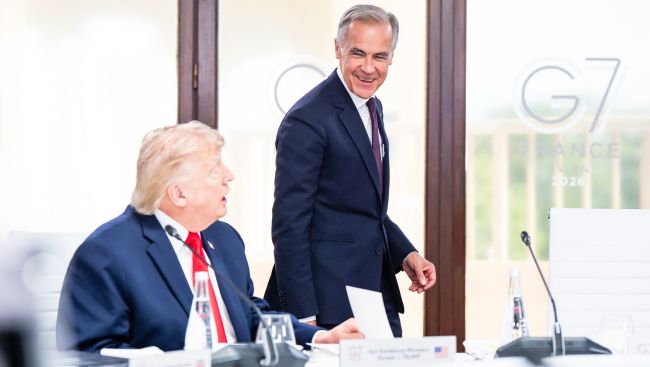
"Canada is of course willing to help, if that's appropriate," Prime Minister Mark Carney told reporters Wednesday as the G7 summit in France came to a close.
Carney also repeated his praise for the preliminary agreement. "It creates a possibility of a game changer," he said.
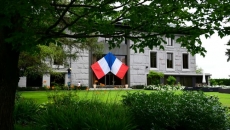
The U.S. war with Iran was a chief topic of conversation at the G7 summit hosted by French President Emmanuel Macron in the picturesque resort town of Évian-les-Bains in the French Alps.
During the summit, Carney did not have a formal bilateral meeting with U.S. President Donald Trump, but Carney said he had at least "seven or eight" informal discussions with him, including lighter topics, such as Trump's recent 80th birthday, and heavier ones, such as Iran, Ukraine, artificial intelligence and trade.
He said there was nothing to be read into the fact he didn't have an official sit down with Trump, noting Trump only had scheduled meetings with Macron and Indian Prime Minister Narendra Modi.
In a Tuesday interview with CNN, Carney said he had seen the preliminary agreement between the U.S. and Iran and it "exceeded" his expectations and should prevent Iran from obtaining a nuclear weapon.
He said Canada will do what it can to help put the deal in place.
"The very fact of it, and the fact that so many countries were involved in its development and are vested in its development, does create positive knock-on effects," he said.
The deal also references the possibility of Iran receiving at least $300 billion to rebuild after the war, funds that may be contingent on Iran meeting certain requirements. Carney said Canada isn't offering to contribute financially but can play a role.
"What you need in any of these accords is you need people to help implement them, third parties to help them implement them," he said. "Moderators overseeing, if you have money that's linked to, which is the case with this deal, which has conditions and linked to the fulfillment of those conditions and being managed, sometimes you have third countries do that. Canada is of course willing to help if that's appropriate."
The G7 concluded on Wednesday with agreements that took aim at Chinese economic practices without calling out Beijing by name. In statements, the leaders urged an end to excessive subsidies and the use of access to critical minerals as a tool of coercion.
The summit was delayed by a day after Trump announced that the White House would host a UFC fight on June 14, which is Flag Day in the United States and also Trump's 80th birthday.
"I'm the boss," Trump told his fellow G7 leaders ahead of taking his seat at a session on economic growth.
Carney later told reporters they had a follow-up conversation about the subject.
"We are only interested in Chinese investment in Canada when it's material Canadian production," he said. "We're not interested in kits being put together in Canada.
"We will only do what's in the interest of Canadian consumers (and) Canadian workers."
Fen Osler Hampson, an international affairs professor at Carleton University, said a prime minister who frequently texts and talks with the president shouldn't need to make his case on Chinese EVs as an aside at a working lunch, with no leader-to-leader meeting planned.
"The gap between that advertised intimacy and a pitch caught by an open microphone is the real story," he said.
While at the summit, Carney met with the leaders of Ukraine, the United Arab Emirates, India, Italy, South Korea and Germany.
After his meeting with German Chancellor Friedrich Merz, the Prime Minister's Office announced in a readout the conclusion of negotiations on a new general security of information agreement. It said the deal will unlock defence procurement opportunities for Canadian businesses.
During his meeting with Modi, Carney said the two countries are looking to complete their trade agreement by the G20 summit later this year.
Tuesday also saw Canadian announcements of more sanctions on Russia and talks to purchase military jets from Italy.
Over the course of the summit, G7 leaders issued nine joint statements pledging, among other things, to reform how developing countries access financing, collaborate more on cancer research and respond to Ebola.
Statements released Wednesday took aim at countries with large trade surpluses and non-market policies that are driving an oversupply of goods, causing "harmful spillovers … and growing economic dependencies."
This was widely understood as a shot at China's industrial overcapacity. Other developed countries have blamed that overcapacity on Chinese subsidies artificially driving down costs, making it impractical to produce certain goods in the West.
The leaders also pledged to "reduce our dependencies on a single supplier outside the G7 and partner countries" for certain rare earth elements — another reference to China — to less than 60 per cent by 2030, and by half when possible.
In other statements, the leaders committed to preventing the smuggling of migrants and tackling drug trafficking.
In a statement on geopolitical issues, the leaders said they stood united in their support for Ukraine and the peace deal between the U.S. and Iran.
The document said the leaders recognize "the breakthrough and the opportunity" in the Middle East and that they support and are ready to contribute to the implementation of the peace deal between the U.S. and Iran.
It also said they committed to accelerating the diversification of energy supply routes to reduce global vulnerability to the Strait of Hormuz, and to increase energy stocks.
"We welcome the potential for Canada to deliver significant additional capacity to global markets in coming years," said the document.
On Wednesday, Carney said the "choke point" nature of the Strait of Hormuz showed the world the urgent need for diversification of both energy supply and transport.
"There's intention to build out a series of energy infrastructure there. Canada has the ability to do several things, and we're on the path to do several things," he said, citing liquefied natural gas exports and the expansion of the Trans Mountain pipeline.
In another document, the leaders said they stand united in their "unwavering" support for Ukraine's freedom, sovereignty and territorial integrity. They said they agreed to boost defence supports and consider extending licences to allow for an increase in Ukraine’s military production.
The leaders also said they would strengthen their sanctions on Russia, including those on the oil and gas sectors.
Before returning to Canada, Carney took part in a G7 working session on economic growth and was expected to attend a luncheon with AI companies.
Earlier this month, the Liberal government introduced an online harms bill that includes a plan to force social media companies to ban kids under 16 from their platforms. Bill C-34 would also regulate AI chatbots.
International support for age restrictions on social media has been mounting since Australia became the first country to introduce a ban. Multiple countries, including Malaysia, Brazil, Indonesia, Britain, France, the U.K., Spain, Denmark, Thailand and South Korea, are introducing or are considering similar measures.
Picture Courtesy: THE CANADIAN PRESS/Christopher Katsarov