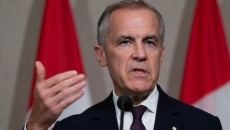
Prime Minister Mark Carney wants the Canadian lumber and steel sectors to look for more opportunities at home as U.S. tariffs and shifting global trade tides limit their opportunities abroad.
Carney unveiled a suite of new supports for the tariff-stricken sectors at an event on Parliament Hill on Wednesday.
He told reporters that since U.S. President Donald Trump launched his global tariff campaign, many of Canada's "strengths have become our vulnerabilities."
He pointed out that in 2024, 75 per cent of Canada's exports — and 90 per cent of its lumber, aluminum and steel exports — went to the U.S. Almost half of Canada's steel goes to the U.S. in a typical year, but those exports are now down 24 per cent annually.
The steel industry continues to be hammered by the 50 per cent tariffs Trump imposed in June.
Carney said steel producers must now find new markets for those products and he wants the domestic Canadian market to help fill that void.
Many of the measures Carney unveiled Wednesday are aimed at boosting the use of Canadian steel and lumber in domestic homebuilding and infrastructure projects.
Ottawa's new Buy Canadian plan means firms must prioritize the use of Canadian materials — steel, aluminum, lumber — in federal government defence or construction contracts worth $25 million or more.
The new measures tighten the quota on steel imports from countries that don't have free trade pacts with Canada from 50 per cent to 20 per cent of 2024 levels.
That measure is meant to allow Canadian steel producers to fill the gap in the domestic market, opening up an estimated $854 million in domestic demand.
Countries outside of the United States and Mexico that do have trade pacts with Canada will also see their quotas dropped from 100 per cent to 75 per cent of last year's levels.
Any steel imported above those thresholds will be hit with a surtax of 50 per cent.
Ottawa is also levying a new global 25 per cent tariff on steel-derivate products such as wind towers, prefabricated buildings, fasteners and wires.
Those measures, which take effect on Dec. 26, include sharper declines in quotas than the measures Carney announced in July.
Carney said Trump's move to tariff more steel derivatives in August and the recent increase in lumber tariffs motivated Wednesday's announcement.
But he also said that the new supports and restrictions on inflows of foreign steel are not targeted at the United States specifically.
"It's a global approach that is creating space for Canadian steel producers to fill it," he said.
"We are limiting foreign steel imports to ensure that Canadian steel producers have a bigger share of the Canadian market. Doing so will unlock hundreds of millions of dollars in domestic demand for Canadian producers."
Trade talks between Canada and the United States have been on pause since Trump ended negotiations over an Ontario ad campaign featuring former president Ronald Reagan criticizing tariffs. Carney said Wednesday that Canada remains ready to "re-engage" when the U.S. comes back to the table.
Conservative Leader Pierre Poilievre said Wednesday that Carney was spending "billions more" to bail himself out from broken promises to negotiate a deal with Trump.
Poilievre said Conservatives "want to negotiate a hard bargain to protect them and get them re-entry into the American market, tariff-free." He also repeated calls to remove the industrial carbon price to offer relief to affected sectors.
With north-south supply chains to the United States hampered by tariffs, Carney also announced measures to help domestic firms send their products across the country instead.
Starting next spring, the federal government will offer subsidies to rail companies to cut freight fees in half on shipments of steel and lumber across provincial borders for a year.
This would cost the federal government $146 million annually, based on 2024 figures, according to a senior government official at a media briefing on the announcement Wednesday. The official noted stronger uptake for the program would drive the cost higher.
Ottawa is also giving more training and resources to the Canada Border Services Agency to crack down on steel dumping — foreign producers flooding the Canadian market with cheap product to undercut the domestic industry.
Canadian Steel Producers Association president and CEO Catherine Cobden broadly welcomed the measures announced Wednesday, particularly the efforts to crack down on dumping.
“By further tightening and broadening border measures, providing support for workers and lowering freight rail rates, Canada is serious about protecting its domestic industry from the ongoing overcapacity crisis and that the country is prepared to take action to protect our market," she said in a media statement.
Industry Minister Melanie Joly told reporters in a callback from Tokyo earlier Wednesday that Canada will continue to engage with trading partners, including China, while "defending our national interest."
She said she's hearing from allies in the European Union and South Korea that they're also moving to protect their domestic steel sectors.
"The internal market can actually be a market that is profitable for our steel sector, as long as they're able to have access to the market without any form of dumping from any other countries that are creating, manufacturing, producing steel," she said.
Canada is also extending a remission program launched last spring that offers producers in the manufacturing, food and beverage and agricultural production industries relief from Canada's steel tariffs. That program, which was set to expire on Dec. 15, will now end on Jan. 31 of next year.
Carney said that while that program can't be sustained indefinitely, it will be extended again to give domestic firms more time to adjust their supply chains to use more Canadian steel.
A senior government official told a technical briefing before Carney's announcement that this will be the last extension of the program, which was first expected to end in October but was extended for two months at that time.
Softwood lumber, which has long been a target of U.S. tariffs, is currently taxed at 45 per cent after the Trump administration increased the rate last month.
Carney said the federal government is adding an extra $500 million in loan guarantees for the softwood lumber industry on top of other measures to encourage homebuilders to use made-in-Canada materials. That's in addition to $700 million in loans for the sector announced back in August.
The federal affordable housing agency Build Canada Homes will also prioritize funding for shovel-ready housing projects using Canadian wood products that can start work in the next 12 months.
Carney said Build Canada Homes alone will create $70 to $140 million in new demand for Canadian wood.
Ottawa is also setting aside $100 million over two years to support work-sharing agreements, which see the federal government offer employment insurance boosts when employers have to reduce hours for staff.
The federal government says the boosted income replacement will help 26,000 Canadian workers in such sectors as steel and lumber.
Kurt Niquidet, president of the BC Lumber Trade Council, said Wednesday's announcement was “a step in the right direction for companies, workers, and the communities that rely on them."
"But ultimately, a negotiated agreement is the path to long-term stability," he said.
Picture Courtesy: THE CANADIAN PRESS/Darryl Dyck