Prime Minister Mark Carney says Canada can't rule out military participation in the escalating conflict in the Middle East.
Speaking to reporters at a joint news conference with Australian Prime Minister Anthony Albanese in Canberra, Carney said the question around Canada's potential future involvement is a "fundamental hypothetical," adding the conflict can spread very broadly.
"One can never categorically rule out participation," he said.
"We will stand by our allies, when it makes sense. There's a distinction between the offensive actions that were taken and are being taken by the United States and Israel, that were taken by them without consultation with Canada, with other allies, and we're not party to those actions.
"But we will always defend Canadians, we will always stand by and defend our allies when called upon."
Over the weekend, Carney said he supports the U.S. action in Iran, but that Canada will not get directly involved in the conflict after American and Israeli militaries launched an attack on the Middle Eastern country that left its leader dead.
"Canada supports the United States acting to prevent Iran from obtaining a nuclear weapon and to prevent its regime from threatening international peace and security," Carney said Saturday in India.
Carney has since shifted away from his earlier unequivocal support for American airstrikes on Iran, tempering his remarks when in Australia.
"Canada is taking the world as it is, not passively waiting for a world we wish to be. We do, however, take this position with regret because the current conflict is another example of the failure of the international order," he said.
"It appears that these actions are inconsistent with international law."
Carney and Albanese held the joint press conference after Carney delivered remarks at the Australian Parliament in Canberra on Thursday.
Asked by a reporter if he was calling for a ceasefire in Iran, Carney said that first there needs to be a de-escalation of hostilities and the end of targeting civilians and civilian infrastructure.
Asked if he should have called for de-escalation in his first statement, Carney said "no."
"It is a very volatile, it's an extremely complex situation, it's getting more complex as time goes on but we absolutely stand by the fundamental principle that Iran should not be allowed to have a nuclear weapon," Carney said.
One expert says Canada could still be drawn into the conflict under pressure from U.S. President Donald Trump or Gulf nations.
"The more you say, the more you lay a trap for yourself with a very mercurial president," said Fen Osler Hampson, an international affairs professor at Carleton University.
Hampson accused Carney of employing "studied ambiguity" in an effort to walk back his support for a war that is quickly engulfing countries around the region — while also trying not to upset Trump.
Stephen Saideman, a defence expert at Carleton, said Carney was also reacting to "very conflicting statements" from Washington about the goals of the U.S. campaign, which have shifted from regime change to pacification in recent days.
"Carney has realized the Americans don't really know what they're doing and wants to distance himself from it," he said.
"Canada may not want to be associated with heaps of war crimes. It might also be that Carney is looking around at the reactions to his first statement — that (airstrikes) were very unpopular in Canada, that other countries are showing much more gumption."
Canada has long opposed the Iranian regime for its many human rights abuses and acts of interference abroad. It also historically has insisted on United Nations approval for any use of force against a sovereign nation, Hampson said, even when such missions have a stated purpose of protecting civilians.
But Hampson said it's clear the Liberals are shaping their foreign policy around avoiding the kind of open conflict with Washington that could lead to the termination of the continental trade pact on which Canada's economy relies.
"This government is very worried about the future of the bilateral relationship with the United States, the consequences of a zombie CUSMA or the shredding of CUSMA," he said, referring to the trade pact.
He said Trump could use the fate of the trade deal as leverage to get Canadian military personnel involved in the conflict.
The war is already choking global fuel supplies. A fifth of the world's oil and liquefied natural gas passes through the Strait of Hormuz, a narrow body of water that Iran has said it will block. Trump has responded by suggesting the U.S. will conduct patrols to escort tankers through the strait.
"He may well lean on countries like Canada, which have naval assets, to assist in those operations — not necessarily to put fighters on the ground to bomb the Iranians," Hampson said.
Hampson noted the U.S. already has pressured the U.K. to allow it to use British bases for its bombing campaign, while Trump has been quick to threaten crushing tariffs on countries that don't bend to his will.
During the 2003 Iraq War, Hampson noted, Canada deployed naval assets to help Americans with patrols, even though Ottawa avoided taking part in the combat mission.
Hampson also said the Gulf countries to which Carney has turned for investment — Qatar, the United Arab Emirates and Saudi Arabia — also might demand Canadian naval support to protect their oil shipments.
"It's not far-fetched to think that the Qataris and the Emiratis and others will say to Canada, 'Well, if you want to do business with us, there's a security premium that comes with this to help us secure our shipping,'" he said.
Saideman disagreed, saying Canada has limited naval assets and Ottawa would avoid sending them to a "highly risky" Middle East.
While in the past the United States might have sought the presence of allies' ships in the region as a sign of international support for the campaign, Saideman said, the Trump administration tends to treat such gestures with contempt. Unlike many European states, Canada does not have military bases in the Middle East.
Younes Zangiabadi, executive director of the Institute for Peace and Diplomacy, said Iran sees the war as an existential battle for the future of the regime, which is why it has been willing to attack American assets in multiple countries.
He noted that Tehran designated Canada's navy as a terrorist organization a few months ago, in response to Ottawa’s decision to add an Iranian military branch to its list of extremist groups. Canadian troops or ships in the region could be targets, he said.
"I don't think the Iranian regime really needs a justification to attack any of the forces supporting the Americans, as they have already attacked many of the Gulf countries," Zangiabadi said.
Hampson said there is "huge potential for mischief" in Iran even if the war ends soon — particularly if Iran implodes and various ethnic groups and militias end up battling for control.
Carney and Foreign Affairs Minister Anita Anand have said Canada is trying to broker diplomacy between countries in the region — a statement that has confused some analysts.
Roland Paris, who leads the University of Ottawa's graduate school of international affairs, said it was "puzzling" for Carney to say he is "taking the world as it is," and to endorse American claims that negotiations with Iran failed, while still calling for de-escalation and a diplomatic solution.
Hampson said there is no evidence Ottawa is effective in Mideast diplomacy.
Canada cut off diplomatic relations with Iran in 2012 and Anand has suggested "regime change" would be required to restore them. Carney, meanwhile, has said Israeli Prime Minister Benjamin Netanyahu would be arrested on an international warrant if he ever entered Canada — and the two have never had an official conversation.
"I see no evidence that Canada is conducting any diplomacy here to end the conflict. There is zero evidence of that," Hampson said.
He argued the best way for Carney's government to withstand American pressure in the Middle East would be for the prime minister to work with like-minded countries. Spain, for example, has said it will refuse American requests to use Spanish military bases for its Iran campaign.
Hampson said pushback on the U.S. must be done carefully if it's to have any effect.
"We have to recognize that if our foreign policy is all just about virtue-signalling, we are going to be talking to ourselves, and we are going to make life even more miserable for ourselves than it is now," he said.
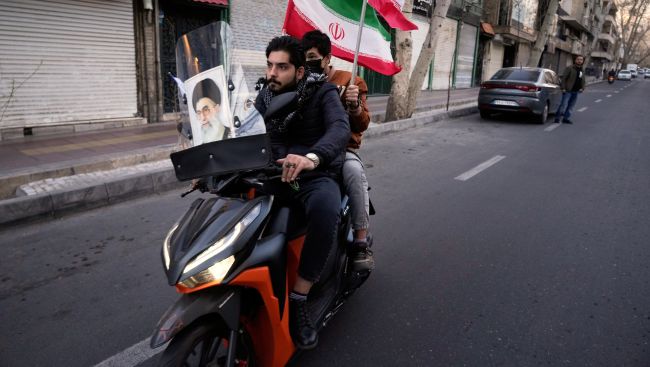
Picture Courtesy: AP Photo/Vahid Salemi