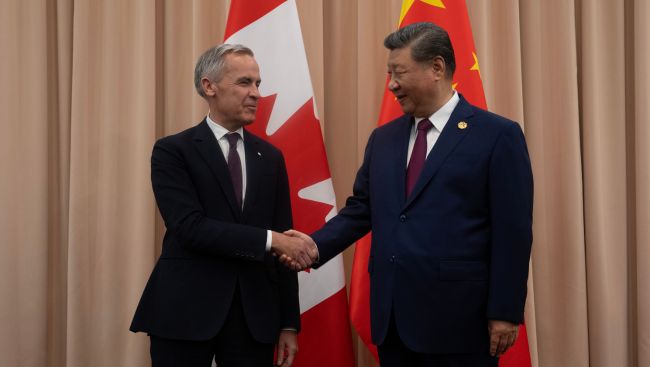
Prime Minister Mark Carney concluded a meeting with Chinese President Xi Jinping on Friday with an invitation to visit China, but no movement on the trade issues that have plagued the relationship.
Still, Carney said he was "very pleased" with the outcome.
"We now have a turning point in the relationship, a turning point that creates opportunities for Canadian families, for Canadian businesses and Canadian workers, and also creates a path to address current issues," he told reporters.
Carney and Xi spoke for nearly 40 minutes on Friday afternoon on the sidelines of the Asia Pacific Economic Cooperation summit in Gyeongju, South Korea.
The prime minister said he accepted Xi's invitation to visit China, though he gave no indication of when that may happen. He is expected to travel to the country when it hosts the APEC summit next year.
The last visit by a Canadian prime minister was in 2017 — also the last time the leaders of the two countries held an official meeting.
In a brief statement as the meeting began, Carney applauded the constructive engagement on both sides in the last several months.
"Distance is not the way to solve problems, not the way to serve our people with people-centred growth, as you have advocated for," he said to Xi.
Carney did not answer questions Friday evening about whether the meeting yielded any change in the trade relationship.
Canadian canola producers, seafood exporters and pork farmers are dealing with steep Chinese tariffs in retaliation for the 100 per cent tariffs Canada imposed on Chinese electric vehicles, batteries and other goods last year.
China's ambassador in Ottawa recently said Beijing would drop its levies if Ottawa cancels the EV tariffs.
A statement on the meeting from Carney's office said the leaders directed their officials "to move quickly to resolve outstanding trade issues and irritants" and noted they spoke about sensitive issues including canola, seafood and electric vehicles.
Xi's official statement said the two countries "should develop an objective and rational perception of one another, view each other in the correct way, and advance the bilateral relations in light of the common and long-term interests of both countries."
It also said the two sides agreed to resume or restart exchanges and co-operation in various fields, without specifying what those are. It characterized Canada's stance as wanting to "make up for lost time."
Carney has overseen a shift in tone from the Trudeau government, which branded Beijing as a "disruptive global power" whose values don't align with Canada three years ago in its Indo-Pacific strategy.
Now, Canada has identified China as a strategic partner in a turbulent world as the government aims to rapidly increase exports to countries that are not the United States.
Carney told CEOs at the APEC summit Friday Canada is facing "profound shifts" due to technology and especially geopolitical changes.
"That old world of steady expansion of rules-based, liberalized trade and investment, a world on which so much of our nations' prosperity (depended) — very much Canada's included — that world is gone.
"We have to be clear-eyed about that reality, because nostalgia is not a strategy," he said in a speech that did not directly name U.S. President Donald Trump.
The relationship between Canada and China collapsed in 2018, when Canada arrested Chinese telecom executive Meng Wanzhou at the request of the United States.
China responded by detaining two Canadian men, Michael Kovrig and Michael Spavor, detentions Canada said were arbitrary.
In 2022, Xi angrily confronted former prime minister Justin Trudeau at the G20 summit and claimed his government was leaking information to media.
Canada's concerns over foreign interference have dominated the relationship more recently. In January, a federal inquiry declared that "China is the most active perpetrator of foreign interference targeting Canada's democratic institutions" at all levels through cyber attacks and disinformation campaigns.
China has rejected these claims, saying they lack clear evidence and echo tropes about Chinese people as malicious actors.
Beijing similarly rejects criticism of repressive laws in Hong Kong and the United Nations' 2022 finding that China committed "serious human rights violations" against the Uyghur minority that "may constitute international crimes, in particular crimes against humanity."
There was no mention in either official statement about Friday's meeting of either human rights concerns or foreign interference.
Speaking to reporters in Gyeongju before the meeting, Asia Pacific Foundation president and CEO Jeff Nankivell said Canada should be able to continue to raise concerns about such matters, "at the same time as we build commercial relations that are in our national interests and are critical for our own prosperity."
In April, Carney called China "the biggest security threat" facing Canada. But he has changed his tone drastically since then, saying in September Canada could "engage deeply" with China on energy and basic manufacturing, and that Beijing is "very sincere and engaged" on climate change because it's "a country run by engineers."
Carney has said sensitive projects that touch on national security should be off-limits to China, and his government is advancing an Arctic foreign policy that is skeptical of Chinese research in the region, arguing it often comes with military applications.
Both Xi and Carney say they want to uphold the rules-based order and international trading system, though each country has a vastly different understanding of what that means.
The two align on wanting a more functional UN and a new model for how developing countries access funding to adapt to climate change, but they differ vastly on trade rules and territorial sovereignty.
China executed four Canadian citizens in early 2025, and Robert Schellenberg has been on death row in China since 2019.
Ottawa participates in naval exercises in the Taiwan Strait meant to signal the area remains international territory — exercises that particularly annoy Beijing.
Foreign Affairs Minister Anita Anand has said while engagement with Taiwan is not going to end, Canada still adheres to its One China policy.
"Diplomacy is not walking away from tough issues. Diplomacy is being able to have the conversation about Canadian interests and Canadian values," she told the House foreign affairs committee Thursday, as MPs challenged her on calling China a strategic partner.
Picture Courtesy: THE CANADIAN PRESS/Adrian Wyld