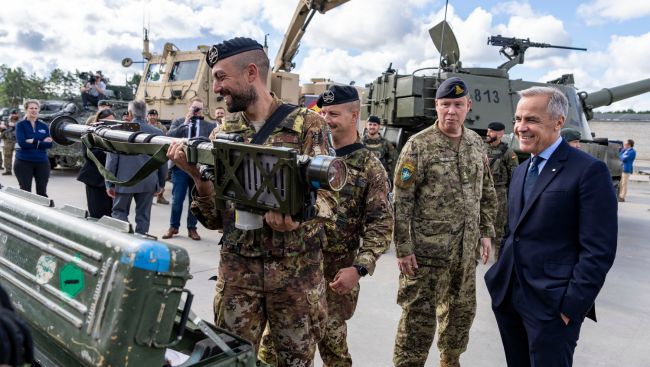
The Liberal government is making sweeping changes to the way it approaches supporting the domestic defence industry, as Canada looks to transition away from overreliance on the United States for military gear.
"In this uncertain world, it is more important than ever that Canada possess the capacity to sustain its own defence and safeguard its own sovereignty," reads the defence-industrial strategy Ottawa is set to release this week.
"This is especially important when it comes to protecting Canada’s Arctic sovereignty and promoting a secure North."
The government was expected to announce its strategy last week, but Prime Minister Mark Carney suspended his travel due to a mass-shooting in B.C. and pushed the announcement to later this week. Media outlets on Sunday published the details of the document officials shared with journalists ahead of its official launch.
The $6.6-billion strategy aims to help small and medium-sized Canadian businesses break into the defence industry and reorient spending decisions to prioritize equipment made in Canada, instead of relying on foreign military contractors such as American firms.
The document claims it will spur 125,000 jobs over a decade. According to a government press release last December, the Canadian defence industry "supports" more than 81,000 jobs.
The strategy promises to restructure how Ottawa takes into consideration benefits to the Canadian economy when it awards contracts, known as an industrial technological benefit policy.
Canada intends to partner with "Canadian champions" that actually deliver within stated budgets and timelines, in exchange for benefits such as research funding, export promotion, financing and access to testing infrastructure.
"They will be expected to deliver capability on time and on budget and support national sovereignty through their Canadian supply chains, while also ensuring continued value for money," the document reads.
It does not specify how Ottawa will ensure companies do not fall into habits of costly overruns.
The document calls for increasing defence-procurement contracts awarded to Canadian firms from roughly half to 70 per cent of acquisitions, in an aim to bolster Canadian manufacturing sectors being hit hard by U.S. tariffs.
The strategy aims to "increase Canada's defence exports by 50 per cent" and "increase total Canadian defence industry revenues by more than 240 per cent."
This all comes as the federal government moves to quickly ramp up defence spending to meet its NATO commitments, something that the entire alliance is working on after years of sabre-rattling from U.S. President Donald Trump.
The document says Canada needs reliable infrastructure in the North and enough autonomy to navigate a world where "imperial conquest" could return just as "old alliances" are under pressure -- though it says Canada is committed to a strong defence relationship with the U.S.
Conservative shadow minister for national defence, James Bezan, responded in a statement that the Opposition will review the policy, but noted the Liberals' "lack of political will and leadership" have left the military in decay.
Bezan said the government has created new bureaucracies, when what's needed is to get time-consuming procurement processes out of the way.
"After a decade of dragging their feet and ignoring repeated calls from our armed forces and the defence industry, the Liberals are issuing another ‘strategy’. But Conservatives know that when it comes to national defence and security the Liberals have been all talk and no action," Bezan said.
The strategy does not mention China and has one mention of Russia undermining the global order through its invasion of Ukraine. It says Canada wants to work more on the defence industry with the European Union, the U.K., Australia, New Zealand, Japan and South Korea.
To that end, Canada will deploy more trade commissioners and participate in military-industrial trade fairs, and try shoring up a domestic supply chain in areas like aerospace, drones, ammunition and sensors.
The strategy calls for building equipment at home when possible, with a second preference of creating material with allies and a third of buying from abroad.
"The rise of new powers, increasing protectionism, and shifting dynamics in international relations have also underlined the necessity of thinking differently about the intersection of Canadian sovereignty, defence needs, and economic development," the document reads.
The strategy was rumoured for release early last fall, then delivery was publicly promised by Christmas, only for Ottawa to blow past its own deadline by more than a month.
Picture Courtesy: THE CANADIAN PRESS/Christinne Muschi