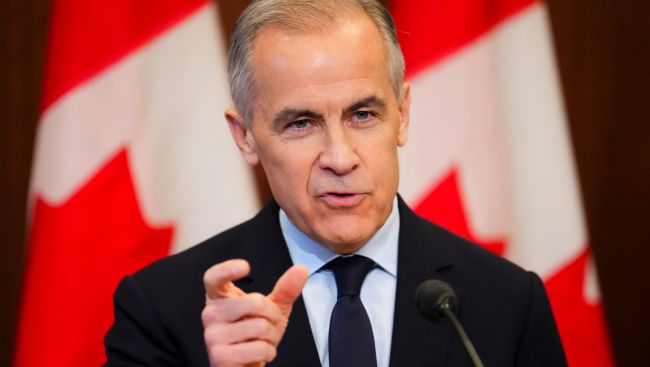
Prime Minister Mark Carney unveiled Canada's long-awaited new electricity strategy Thursday, placing a heavy emphasis on expanding the role of natural gas in powering the grid as he seemed to distance the government from its 2030 Paris climate commitments.
The new strategy looks to double Canada's electricity grid by 2050 and would adjust the clean electricity regulations to provide more flexibility to allow natural gas to play a larger role in building the grid.
At a news conference on Parliament Hill, Carney said there is a role for gas in helping some provinces meet an anticipated increase in demand for electricity.
"Under some interpretations of the current electricity regulations, it would be difficult to build some additional natural gas that would complement much bigger builds," Carney said.
He called the measure a "very practical approach" that recognizes not all provinces are starting at the same place, adding gas will help "deliver affordability.
"We have some of the cheapest gas in the world in Canada," he said.
Affordability is a key consideration in the plan and the goal is to lower energy costs for 70 per cent of Canadian households, Carney said.
"If we get it wrong, Canadians will pay higher utility bills," he said. "If we're too timid, Canadians would end up short of power, losing good jobs and growing reliant on foreign suppliers. We can't pursue business as usual. We can't simply rely on restrictions and prohibitions. We must do things differently."
The strategy document says natural gas provides "baseload and operational flexibility" which complements other renewables, like wind and solar.
"As such, some jurisdictions have concluded that natural gas would be the preferred option for providing affordable baseload power. Gas-fired plants can start quickly, ramp output up or down, and respond in real time to changes in demand or renewable generation," the strategy reads.
The electricity strategy is the latest move by Carney to loosen climate policies put in place by the previous Liberal government under Justin Trudeau, after he eliminated the consumer carbon price and scaled back emissions caps on oil and gas production.
Trudeau's plan was billed as a "clean electricity" strategy, while Carney's is being presented as a "national electricity strategy." Trudeau's plan, which promised to eliminate emissions from Canada's grid by 2050, set limits on carbon dioxide pollution from almost all electricity generation units that use fossil fuels.
Carney said Thursday the aim of the new plan is not to pursue "absolute purity in generation" in reducing emissions through electrification.
The new strategy says construction will cost more than $1 trillion and public dollars will be used to cover some of the cost.
"Doubling generation in the next few decades will require massive investment," Carney said.
"It requires permitting reform, new partnerships with Indigenous Peoples and a willingness to use a wide range of energy, including hydro, nuclear, wind, solar, some gas, carbon capture and geothermal."
The new plan also appears to push back the timeline for lowering emissions.
Carney said the new strategy would result in the removal of 250 to 300 million tonnes of emissions by 2050 annually, through electrification with clean power sources.
To hit the current emissions target, Canada must reduce emissions by at least 227 million tonnes by 2030.
"We are putting in place a series of initiatives that will make material emission reductions. We will update our climate plans and emission reduction targets in due course," Carney said when asked whether Canada is still committed to reaching its 2030 emissions reduction target.
When asked later to clarify his remarks on the government's targets, Carney pushed back on the notion that Canada is "changing" its climate targets.
"That's not what I said. What we are doing is we're focused on investing to get results," Carney said.
"It doesn't do us good to be sitting in court all the time with provinces. It doesn't do us good to be talking past each other. What does do us good is to come together, specific projects ... going out and building things, connecting things, making progress.
"That's what we're focused on. That's what's going to deliver the results."
In November, Carney said on the floor of the House of Commons his government would "respect our Paris commitments for climate change, and we’re determined to achieve them."
Electricity accounts for about seven per cent of Canada's total greenhouse emissions, an amount that has fallen substantially over the last 15 years as most provinces reduced or phased out the use of coal power.
The strategy doesn't say how much money the government is willing to spend to achieve the goal, although it mentions offering tax credits and bringing back energy-saving retrofits for up to a million households.
Carney said the government will pay for those retrofits through loans, grants and "complementary measures."
The government forecasts 130,000 new workers will be needed to double the size of grid. Carney said in his remarks 30,000 jobs will be created by the end of 2028, and 100,000 more by 2050.
"But right now, over 80 per cent of employers in the electricity sector are facing labour shortages," he said.
"Through upcoming consultations, we will build on this momentum to ensure our workforce measures are effectively targeted to the needs of the electricity sector."
The strategy commits to building electricity capacity in the North but doesn't say how, other than that Ottawa will work with the territories and Indigenous stakeholders to make it happen.
Picture Courtesy: THE CANADIAN PRESS/Sean Kilpatrick