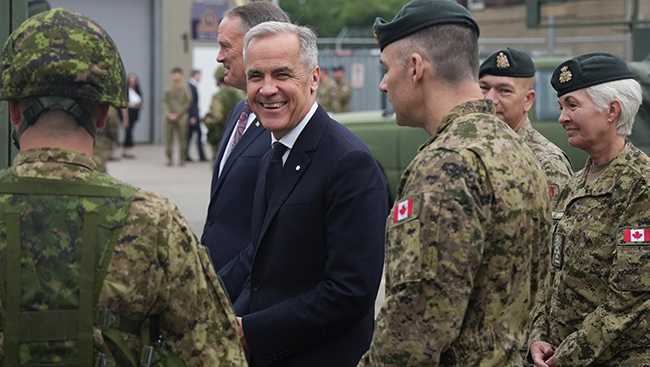
Canada will meet its NATO defence spending commitment for the first time in decades as it comes to grips with an alarming new world of threats, Prime Minister Mark Carney announced in Toronto Monday morning.
Carney said Ottawa will rapidly advance its military spending timeline to hit the NATO target of two per cent of national GDP by adding $9 billion in spending to the fiscal framework this year.
“Canada will achieve NATO’s two per cent target this year, half a decade ahead of schedule,” Carney said.
At the same time, he warned Canada depends too much on an increasingly unreliable United States for its defence and is spending too much of its rearmament budget south of the border.
“The United States is beginning to monetize its hegemony, charging for access to its markets and reducing its relative contribution to our collective security,” he warned.
The federal government currently is spending about 1.45 per cent of real GDP on defence and has not spent anywhere near two per cent since 1990 — despite having promised its biggest allies for years that it would.
NATO's GDP forecast puts Canada's economy at $3.1 trillion for the year, making its two per cent NATO commitment worth about $62.5 billion, according to senior government officials.
Carney said he will “expand the reach, security mandate and abilities of the Canadian Coast Guard and integrate it into our NATO defence capabilities to better secure our sovereignty.”
Senior officials said in a background briefing that while the Coast Guard will be folded into defence, there are no plans to arm Coast Guard personnel.
Canada has come under intense pressure from allies to swiftly increase its military budget to levels not seen since the Cold War.
Monday's announcement comes just ahead of a major NATO meeting in the Netherlands set for later this month. Allied nations are expected to adopt a plan at that meeting to hike the NATO member spending target to five per cent of national GDP — a level Canada has not reached since the 1950s.
NATO Secretary-General Mark Rutte also said during a visit to London Monday that alliance members will need to increase their air and missile defences by 400 per cent to counter the threat from Russia.
During the recent election campaign, Carney promised only to meet the two per cent target by the end of the decade.
But Carney said Monday his agenda will move forward at a rapid pace and Ottawa will design a new defence policy and industrial strategy to lift up the defence sector.
He said that work will make use of Canadian steel and aluminum — industries currently under threat from U.S. President Donald Trump’s tariff war.
Business groups that have long called for Canada to meet the target applauded the move. The Chamber of Commerce said it suggests a change in approach under Carney, while the Business Council of Canada called it encouraging.
Christyn Cianfarani, president of the Canadian Association of Defence and Security Industries, said that while Canada's collective defence has "atrophied" over the decades, the sector has a lot to offer the economy at a precarious time.
"There is a very big economic boost that you can get and perhaps Prime Minister Carney, being a businessperson, could see the connection between the two — that if you're going to spend a lot of money trying to right the ship ... then you want to do it in your own backyard," she said.
But Cianfarani said that for Carney's plan to work, a risk-averse federal bureaucracy will have to learn how to accelerate defence spending.
“Will the machinery of the government underneath the prime minister be able to go from flash to bang and make this happen? And that is a real risk," she said. "They will need to dig deep. There will need to be very creative solutions.”
The Department of National Defence has long struggled to spend all the money budgeted for it. Carney said the new funds being injected into the department are very "spendable" and added that his government is working to reform defence procurement.
The new defence spending plan includes $2.6 billion for recruiting and retaining Canadian Armed Forces members, $1 billion for boosting military capabilities, $2.1 billion for a new defence industrial strategy and $2 billion to diversify Canada's defence relationships beyond the U.S.
Carney cited in his speech planned purchases of aircraft, submarines and drones — all items he spoke about during the recent election campaign. Although background documents given to journalists Monday referred to boosting military capabilities, the Department of National Defence offered no new details.
Conservative Leader Pierre Poilievre told a press conference in Ottawa on Monday that he wants to see the details on the military capabilities the federal government is planning to acquire.
"Yes, we'll hit the two per cent and then we can discuss how much higher to go after that," he said. "But the focus of NATO and our country has to be what extra defence capabilities are we able to add, and how can we be the strongest possible military with the most affordable price tag to the taxpayer at the same time."
Carney vowed that "none" of the new spending announced Monday would be "creative accounting" meant to impress NATO accountants. He also said he won't have to raise taxes to pay for any of it.
Carney also announced a plan to set up a new defence research bureau, to be called BOREALIS, which he said would "advance cutting-edge research in artificial intelligence, quantum computing, and other frontier technologies."
Picture Courtesy: THE CANADIAN PRESS/Chris Young