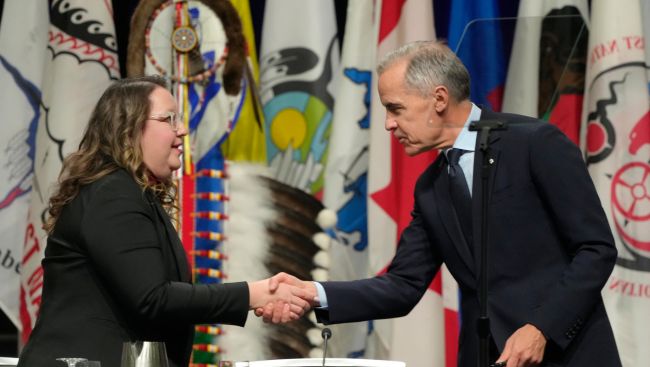
Prime Minister Mark Carney promised to meet with Coastal First Nations after chiefs voted unanimously Tuesday to press the government to uphold the oil tanker ban off the northern British Columbia coast and withdraw an agreement signed with Alberta last week that clears a path for a new oil pipeline.
B.C. Regional Chief Terry Teegee, speaking to Carney during the Assembly of First Nations special gathering in Ottawa, said First Nations title in the province "is not a policy issue."
"Do you respect the direction of the rights and title holders, and what concrete steps will your government implement to ensure that First Nations have true decision-making authority, as stated in the United Nations Declaration?" Teegee asked after Carney delivered remarks to the hundreds of chiefs gathered.
Carney said his office had already made the formal request to have a meeting with Coastal First Nations.
"I look forward to that meeting at the earliest opportunity," he said.
Teegee, when asked what he made of Carney's response to his question, said the promise to meet is only as good as the deed.
"If he doesn't follow up, all of this is just empty promises and that's very concerning to many First Nations, not just in British Columbia," Teegee said.
Carney and Alberta Premier Danielle Smith signed a memorandum of understanding on Nov. 27 to co-operate on energy, opening up the prospect of an exemption from the tanker ban to support the pipeline.
The ban was passed in legislation in 2019, putting legal teeth behind a non-binding moratorium that had been in place in the region since the 1970s. It bars oil tankers carrying more than 12,500 tonnes of crude oil from stopping or unloading at ports from the northern tip of Vancouver Island to the Alaska border.
Chief Donald Edgars of Old Massett Village in Haida Gwaii put forward the resolution Tuesday calling on chiefs to affirm support for the oil tanker ban, and to support First Nations in B.C. in their opposition to any new pipeline.
Edgars told his fellow chiefs a new pipeline to B.C.'s coast is "nothing but a pipe dream" and that passing his resolution would show Carney they are united in their opposition.
"We cannot let this happen," Edgars told the chiefs.
"I call on all chiefs to reject this dangerous precedent. I ask the chiefs to stand in support of coastal First Nations who firmly reject any pipelines that propose running through our territories."
The resolution was seconded by B.C.-based Indigenous resource lawyer Merle Alexander, who said an oil spill would destroy the livelihoods of people in the region.
Carney was generally well received by the standing-room only crowd, though some chiefs heckled him and others decried the limited amount of time to ask him questions. Chiefs were asked by the AFN to limit their time at the mic to two minutes each.
"He gets 20 minutes, and we only get two?" shouted Mohawk Council of Khanawake Grand Chief Cody Diabo as he was denied speaking time.
Cold Lake First Nation Chief Kelsey Jacko, a chief known for vocalizing his opinions during AFN gatherings, shouted at Carney as he left the stage, saying chiefs spent hours travelling to Ottawa in hopes of getting face time with the prime minister.
Prime ministers and their cabinets traditionally attend the December AFN meeting to gauge the outlook of First Nations leadership and field chiefs' questions and criticisms.
Before the event, AFN National Chief Cindy Woodhouse Nepinak told The Canadian Press Carney would be wise to come to the meeting with firm commitments to things the chiefs want, such as the clean drinking water legislation.
He did just that, telling chiefs his government will introduce clean drinking water legislation in the spring, delaying a bill that had been promised for this fall.
Carney also said he will host a joint meeting with federal, provincial, territorial and First Nations leaders early in the new year and that co-ordination on water solutions will be a key agenda item — something Woodhouse Nepinak and her predecessors have for years called for.
In his speech, Carney said 85 per cent of drinking water advisories on reserve have been lifted through investments of over $7 billion since 2016. He said his government is committed to ending the remaining 38 advisories and allocated an additional $2.3 billion to the project in Budget 2025.
The prime minister said he recognizes the need for a more permanent solution through a co-ordinated approach, "supported by the right funding mechanism, and with the provinces and territories at the table."
Bill C-61, introduced in the last Parliament, sought to ensure First Nations have access to clean drinking water and can protect fresh water sources on their territories. It died when the election was called this spring.
It recognized that First Nations have an inherent right to clean drinking water and committed the government to provide adequate and sustainable funding for water services in First Nations.
It's unclear if that exact legislation will be brought back to the House of Commons, or if Carney is planning for new legislation altogether, as it faced fierce opposition from the governments of Alberta and Ontario.
During her opening remarks Woodhouse Nepinak slammed Carney’s government over what she called its failure to consult meaningfully with First Nations and cuts to federal investments in First Nations communities.
Woodhouse Nepinak said First Nations will continue to protect their rights, in and outside of the courts.
First Nations leaders have for months criticized the Carney government's approach to First Nations, saying its actions signal a major shift in the tone of the relationship set by former prime minister Justin Trudeau.
They have accused his government of introducing legislation that affects them without their consent or co-operation as it seeks to remake the economy in response to U.S. President Donald Trump's trade war.
Woodhouse Nepinak acknowledged "Canada is going through challenging times" but insisted Carney won't get the economic wins he wants by shutting First Nations out of the conversation.
"Canada can create all the MOUs, projects offices and advisory groups (it wants), but chiefs will be united — and are united — when it comes to the approval of projects on First Nations lands," she said. "There will be no getting around rights-holders."
The assembly continues through Thursday, and several other federal ministers are scheduled to speak before the meeting ends.
Picture Courtesy: THE CANADIAN PRESS/Adrian Wyld