

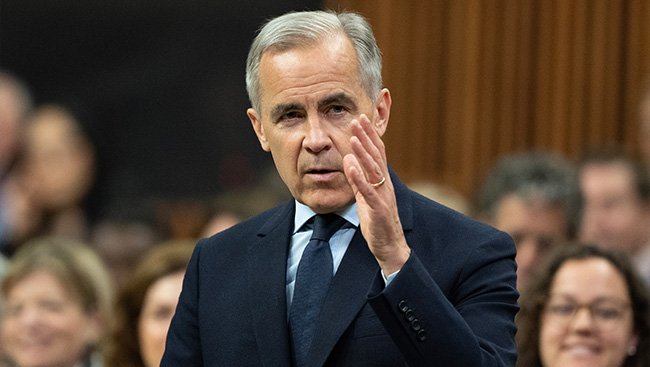
Prime Minister Mark Carney said he "welcomes" the decision by the U.S. Court of International Trade to strike down President Donald Trump's broad-based tariffs on most countries.
On Wednesday, the court ruled that Trump does not have the authority to impose tariffs on nearly every country using the International Economic Emergency Powers Act, usually referred to by the acronym IEEPA.
The decision blocked both the "Liberation Day" duties and the fentanyl-related tariffs on Canada, Mexico and China.
Addressing the House of Commons Thursday morning, Carney said the decision "is consistent with Canada's long-standing position that the U.S. IEEPA tariffs were unlawful as well as unjustified."
Carney added that Canada's "trading relationship with the United States is still profoundly and adversely threatened" by "unjustified" tariffs on steel, aluminum and the auto sector.
"It therefore remains the top priority of Canada's new government to establish a new economic and security relationship with the United States and to strengthen our collaboration with reliable trading partners and allies around the world," he said.
The tariffs on steel, aluminum and the auto sector remain in place because they were implemented under a different U.S. law.
Candace Laing, Canadian Chamber of Commerce president, said that this is not the end of the trade war and business is still looking for stability.
"Ultimately, the end of this trade war with the U.S. will not come through the courts. It will come when we have negotiated a durable new agreement on trade that is trusted and respected by all involved," she said in a media statement.
The Trump administration filed a notice of appeal soon after the ruling came down. While the president has not yet commented on the ruling, members of Trump's team have widely condemned it.
White House deputy chief of staff Stephen Miller posted on social media that Americans are "living under a judicial tyranny." White House spokesman Kush Desai said "it is not for unelected judges to decide how to properly address a national emergency."
The decision at the New York-based federal court was delivered by a panel of three judges. One was appointed by Trump during his first administration, another by former president Barack Obama and the third by former president Ronald Reagan.
The ruling said "any interpretation of IEEPA that delegates unlimited tariff authority is unconstitutional." The decision separately blocked the fentanyl tariffs because it said "they do not deal with the threats" Trump cited to justify the duties in his executive order.
Mona Paulsen, an associate international economic law professor at the London School of Economics, said this was a straightforward question for the court to answer.
"They don't scrutinize the national emergency. They look at that reasonable relationship," she said. "They basically just find there's no direct link here between the imposition of tariffs and the unusual and extraordinary threat that the trafficking orders said it was trying to address."
The decision calls into question how Trump can continue to wield the threat of tariffs against the world. He has said he imposed the duties to encourage other countries to make trade deals with the U.S. He's also claimed they'll bring manufacturing back to America and fill federal coffers.
"We actually see almost contradictory objectives sometimes being put into play, where it doesn't make sense that you would want a tariff to both increase revenue for the government and also be leverage," Paulsen said.
"Because as leverage in negotiation, let's say with Canada, you would expect that in negotiations that the tariffs would go away, but not if they're source of government revenue. And you can't have it both ways."
The president relied heavily on IEEPA to implement many of his tariffs. While the national security statute gives the U.S. president authority to control economic transactions after declaring an emergency, it had never been used before to impose tariffs.
Trump declared an emergency at the northern border to hit Canada with economywide tariffs in March. He partially paused those levies a few days later for imports that comply with the Canada-U.S.-Mexico Agreement on trade.
The next month, he declared America's trade deficits also amounted to a national emergency in order to hit nearly every country with tariffs. The president walked back the most devastating duties a few hours later but left a 10 per cent universal tariff in place.
Trump has continued to use IEEPA to threaten unpredictable increases to tariffs. After recently vowing to increase duties on the European Union to 50 per cent starting in June, he pushed the date back to July.
Paulsen said that more tariff powers exist in U.S. law, such as section 338 of the U.S. Trade Act of 1930. This provision, which has never been used, allows the president to impose tariffs of up to 50 per cent on countries believed to be discriminating against U.S. commerce.
"We don't know what could be considered discriminating against U.S. commerce, and so that could actually be really, really broad," Paulsen said.
"We've seen lots of different, sometimes counterintuitive arguments, about what the United States, the current administration, thinks is discriminating against U.S. commerce or is unfair to U.S. commerce, so that law may actually get applied more now."
Conservative Leader Pierre Poilievre called the court's decision "good news" but said Canada "can no longer put all our eggs in the U.S. basket. Too risky."
"Canada must fire up free enterprise to build pipelines, power lines, ports, rail, roads, and tech — so we are strong, self-reliant and sovereign for a change," Poilievre said in a post on social media Thursday.
Bloc Québécois Leader Yves-François Blanchet told reporters Thursday that the court ruling gives Canada “a better position” from which to negotiate with the United States.
Blanchet said he hopes the court ruling helps to lower the temperature when the trading partners are next at the bargaining table.
“It might call for some more reasonable, quiet and serene negotiations,” he said.
Picture Courtesy: THE CANADIAN PRESS/Adrian Wyld


