As Prime Minister Mark Carney gets ready to host U.S. President Donald Trump and other leaders at the G7 summit in Alberta, analysts say Canada's most important goal will be to keep the group from falling apart — even if that means not issuing a joint statement.
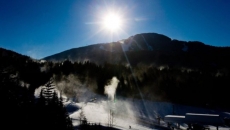
Trump arrived Sunday night in Calgary on Air Force 1 and then boarded a helicopter to make his way to the summit site in the Rocky Mountain resort community of Kananaskis.
It's his first visit to Canada since attending a G7 summit in Quebec seven years ago.
That visit ended in a blowout: Trump left early, lambasting then-prime minister Justin Trudeau as “very dishonest and weak" in a spat over tariffs and refusing to sign a joint statement with the other leaders.
"Keeping this informal international organization together will, I think, be a mark of success," said Sen. Peter Boehm, a former diplomat who played a central role in Canada's participation in the G7 for decades.
"The challenge I think that we will be seeing at Kananaskis is whether we still have like-mindedness in the G7 and whether that can still project (unity), in terms of dealing with some of the big global challenges."
The G7 also includes France, Germany, Japan, the United Kingdom and Italy, as well as the European Union. For five decades, the group's members have co-ordinated how liberal democracies respond to economic and social challenges.
The group has set the tone for other industrialized democracies and the United Nations for decades and, in recent years, has gone beyond economics to focus on global security.
Each nation takes a turn at a rotating presidency of the group and this year is Canada's turn. Carney welcomed some of leaders in Calgary and Kananaskis on Sunday for the summit, which runs through Tuesday.
The gathering comes days after Israel and Iran exchanged missile strikes and after months of Trump disparaging multilateral institutions and implementing tariffs widely seen as damaging to the global economy.
Trump has said repeatedly Russia should rejoin the group, which it was expelled from after the country invaded Ukraine in 2014 — despite Moscow saying it has no interest.
Carney was slated to have a one-on-one meeting with Trump first thing Monday, an opportunity for the prime minister to advance work on steering relations with Canada's biggest trading partner toward more stable ground.
Foreign Affairs Minister Anita Anand said late Sunday bilateral negotiations to end U.S. tariffs have been underway "for some time."
"Our economies are incredibly integrated. Eighty per cent of our trade is with the United States, and so those negotiations are complex and have been proceeding," she said.
"They are sensitive, and so this would not be the moment for me to opine on what will happen tomorrow or thereafter in terms of the bilateral trade relationship."
The summit was organized hastily. Trudeau's resignation as prime minister and the recent general election caused the bureaucracy to scale back its planning and outreach to other G7 countries.
It will be Carney's first major summit, though Boehm noted the prime minister took part in G7 and G20 meetings during his former career as a central banker.
The summit normally ends with a joint communiqué, a lengthy statement outlining views shared by G7 countries that is negotiated over weeks and often through the night. In 2019, however, France issued a chair's statement — a step Boehm said leaders reserve for the worst-case scenario when they are unable to arrive at a consensus.
"What's the point of driving towards consensus, when you're not going to get it?" he said, adding he doesn't expect this summit to produce a full communiqué.
"There is always going to be some bumps and hiccups and one country not seeing it quite the way the others do. But it's a venerable institution."
Federal officials who briefed Canadian media last Thursday hinted this G7 might not end with a joint statement.
"Canada is adopting a focused approach this year. We have a streamlined number of priorities, ministerial meetings and negotiated outcome documents," said a senior official who spoke on the condition she not be named.
"We really want to ensure that we continue to focus on actions that we can take together."
Kerry Buck, a former Canadian ambassador, said it might be impossible to reach agree with the United States on things like Russia's invasion of Ukraine, climate change and the need to preserve free trade.
"It's in no one's interest to pick a fight and have open conflict at the table," Buck told a panel held by the Canadian International Council on June 4.
"A message of disunity coming from the leaders would actually do more damage to the G7, and it's in our interest to preserve it."
Buck said she expects one-on-one meetings on the sidelines of the summit will lead to fruitful "quiet diplomacy."
"I would aim for a thin G7 leaders' declaration at best, (and) work to minimize damage to the institution," she said.
Carney had bilateral meetings Sunday in Alberta with his counterparts from South Africa, Australia and Germany.
The actual summit starts Monday. A working lunch could touch on energy security, artificial intelligence and critical minerals. The afternoon is expected to focus on security, including Canada's concerns about wildfires and foreign interference.
Tuesday is to focus on foreign policy and involve at least 10 invited leaders from non-G7 countries or international institutions.
Indonesian President Prabowo Subianto announced he would attend the summit after an invitation from Carney, but his office later said he had a prior trip scheduled to Russia.
Ukrainian President Volodymyr Zelenskyy is visiting and could play a large role, though the recent hostilities between Israel and Iran might also loom large.
Anand said there's space for both issues on the table.
"This is the opportune moment for world leaders to have conversations about Ukraine, about peace in the Middle East, about defence and security globally," she said.
North Korea is a frequent topic at the G7, Boehm said, adding he hopes discussion also touches on the crisis in international development spurred by the United States pulling back from foreign aid.
The agenda has lengthy gaps between sessions — time set aside for leaders to meet new peers. German Chancellor Friedrich Merz started his new job last month, just as Carney's postelection ministry was sworn in.
Boehm said many leaders will want to meet Trump, and the president prefers one-on-one chats to multilateral meetings.
The talks could also shape ministerial meetings that Canada can host later in the year, particularly on energy and the environment.
John Kirton, head of the G7 Research Group at the University of Toronto, said two G7 ministerial meetings already hosted by Canada generated much consensus on issues including artificial intelligence in banking and maritime security.
Kirton is predicting a "significant performance," even if there is no joint communiqué. "I'm expecting that there will be probably a short, crisp, compact concluding chair's statement."
He said he also predicts Canada will release six subject-specific documents summarizing the general position of G7 members.
G7 hosts also tend to unveil a major development or humanitarian project — a "signature initiative" — in a bid to get funding from partner countries. Canada has previously used the G7 to advance education for girls in conflict zones and maternal health in poorer countries, while Italy focused last year on biological threats in Africa.
It's not clear if Canada will have the cash to make a major announcement this year. Kirton cited a budget crunch among G7 members, while Boehm said the spring election stopped a lot of outreach Canada would normally do in the months leading up to a summit.
Some are anticipating a project pitch that wouldn't involve large sums of money, such as an initiative aimed at countering transnational repression.
Given its power, the G7 is a target for advocates on a range of issues who hope to see their priorities reflected in the communiqué. Ottawa has faced calls to speak out against arbitrary detainment, Africa's debt crisis and Pakistan's Kashmir dispute with India.
Business and civil society leaders will be holding a series of side events associated with the summit, although many will be far removed from Kananaskis.
Picture Courtesy: AP Photo/Mark Schiefelbein