Saturday, December 20, 2025
ADVT 
National

Cautious Canadians increasingly wearing masks, fear second wave of COVID: Poll

Darpan News Desk The Canadian Press, 09 Jun, 2020 06:52 PM
  • Cautious Canadians increasingly wearing masks, fear second wave of COVID: Poll

Canadians are increasingly wearing protective face masks as they emerge from months of isolating at home to curb the spread of COVID-19, a new poll suggests.

And it suggests that fear of a second wave of infections as bad as or worse than the first wave may behind their increased caution.

Fifty-one per cent of respondents to the Leger and Association for Canadian Studies survey said they have worn masks to go grocery shopping — up eight percentage points in one week.

Forty-five per cent said they've worn masks to go to a pharmacy (up seven points), 17 per cent at work (up four points), 14 per cent on public transit (up four points) and 12 per cent to go for walks (up two points).

And 53 per cent — up two points — said masks should be mandatory in public and confined spaces, like shopping malls and public transit.

The online poll, conducted June 5 to 7, surveyed 1,523 adult Canadians; it cannot be assigned a margin of error because internet-based polls are not considered random samples.

The increased wearing of masks reflects the fact that restrictions on activities are slowly easing across the country, with more Canadians venturing out of their homes and going back to work.

But Leger executive vice-president Christian Bourque said it may also reflect fear of a second wave of the deadly coronavirus that causes COVID-19.

Seventy-six per cent of respondents said they expect a second wave will hit Canada. And 32 per cent said they expect a second wave that is stronger than the first, with another 40 per cent saying they expect it to be just as strong.

Bourque said that fear is also reflected in widespread support for a go-slow approach to reopening the country after three months of pandemic-induced lockdowns.

Two-thirds of respondents said governments should maintain the current, cautious pace of reopening, while another 21 per cent said they should slow down. Just 13 per cent wanted the pace sped up.

Fewer than 10 per cent supported reopening restaurants, hotels, gyms, bars, concert halls and theatres without any restrictions.

As long as safety precautions are in place, 68 per cent were comfortable seeing restaurants reopen, 67 per cent hotels, 55 per cent gyms or other fitness facilities and 50 per cent bars. But even with restrictions, just 44 per cent supported reopening concert halls and theatres, while 49 per cent were opposed.

"Canadians are being extremely prudent and careful about how they want us to go into sort of this exit strategy of Wave 1, probably because they fear Wave 2 is coming soon," said Bourque.

"By no means is this over in Canadians' minds ... Maybe it's just Canadians being Canadians, being careful about everything."

Fully 80 per cent of respondents said it's each Canadian's individual responsibility to try to prevent a second wave of the pandemic. Just 17 per cent put the responsibility on governments.

Still, 16 per cent of respondents said they don't intend to get an eventual vaccine against COVID-19, while another 16 per cent said they don't know if they will. Sixty-eight per cent said they would get vaccinated.

Bourque speculated that not all those who said they won't or might not get vaccinated are "anti-vaxxers." Some likely feel they are young and healthy and at little risk of falling seriously ill.

MORE National ARTICLES

Search for missing B.C. woman prompts homicide fears, second death

Search for missing B.C. woman prompts homicide fears, second death
Police are releasing more details about a British Columbia woman they fear may be the victim of a homicide. Metro Vancouver's Integrated Homicide Investigation Team says 45-year-old April Parisian was last heard from on March 28 and was declared missing earlier this month.

Search for missing B.C. woman prompts homicide fears, second death

Reports of hate crimes are up in Vancouver: police

Reports of hate crimes are up in Vancouver: police
An assault on a 92-year-old Asian man with dementia in Vancouver is being investigated as a hate crime and police say they have recently noticed an increase in reports of hate-motivated incidents. Vancouver police say the man has "severe dementia" and wandered into a convenience store on March 13 when another man yelled racist remarks that included comments about COVID-19.    

Reports of hate crimes are up in Vancouver: police

More signs COVID-19 is slowing in Canada; students to get federal help

More signs COVID-19 is slowing in Canada; students to get federal help
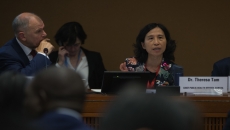
Chief Public Health Officer Dr. Theresa Tam said Canada was making progress in slowing the epidemic but warned against letting down its guard. The focus, Tam said, must be placed on stopping outbreaks in places like seniors homes and in other places where vulnerable populations live together in close quarters. How exactly Canada gets on the road to normalization will largely depend on the provinces, Prime Minister Justin Trudeau said on Wednesday. However, the closure of the Canada-U.S. border will stay in place until May 21st at least, he said.

More signs COVID-19 is slowing in Canada; students to get federal help

Prime Minister Justin Trudeau defends not creating universal COVID-19 benefit, announces student aid

Prime Minister Justin Trudeau defends not creating universal COVID-19 benefit, announces student aid
As he announced yet another emergency financial aid package Wednesday — this one aimed at students — Prime Minister Justin Trudeau defended his decision not to create a universal benefit that would ensure no Canadians affected by COVID-19 fall through the cracks. His focus for specific help Wednesday was students, announcing a $9-billion suite of programs for students whose education and job prospects are disrupted by the novel coronavirus.  Trudeau says his government's approach has been to try to target its emergency financial assistance in stages to those who need it most, rather than to everyone at once, including those who don't need it.      

Prime Minister Justin Trudeau defends not creating universal COVID-19 benefit, announces student aid

What BC is doing to fight COVID-19

What BC is doing to fight COVID-19
B.C. declared a provincial state of emergency on March 18, a day after announcing a public health emergency, and it has been extended to April 28. The measure gives the province authority to take any action necessary to protect people and communities, including charging people who ignore public health orders.

What BC is doing to fight COVID-19

Feds scramble to bring stranded Canadian travellers home from India PM: Canadians stranded in India need more help

Feds scramble to bring stranded Canadian travellers home from India PM: Canadians stranded in India need more help
Prime Minister Justin Trudeau says 20,000 Canadian travellers stranded abroad have been repatriated to Canada. But he says many more flights are needed to bring back large numbers of Canadians from India in particular.

Feds scramble to bring stranded Canadian travellers home from India PM: Canadians stranded in India need more help