Thursday, December 25, 2025
ADVT 
National

CFIB says internal trade barriers coming down, but patchwork could create challenges

Darpan News Desk The Canadian Press, 30 Jun, 2025 09:38 AM
  • CFIB says internal trade barriers coming down, but patchwork could create challenges

A new report by the Canadian Federation of Independent Business says progress has been made on removing trade barriers within Canada, but it adds that the patchwork of approaches could create new issues.

The organization's latest "internal trade report card" grades the federal and provincial governments based on factors related to interprovincial and territorial co-operation. It said Nova Scotia ranked highest in its 2025 evaluation, as the first province to introduce and implement mutual recognition legislation.

Mutual recognition refers to an arrangement where provinces or territories agree to accept the standards, regulations or laws in other jurisdictions.

Ontario was a close second after eliminating all of its Canadian Free Trade Agreement exceptions.

The federal and provincial governments have been working to remove internal trade barriers in the face of U.S. tariffs imposed by President Donald Trump.

SeoRhin Yoo, CFIB’s senior policy analyst for interprovincial affairs, said the internal trade file is "finally getting the attention is has desperately needed" since the CFTA was signed in 2017.

"Three years ago, we challenged governments to blow a hole through Canada’s internal trade barriers by adopting mutual recognition policies to get the flow of goods, services and people moving across the country. At the time, we heard all the reasons why it couldn’t be done," Yoo said in a press release.

"But just in the past six months we’ve seen seven jurisdictions with mutual recognition legislation on the books."

Ryan Mallough, CFIB's vice-president of legislative affairs, said the progress has been encouraging, but he pointed out the risk of having seven different jurisdictions taking seven different approaches to mutual recognition.

"That kind of patchwork can wind up recreating the barriers it was meant to knock down," said Mallough in a statement.

Prime Minister Mark Carney repeatedly vowed to "eliminate" interprovincial trade barriers and create "free trade by Canada Day" throughout the spring federal election campaign.

Carney's government has since passed its planned changes into law ahead of Canada Day. Bill C-5, the omnibus bill that reduces federal restrictions on interprovincial trade and also speeds up permitting for large infrastructure projects, became law on June 26.

But experts have said that law is only the first step of the process.

When Carney made his campaign promise, he was talking about cutting red tape put up by the federal government — not the rules set by the provinces, which have the most authority in this area.

"We’re marching the ball down field, but we haven’t reached the end zone just yet," said Mallough.

"The premiers and the prime minister have instructed the Committee on Internal Trade to reach a pan-Canadian mutual recognition agreement for December. We’ll be watching those conversations closely to ensure we cross the goal line and finally eliminate Canada’s internal trade barriers once and for all."

The CFIB has estimated that existing internal trade hurdles cost the economy some $200 billion a year.

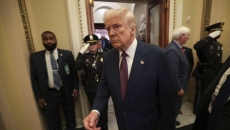
Picture Courtesy: THE CANADIAN PRESS/Sean Kilpatrick

MORE National ARTICLES

Police in New Westminster arrest female student at high school with knife

Police in New Westminster arrest female student at high school with knife
Police in New Westminster, B.C., say they acted on a 911 call about a student armed with a knife at a local high school on Thursday. They say the caller told them the female student had made comments that caused them concern for the safety of other students and staff at New Westminster Secondary School. 

Police in New Westminster arrest female student at high school with knife

Why are clocks set forward in the spring? Thank wars, confusion and a hunger for sunlight

Why are clocks set forward in the spring? Thank wars, confusion and a hunger for sunlight
Once again, most Americans will set their clocks forward by one hour this weekend, losing perhaps a bit of sleepbut gaining more glorious sunlight in the evenings as the days warm into summer. Where did this all come from, though?

Why are clocks set forward in the spring? Thank wars, confusion and a hunger for sunlight

Rainfall warning issued for Vancouver Island as atmospheric river approaches

Rainfall warning issued for Vancouver Island as atmospheric river approaches
Environment Canada has issued a rainfall warning for west Vancouver Island as an atmospheric river approaches. It says the weather system will bring up to 120 millimetres of rain that is expected to begin Friday evening and last until Saturday night.

Rainfall warning issued for Vancouver Island as atmospheric river approaches

Trump's temporary pause on some tariffs brings little relief to Canada

Trump's temporary pause on some tariffs brings little relief to Canada
Trump signed an executive order Thursday delaying tariffs on goods that meet the rules-of-origin requirements under the Canada-U.S.-Mexico Agreement, often referred to as CUSMA, and lowering levies on potash to 10 per cent, until April 2.

Trump's temporary pause on some tariffs brings little relief to Canada

B.C. Conservative attacks 'super angry' Indigenous colleague over residential schools

B.C. Conservative attacks 'super angry' Indigenous colleague over residential schools
Dallas Brodie didn't name anyone, but appeared to single out the Conservatives' house leader, A'aliya Warbus, by criticizing an Indigenous woman who sided with the governing NDP to criticize Brodie. Warbus is the only Indigenous woman in the Opposition ranks

B.C. Conservative attacks 'super angry' Indigenous colleague over residential schools

Canadians should expect AI-enabled foreign meddling in election: cybersecurity centre

Canadians should expect AI-enabled foreign meddling in election: cybersecurity centre
In a new report, the Canadian Centre for Cyber Security says it expects individuals affiliated with the Chinese government will continue to target diaspora communities, pushing narratives favourable to Beijing's interests on social media platforms. Cybercriminals are also likely to take advantage of election-related opportunities to perpetrate scams, says the centre, which is an arm of Canada's cyberspy agency, the Communications Security Establishment. 

Canadians should expect AI-enabled foreign meddling in election: cybersecurity centre