
Friday, December 26, 2025
ADVT 
National

CFIB says internal trade barriers coming down, but patchwork could create challenges

Darpan News Desk The Canadian Press, 30 Jun, 2025 09:38 AM
  • CFIB says internal trade barriers coming down, but patchwork could create challenges

A new report by the Canadian Federation of Independent Business says progress has been made on removing trade barriers within Canada, but it adds that the patchwork of approaches could create new issues.

The organization's latest "internal trade report card" grades the federal and provincial governments based on factors related to interprovincial and territorial co-operation. It said Nova Scotia ranked highest in its 2025 evaluation, as the first province to introduce and implement mutual recognition legislation.

Mutual recognition refers to an arrangement where provinces or territories agree to accept the standards, regulations or laws in other jurisdictions.

Ontario was a close second after eliminating all of its Canadian Free Trade Agreement exceptions.

The federal and provincial governments have been working to remove internal trade barriers in the face of U.S. tariffs imposed by President Donald Trump.

SeoRhin Yoo, CFIB’s senior policy analyst for interprovincial affairs, said the internal trade file is "finally getting the attention is has desperately needed" since the CFTA was signed in 2017.

"Three years ago, we challenged governments to blow a hole through Canada’s internal trade barriers by adopting mutual recognition policies to get the flow of goods, services and people moving across the country. At the time, we heard all the reasons why it couldn’t be done," Yoo said in a press release.

"But just in the past six months we’ve seen seven jurisdictions with mutual recognition legislation on the books."

Ryan Mallough, CFIB's vice-president of legislative affairs, said the progress has been encouraging, but he pointed out the risk of having seven different jurisdictions taking seven different approaches to mutual recognition.

"That kind of patchwork can wind up recreating the barriers it was meant to knock down," said Mallough in a statement.

Prime Minister Mark Carney repeatedly vowed to "eliminate" interprovincial trade barriers and create "free trade by Canada Day" throughout the spring federal election campaign.

Carney's government has since passed its planned changes into law ahead of Canada Day. Bill C-5, the omnibus bill that reduces federal restrictions on interprovincial trade and also speeds up permitting for large infrastructure projects, became law on June 26.

But experts have said that law is only the first step of the process.

When Carney made his campaign promise, he was talking about cutting red tape put up by the federal government — not the rules set by the provinces, which have the most authority in this area.

"We’re marching the ball down field, but we haven’t reached the end zone just yet," said Mallough.

"The premiers and the prime minister have instructed the Committee on Internal Trade to reach a pan-Canadian mutual recognition agreement for December. We’ll be watching those conversations closely to ensure we cross the goal line and finally eliminate Canada’s internal trade barriers once and for all."

The CFIB has estimated that existing internal trade hurdles cost the economy some $200 billion a year.

Picture Courtesy: THE CANADIAN PRESS/Sean Kilpatrick
MORE National ARTICLES

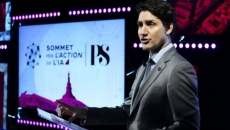
AI shouldn’t only benefit ultra-wealthy 'oligarchs,' Trudeau tells global AI summit

AI shouldn’t only benefit ultra-wealthy 'oligarchs,' Trudeau tells global AI summit
The world needs regulation to ensure the benefits of artificial intelligence aren't only enjoyed by extremely wealthy "oligarchs", Prime Minister Justin Trudeau said in a speech Monday at a global conference on AI. Trudeau said that the goal isn’t to stop progress but the technology needs guardrails, transparency and accountability.

AI shouldn’t only benefit ultra-wealthy 'oligarchs,' Trudeau tells global AI summit

Justice Minister Arif Virani won't run in next election

Justice Minister Arif Virani won't run in next election
Justice Minister Arif Virani says he won't be running in the coming federal election. Virani says in a social media post that the past decade in public office has taken a toll on his family life.

Justice Minister Arif Virani won't run in next election

RCMP's First Turbaned Officer Baltej Dhillon Among Three Newly Appointed Senators

RCMP's First Turbaned Officer Baltej Dhillon Among Three Newly Appointed Senators
The Prime Minister's Office says in a news release that the Governor General has appointed Baltej Dhillon for British Columbia, Martine Hébert for Quebec and Todd Lewis for Saskatchewan.

RCMP's First Turbaned Officer Baltej Dhillon Among Three Newly Appointed Senators

B.C. judge tosses drug evidence for 'numerous and flagrant' rights violations

B.C. judge tosses drug evidence for 'numerous and flagrant' rights violations
The court issued two rulings on evidence collected by Vernon Mounties in a case against Nabil Abdelkader, who police believed was in the drug trade after finding methamphetamine and cocaine in a jeep they searched in October 2020. 

B.C. judge tosses drug evidence for 'numerous and flagrant' rights violations

Canada invests $72 million in satellite constellation to monitor active wildfires

Canada invests $72 million in satellite constellation to monitor active wildfires
Canada is investing $72 million on a novel satellite constellation that will monitor active forest fires across the country. Federal Environment Minister Steven Guilbeault made the announcement today at the Canadian Space Agency headquarters south of Montreal.

Canada invests $72 million in satellite constellation to monitor active wildfires

Three men in Quebec accused of smuggling people from the U.S. into Canada

Three men in Quebec accused of smuggling people from the U.S. into Canada
The RCMP say three men in Quebec have been charged for helping to smuggle people into Canada from the United States.  During two separate events last year, the three men were intercepted in vehicles near the U.S. border in the Montérégie region southwest of Montreal, allegedly waiting to pick up people who had crossed into Canada illegally. 

Three men in Quebec accused of smuggling people from the U.S. into Canada