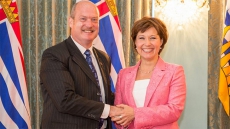
WHISTLER, B.C. - In what sounded more like a speech to the United Nations rather than local politicians, British Columbia Premier Christy Clark travelled through history from past aboriginal-settler conflicts to the recently concluded teachers' strike to highlight how the path to peace can shape the province's future.
Clark told the roomful of municipal politicians at the annual Union of B.C. Municipalities Convention that peace talks — not conflicts — can settle difficult issues, including school strikes, aboriginal claims, resource disputes and the high-cost of running governments.
She said possessing the courage to talk out difficult issues between parties with opposing viewpoints has helped make the province what it is today, and the recent strike by members of the B.C. Teachers' Federation is one of those examples.
"The BCTF could have decided to force the government's hand, and the government could have decided to legislate them back to work," she said.
But both sides decided leadership was needed to reach an agreement after decades of acrimonious battles on picket lines, courtrooms and inside the legislature, she said.
"Today, none of us is leading our communities to war, thank goodness," said Clark.
She said similar difficult issues exist between government and First Nations, but the willingness to talk offers hope that both sides can reach settlements.
The recent Supreme Court of Canada ruling granting the Tsilhqot'in Nation title to 1,750 square kilometres of land southwest of Williams Lake represents a fork in the road for government and aboriginal relations, and it appears the sides are ready to talk it out, Clark said.
The premier and her cabinet met with more than 400 aboriginal leaders earlier this month to find ways to address the court ruling. Legal experts say the high-court ruling forces government to include First Nations in decisions over land use.
"The first step to solutions is dialogue," she said. "It's what made the province the place it is today."
Clark said similar issues were faced more than 150 years ago in 1858 before B.C. was a province, when a militia army and First Nations chiefs reached an accord in the Fraser Canyon after several tense standoffs.
"Both had the courage to shape our history," she said.
The premier also addressed potentially divisive issues between municipal and provincial government relations that have dominated the convention.
Several reports released days before the gathering put both levels of government on the defensive.
A report released by a UBCM committee concluded rising ferry fares and service cuts have hurt coastal communities and have resulted in financial losses in those areas of more than $2 billion. A government-commissioned report found municipalities are not controlling the wages of their workers, ultimately hurting taxpayers.
Clark said controlling costs is difficult but all governments must do their utmost to protect taxpayers.
"I'm not here to point the finger — this is a healthy process that all levels of government need to go through," she said.
Clark said negotiating contracts with labour unions is tough work, but taxpayers demand settlements they can afford.
"We are all going to have to stick to our guns, and that means we will not raise taxes," she said. "We will not spend more that we can afford and we will not kick the ball down the road for our kids to pay for choices that we made but couldn't pay for."