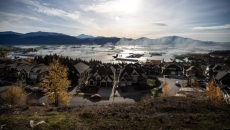
The heart of British Columbia's wine industry is reeling after suffering a litany of climate-related hits, resulting in two years of crop losses in the southern Interior.
Record-breaking heat. Wildfires and smoke that repeatedly contaminated grapes. A destructive cold snap in 2022. Then, the hammer blow — another deep freeze this January that is estimated to have inflicted up to 99 per cent crop loss across the province, wiping out this year's vintage.
While vineyards need support, sommelier Van Doren Chan says it's an opportunity to reshape winemaking in the province.
"It's almost like it's a clean slate," she says. "How are we going to structure the next generation of B.C. wine?"
Chan says all signs suggest only a limited selection of B.C. wine will hit retail shelves in coming years while vineyards and wineries recover.
"Talking to a few producers, I think a lot of them will not make it to the retail market," says Chan, a wine and culinary consultant and board member with the B.C. chapter of the Canadian Association of Professional Sommeliers.
With many undertaking massive replanting efforts — which involve waiting at least three years for vines to produce wine grapes — Chan says she expects wineries will be focused on direct-to-consumer sales and fulfilling orders for their members.
The cost of B.C. wines is likely to rise, continuing a trend that Chan says she's been noticing for several years with crop losses compounded by global inflation.
"For a small wine region, and very young wine region, what we're producing is world class. But it's hard to compare to prices from France or even if we're talking about Argentina or Chile — they produce really high-quality wine at a very competitive price."
Chan says the industry's struggle is also an opportunity to get consumers excited about supporting B.C.'s grape and wine producers for years to come.
"Make it into a marketing campaign and say, 'Hey, we're suffering … We need to raise your price for the next thee years, because we need to re-establish these vines, but then we're going to have all these amazing grapes and you get to try something new.'"
Charlie Baessler with Corcelettes Estate Winery outside Keremeos, B.C., says they're among the producers replanting as much as they can, as fast as they can.
A recent newsletter from the winery says they're scaling back promotional activities to focus on replanting while conserving wine for members and direct sales.
"We just need to be patient, and wait for our new plantings to once again produce some of Canada's greatest wines," it says.
B.C.'s vineyards and wineries have been "kicked while being down" in the last few years, says Baessler, a partner, viticulturalist and general manager at Corcelettes.
The deep freeze in mid-January saw temperatures in major wine-producing areas of B.C.'s southern Interior drop to -27 C, a temperature that Baessler says is "lethal" for grapevines and their buds, no matter the variety.
A February report from Wine Growers BC estimates a harvest of only one to three per cent of normal levels, meaning "an almost complete writeoff of the 2024 vintage" and revenue losses of up to $346 million for vineyards and wineries.
The December 2022 cold snap had already led to "total crop loss" for Corcelettes' 2023 vintage, Baessler says.
That's on top of several severe wildfire seasons, which brought thick smoke that can be "catastrophic" for the flavouring and quality of wine, Baessler says.
The fires also put a damper on tourism throughout B.C.'s southern Interior, reducing the visitors wineries depend on for revenue, he adds.
"Our experience is like a Rubik's cube of challenges that we're constantly navigating," he says. "We haven't exactly been high on the hog to have made bank in order to weather these last two winter events."
Baessler says the team at Corcelettes has decided to replant and rearrange different types of grapes and varietals across the winery's five unique vineyards, which offer varying soil and environmental conditions.
"There are certainly varietals in our existing portfolio that bear more risk than others, so those will certainly be relocated to our lowest-risk vineyard sites."
Miles Proden, president of Wine Growers BC, says there is worry and even panic in the industry given the "steady decline" of grape harvests in recent years.
But many vineyards, like Corcelettes, have been working to adapt to climate challenges, making sure they've got "the right grape in the right place," he says.
"We're in a good place to reset the vineyard for the future," Proden says.
"It's not as though we can't grow grapes and make wine in B.C. It's just that with climate change, there needs to be adjustments."
Still, replanting isn't the only challenge B.C.'s wineries are facing. After two years of crop losses, Proden says wineries need to find enough grapes to sustain the winemaking side of the business, or simply make enough wine to keep their doors open.
"We need to look at some options," he says. It could mean bringing grapes or wine from Ontario, or even Washington state, but governments will need to help with the regulatory changes required to make that happen, even temporarily, Proden says.
The support is crucial, as B.C. wineries employ thousands of people and they're a key part of the rural economy throughout the province, from Vancouver Island to the Fraser Valley, Okanagan, Thompson and Similkameen regions, he notes.
Elizabeth Wolkovich, an ecologist specializing in climate change and plants, says winemaking regions worldwide have been feeling the pinch. In some ways, global heating could improve the climate for wine grapes in Canada, she adds.
But Wolkovich says she hasn't seen any evidence of a grape variety, even a more cold-tolerant hybrid, that could have survived January's freeze.
"The regions on the northern edges, especially, I think, in Canada, are just grappling with this additional factor of the cold snap," says Wolkovich, an associate professor in the department of forest and conservation sciences at the University of B.C.
Baessler, too, says he hasn't seen a vine in the textbook that survives -27 C.
"Once you understand that, it puts them all back on the table."
Baessler says B.C. wines compete on the global stage and contribute more than $3 billion to the provincial economy. The government has many priorities, from health care to housing, but it can't afford to turn its back on the industry, he says.
If support doesn't materialize, "there's going to be a lot of empty, shiny buildings (from) what used to be a really exciting wine industry," Baessler says.
The federal government has a wine sector support program and recently earmarked an additional $177 million over three years. A statement from Agriculture Canada says 207 wineries in B.C. have received support through the program since July 2022.
Earlier this month, Ottawa also announced funding for two initiatives led by the Canadian Grapevine Certification Network "to advance science and research and increase the competitiveness of the sector," the department says.
"There will always be a B.C. wine industry," Proden says. "We make too good of a wine not to."
The climate typically characterized by hot days and cool nights produce crisp vintages that are exactly what today's consumers are looking for, he says.
"Provided we have enough grapes."
—
This is the first in a three-part series, "B.C.'s bitter harvest," examining the consequences of weather and climate crises for agriculture, and how farmers and others are charting a path forward.