

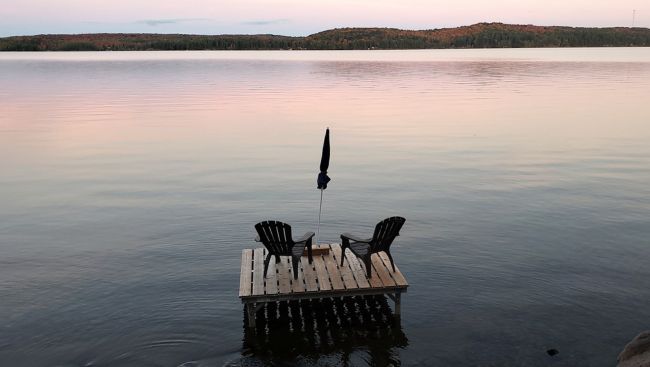
A study of dozens of Canadian lakes suggests global warming is the major driver of surging algae levels, raising questions about the health of a sizable chunk of Earth's freshwater as temperatures continue to climb.
Average algae levels have spiked seven-fold since around the 1960s compared to the previous century, according to a study of 80 lakes across Canada.
Those changes were more pronounced in lakes near human impacts on the environment but were still seen far away from farms, mines and forestry, the study said.
"Even lakes in pristine catchments are vulnerable to change," said the study, published last month in Communications Earth and Environment.
To try to explain what's behind that spike, researchers looked at other possible algae influences such as rain, the sun's radiation and land use changes, such as farming.
Temperature was the leading factor the study associated with surging algae growth.
"This is a warning," said Hamid Ghanbari, the study's lead author and a post-doctoral researcher at Université Laval in Quebec City.
The study doesn't determine which lakes are facing dangerous levels of algae growth or account for toxic algal blooms. The seven-fold increase since the 1960s is an average across the 80 studied lakes.
Some with low algae levels to begin with are still at fairly low levels. But for lakes with lots to begin with, a seven-fold increase could lead to problems, including toxic algal blooms, researchers said.
"If (algae growth) reaches a level of being considered dangerous, we will see some consequences. It's going to harm the lake ecosystem, it's going to hurt the wildlife around it, and it's also going to hurt our wallet," said Ghanbari.
Algae are at the base of the lake's food web, feeding the small fish and zooplankton that then feed the larger fish, and so on. But too much algae growth can suck the oxygen out of the bottom of the lake, leading to large fish kills and so-called "dead zones" where it's hard for aquatic life to survive.
Toxic algal blooms are also a persistent issue for some of Canada's drinking water sources, from Saskatchewan's Buffalo Pound Lake to Ontario's Bay of Quinte, leading to taste, odour and safety concerns and prompting upgrades to local treatment facilities. Contaminated lake water can also be deadly for dogs and cattle.
Pollution packed with nitrogen and phosphorus, such as from fertilizers or stormwater runoff, can fuel algae growth. And what this study shows is lakes already dealing with direct human impacts are even more vulnerable to climate change, said Katrina Eyvindson, the chair of Western University's geography and environment department, who was not involved in the project.
"I think that's what's really key in this research," she said, calling the project an "impressive undertaking."
The research team led by scientists at Laval and McGill University pieced together an algae chronology that starts in 2014 and dates back all the way to 1850 by studying chlorophyll levels in lake sediment cores. Chlorophyll, molecules critical in turning sunlight to plant energy, are a proxy for algae and cyanobacteria known as blue-green algae, which also performs photosynthesis.
Those samples were drawn from lakes covering a massive swath of Canada and facing different conditions.
By the mid 1960s – a "breakpoint" identified by the researchers – both temperature and chlorophyll increases began to accelerate.
Climate change, driven by the burning of fossil fuels, is warming Canada about twice as fast as the global average. Since the mid-20th century, average temperatures in Canada have increased by 2.4C degrees, federal records indicate.
The findings underscore the urgent need to fight climate change and protect Canada's lakes, said Gregory-Eaves. Canada has the most lakes of any country and holds about seven per cent of the world's renewable fresh water.
"I would hope that this is like a big megaphone for, you know, getting people interested in climate change, trying to put pressure on government to make sure that strong policies and laws are in place to bend the curve on emissions," she said.
Picture Courtesy: THE CANADIAN PRESS/Giordano


