"It's happening way faster, more severely and more widespread," said Sherilee Harper of the University of Alberta, one of the 330 authors of the summary report from the Intergovernmental Panel on Climate Change, released Monday.
"We know what needs to be done. We need to act now."
The summary report, intended for policy-makers, makes for grim reading.
"Climate change, caused by human greenhouse gas emissions, is driving widespread losses and damages to nature and people, which are exposing human societies and the natural world to intolerable and irreversible risks, including killing people, damaging food production, destroying nature and reducing economic growth," it says.
The report concludes current emissions policies put the globe on track for up to 2.7 degrees of warming. That's beyond the Paris Agreement target of two degrees, the point at which Earth will be warmer than any time in history.
That warming must be halted, the report says.
"Adaptation also is not an alternative to emission cuts. If warming continues the world will increasingly face changes that cannot be adapted to."
Canada, warming at a rate twice the world average, is no exception.
The panel found climate change costs in Canada have risen to about $1.9 billion from about $400 million in 1983. Just fighting wildfires, a threat exacerbated by climate change, could reach $1 billion a year — a figure already reached in six of the last 10 years.
By 2080, the report predicts cumulative forestry losses from fire, pests and other climate-change factors could add up to $459 billion.
Atlantic Canada will also suffer, experiencing above-average sea level rise. The report points out one Mi'kmaq community is already considering relocating.
Fisheries will also suffer.
Climate change has already nearly wiped out kelp beds off the Nova Scotia coast, an important habitat for fish. Ocean acidification caused by carbon dioxide will harm squid, cod and halibut. If emissions remain high, snow crab landings could decline up to 16 per cent and shellfish and lobster by up to 54 per cent.
The Canadian heartland is at risk of drying out, says the report. While farmers could enjoy a longer growing season and warmer temperatures, by 2050 those benefits are likely to be outweighed by drought across parts of Manitoba, Saskatchewan, Alberta, British Columbia, Yukon, Ontario, and the Northwest Territories.
In the North, melting permafrost and ice thaw will damage infrastructure and transportation networks, as has already happened with the rail line to Churchill, Man.
Everywhere, there will be impacts on human health and well-being. Pest-born maladies such as Lyme disease or dengue fever are already on the increase, said Harper.
"We've seen Lyme disease in places where it just didn't exist before."
Fleeing wildfires and flooding caused by climate change imposes mental-health costs, Harper said. Those costs can also be indirect — the toll on farmers, for example, of not knowing what to expect from the weather or what crops would grow best.
"That's also being shown to increasingly impact their mental health," said Harper.
Nor will Canada escape impacts in the rest of the world.
Extreme weather worsened by climate change will disrupt international supply chains, markets, finance, and trade, reducing the availability of goods in Canada and increasing their price and damaging markets for Canadian exports.
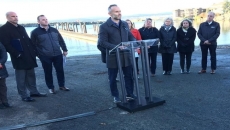
Federal Environment Minister Steven Guilbeault said the report emphasizes how much has been learned since the panel began its work, as well as the need to move quickly.
"The data and the modelling capacities that we had in those days gave us the impression that we had more time. Now, we need to accelerate the deployment of our preparedness strategy."
Guilbeault said the current world crises, from the end of the COVID-19 pandemic to Russia's invasion of Ukraine, can't distract efforts to fight climate change.
"Climate change isn't going away because of that crisis or any other crisis that's coming down the road in six months. We can't lose sight of climate change. We have to be steadfast."